
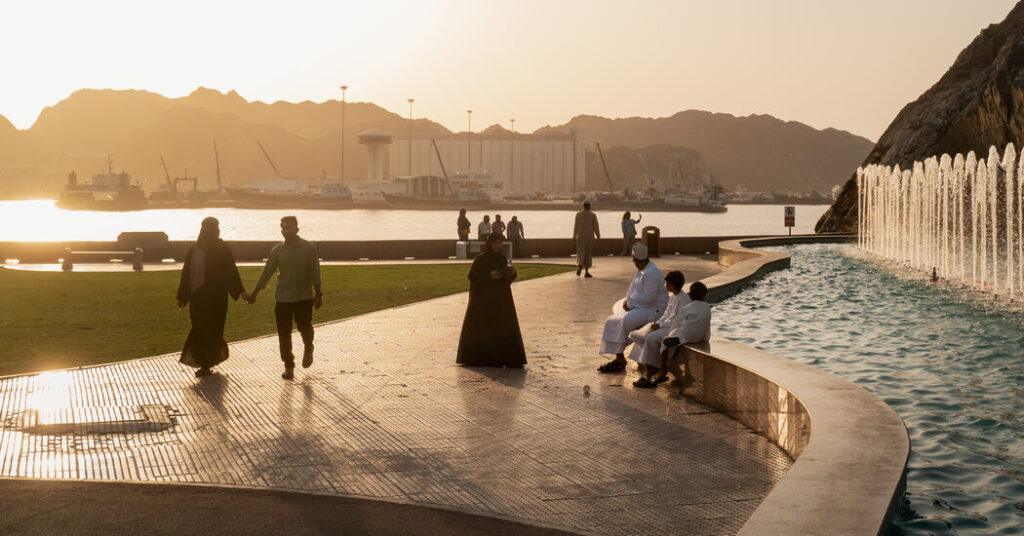
Oil is pouring out of the Persian Gulf as stranded oil tankers take advantage of the fragile detente between the United States and Iran to cross the Strait of Hormuz.
The preliminary agreement signed this week by the two countries to try to end the war promised a formal reopening of the strait, a narrow waterway on Iran’s southern coast. But the deal has not generated a huge rush of oil-laden ships, at least not initially.
Shipowners are eager to get out, but are generally wary of risking crossing the strait until it is clearer that their crews will be safe. Oil producers in the area face a similar calculation: They are willing to increase production, but they want to see evidence that a critical mass of ships are returning to the Persian Gulf to pick up their oil. And any escalation of the regional conflict, such as the violence involving Israel and Iran-backed Hezbollah militants on Friday, could deal a blow to efforts to revive energy flows.
Still, companies in the region that pump and distribute oil are moving forward with plans to expand pipelines and fuel storage. The past 16 weeks have left them eager to become less dependent on the Strait.
“We are seriously thinking about having larger storage facilities around the world,” Yasir O. Al-Rumayyan, president of Saudi Arabia’s state oil giant Saudi Aramco, said Thursday at a conference in Rome.
This month, Sheikh Nawaf Al Sabah, chief executive of state oil company Kuwait Petroleum, said in Washington that the company was in talks with Saudi Arabia and the United Arab Emirates about expanding pipeline systems in those countries to move Kuwaiti barrels around the strait.
Kuwait has been among the hardest hit by the closure of the strait because its location, between Iraq and Saudi Arabia, leaves it no alternative route to export its oil.
“When you look at the pipelines, they are as safe as the export facilities in the end,” Sheikh Nawaf said, noting that during the war, Iran launched attacks against Saudi Arabia and the United Arab Emirates.
The conflict caused the biggest oil supply disruption in history and analysts said the recovery would be uneven, particularly in the Middle East. The continuing repercussions will be felt globally because the strait acts as a major artery, supplying around a fifth of the world’s oil.
Some oil has been flowing. On Thursday, 25 ships transited the waterway, including 14 oil tankers, higher than the average in recent weeks, according to Kpler, a maritime data company. Some appeared to be carrying oil from the Gulf and one of the tankers was carrying liquefied natural gas. Several empty tankers were returning to the gulf, presumably on their way to load the oil that had accumulated there. Fewer ships passed through the strait on Friday amid outbreaks of regional violence.
JPMorgan Chase analysts said in a June 12 report that the strait was “starting to open,” with an estimated flow of 5.1 million barrels of oil per day, compared with 2.9 million barrels per day in May. That rebound was “significant,” but still left flows at about 25 percent of prewar levels, the report said.
That rebound lifted Persian Gulf oil exports to nearly nine million barrels a day in June, JPMorgan Chase estimated, the highest level since the war began, with much of the oil leaving through ports that did not require transit through the Strait of Hormuz.
In Saudi Arabia, the East-West pipeline, which connects the country’s Gulf fields to export terminals on the Red Sea, was a “lifesaver” for the kingdom’s economy, Al-Rumayyan said.
“All regional producers are preparing to increase oil production and get more oil out of the strait as soon as they can,” said Greg Brew, senior analyst at Eurasia Group, a consulting firm.
Many shipowners remain cautious. Jerry Kalogiratos, chief executive of Greek oil and gas shipping companies, said he was seeking not only an end to the fighting in the Persian Gulf but also evidence that his ships could navigate the strait safely and have insurance to do so.
“There are still quite a few boxes to check for the shipowners to be able to say we can pass safely,” Kalogiratos said Wednesday at a conference in New York City.
Ensuring the waterway is safe from mines could take weeks, experts said. Hundreds of ships and their crews, stranded at sea for more than 100 days, need to leave. And shipping companies will need to obtain war risk coverage from marine insurers.
There’s also an obstacle: getting oil tankers back through the strait to help drain regional storage facilities, which companies have filled to the brim.
“There are a lot of oil tankers in the Gulf, which will probably move,” said Robin Mills, chief executive of Qamar Energy, a Dubai-based consulting firm. “But when will you see enough tankers return to be able to return to normal transits?”
Neil Quilliam, an associate fellow at Chatham House, a think tank in London, said the biggest challenge for energy markets had nothing to do with oil but with negotiations between the United States and Iran over Iran’s nuclear program. He said it was “exaggerated” to think those talks could be completed in 60 days. That means the risk level will remain high.
“Convincing shipping companies and insurance companies that this can be sustained over a period of time is going to be quite difficult,” Quilliam said. “If there is anything resembling a return to conflict, it will undo any progress that has been made.”
Developing alternative routes out of the Gulf will also take time. The Emirates are halfway there with a pipeline they hope will double their crude export capacity, with an expected opening in 2027. Kuwait is in talks with Saudi Arabia and the Emirates to explore possible new pipelines that could connect its oil fields to export terminals outside the region.
“It’s going to be a period of prolonged instability,” said Karen Young, a senior fellow at the Middle East Institute, a think tank in Washington.
Jenny Gross contributed reports.


