
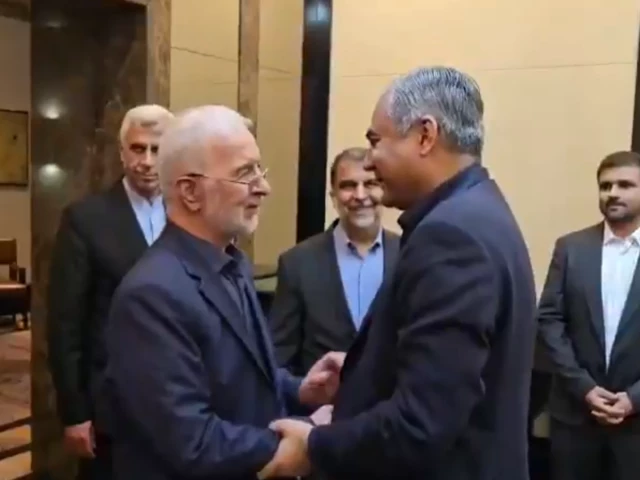
Both ministers emphasize the need to continue diplomatic efforts in a sustained manner to ensure lasting peace in the region.
Interior Minister Mohsin Naqvi and his Iranian counterpart Eskandar Momeni meet in the Kyrgyz capital Bishkek. SCREEN CAPTURE
Interior Minister Mohsin Naqvi and his Iranian counterpart Eskandar Momeni held an important meeting in Kyrgyzstan’s capital Bishkek where they discussed efforts to reduce regional tensions and issues related to internal security, the Interior Ministry said on Friday.
In a post on X, the ministry said the two ministers held talks on Pakistan-Iran relations and the latest developments in the region.
The meeting took place on the sidelines of a meeting of interior and public security ministers of the member states of the Shanghai Cooperation Organization (SCO) in Bishkek, which will be held from June 4 to 6.
وفاقی وزیر داخلہ محسن نقوی اور ایرانی وزیر داخلہ سکندر مومنی کے درمیان اہم ملاقات
پاک ایران تعلقات اور خطے کی تازہ ترین صورتحال پر تبادلہ خیال
داخلی سلامتی کے امور پر تبادلہ pic.twitter.com/9iAXpqvJ6h– Ministry of Home Affairs GoP (@MOIofficialGoP) June 5, 2026
“Tension reduction efforts and internal security issues were discussed,” the ministry said, adding that both sides exchanged views on regional developments during the meeting.
دونوں وزرائے داخلہ نے خطے کے پائیدار امن کے لئے سفارتی کوششیں تسلسل کے ساترت پر زور دیا
– Ministry of Home Affairs GoP (@MOIofficialGoP) June 5, 2026
The ministry further said that both interior ministers emphasized the need to continue diplomatic efforts in a sustained manner to ensure lasting peace in the region.
Naqvi last visited Tehran on May 21, which lasted four days, and was his second visit in just a few days, underscoring a growing sense of urgency, with some sources claiming that President Donald Trump had set a timetable for negotiations to succeed or risk further military escalation.
The interior minister met with Ahmad Vahidi, a top commander of Iran’s Islamic Revolutionary Guard Corps and considered one of the most powerful figures in the country after Supreme Leader Ayatollah Ali Khamenei. Naqvi also met with Iranian President Masoud Pezeshkian for the second time in less than a week.
Two days after Naqvi’s visit, Chief of Defense Forces and Chief of Army Staff Field Marshal Asim Munir visited Tehran and met with Iranian President Masoud Pezeshkian, Speaker of the Iranian Parliament Mohammad Bagher Ghalibaf, Foreign Minister Abbas Araghchi and Interior Minister Eskandar Momeni.
According to the military’s media wing, Inter-Services Public Relations (ISPR), “discussions remained focused on expediting the ongoing consultation process to support peace and stability in the region and reach a conclusive agreement.”
Read: CDF Munir drafts peace agreement: Vawda
On February 28, the United States and Israel launched a joint offensive against Iran. Tehran retaliated with attacks on Israel and other Gulf countries hosting American assets.
Pakistan subsequently positioned itself as a key mediator for peace, negotiating a two-week ceasefire and hosting the highest-level talks between the United States and Iran since the Islamic Revolution of 1979. Although the “Islamabad Talks” ended without an agreement, the ceasefire was held and later extended at Islamabad’s request.
Since then, the two sides have been exchanging proposals and counterproposals in an effort to reach a middle ground and resume a second round of direct talks aimed at ending the conflict, which has already disrupted global energy supplies and daily life across the region.
While Pakistan remains hopeful that direct talks will resume, sources said there was no “significant” change in Iran’s earlier stance on the nuclear issue in its response to the US proposals.
According to the sources, Tehran’s response – delivered to the United States through Islamabad last week – focused mainly on an “immediate” end to hostilities, with “little [in it] in terms of Washington’s core demand over Iran’s nuclear program.”
Iran, the sources added, has proposed “broader and separate” talks on the nuclear issue, citing its “complexity.”
However, Tehran has “reiterated” its willingness to halt uranium enrichment for a period of five years, while rejecting Washington’s demand for a 20-year moratorium, according to the sources.


