
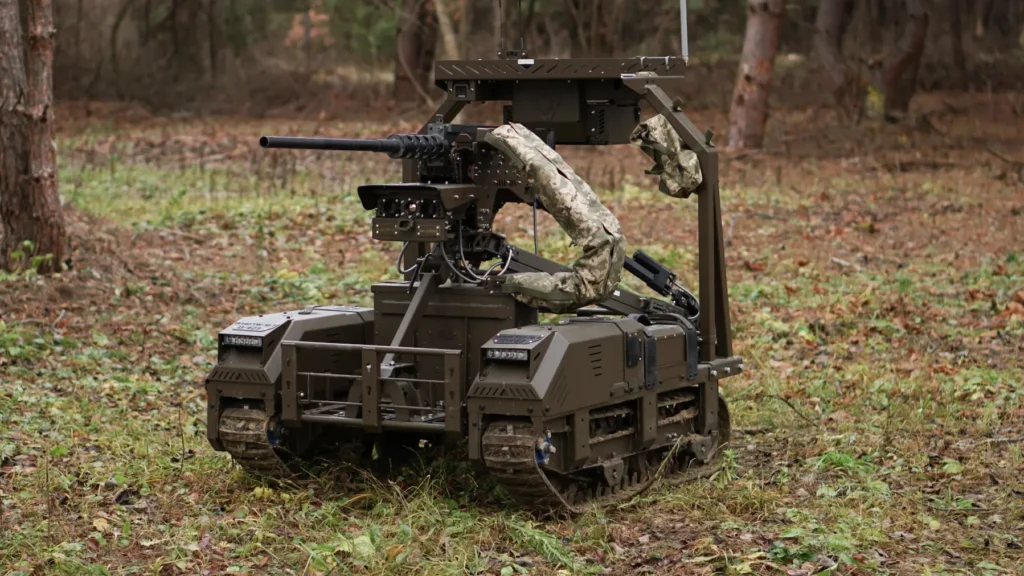
- A Droid TW 12.7 withstood Russian ground attacks for 45 days during the summer of last year.
- This is Ukraine’s first fully robotic defensive operation, with an operator maneuvering the robot from a distance of 10 km.
- It was supported by drone aerial surveillance, allowing it to attack targets in real time.
A single remotely controlled Droid TW 12.7, armed with a machine gun, stopped Russian advances at a contested intersection for 45 days in 2025 without loss of life.
The robot, which can be controlled from a distance of up to 10 km, allowed operators to safely “hold the line” without risking manpower, an increasingly scarce commodity in the current Russian-Ukrainian conflict, and allowed them to hold the ground at a critical moment, with the help of aerial drones in the area.
The Droid TW 12.7 comes equipped with a 12.7mm Browning M2 machine gun that serves as the primary deterrent and requires regular maintenance (ammunition replenishment and battery recharging).

A robotic version of ‘300’ on a rapidly changing front line
UGVs are increasingly replacing infantry on the front lines of the Russia-Ukraine conflict, especially for some of the most dangerous tasks. The driving force behind this is overwhelmingly the shortage of labor and the survivability it grants.
Ukrainian President Volodymyr Zelenskyy has stated that Ukraine now aims to contract a minimum of 50,000 UGVs, including the Droid TW 12.7, for combat operations, calling them the “next big step” after combat drones on a rapidly changing battlefield.
Many UGVs already deliver fuel, ammunition and food to forward positions, making it relatively easy to transport supplies. Others have been used to perform more specialized functions, such as transporting two soldiers injured by an FPV attack to safety, over almost 8 km.
You can expect to see more UGVs armed like the Droid TW 12.7 in the coming weeks and months as both Russia and Ukraine continue to suffer from manpower shortages as the war drags on for more than 4 years.
On the Russian side of the spectrum, reports indicate that it currently uses 32 different ground robotic systems, deploying at least 20 in active combat, although the number of assault UGVs in active combat remains unconfirmed as a single figure.
Regardless of how deeply UGVs are deployed and integrated into the Ukrainian war machine in the near future, the 45-day defensive posture of the Droid TW 12.7 is a testament to how far they have come in terms of lethality and utility.
The UGV has its limitations; He left his post every two days to be attended to by a crew 4 kilometers from the front, where he received new batteries. weapons maintenance and ammunition resupply, even as Ukrainian forces are unwilling to automate processes such as targeting, pointing to the potential for malfunctions in territories where both civilians and active-duty personnel remain in contact with them.

Follow TechRadar on Google News and add us as a preferred source to receive news, reviews and opinions from our experts in your feeds.


