
Pakistan delivers a list of 250 Indian prisoners, consisting of 52 civilians and 198 fishermen
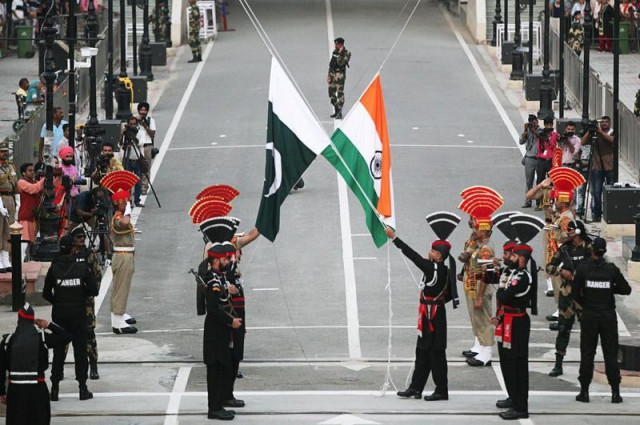
Pakistani rangers (in black uniforms) and Indian Border Security Force (BSF) officers lower their national flags during Pakistan’s 72nd Independence Day parade, at the Pakistan-India joint check post at the Wagah border near Lahore. PHOTO: REUTERS/FILE
Pakistan and India on Wednesday exchanged lists of prisoners held in each other’s custody under a bilateral agreement on consular access, and Islamabad urged New Delhi to repatriate 97 Pakistani prisoners who had completed their sentences and whose nationality had been confirmed.
The exchange was carried out through diplomatic channels in accordance with the Consular Access Agreement, signed on May 21, 2008, according to which both countries must exchange lists of prisoners on January 1 and July 1 of each year, the Foreign Ministry said.
According to the statement, Pakistan handed over a list of 250 Indian prisoners in its custody to the Indian High Commission in Islamabad. The list includes 52 civilian prisoners and 198 fishermen.
At the same time, India shared a list of 439 Pakistani prisoners or “suspected Pakistanis” held in Indian jails. The list included 386 civilian prisoners and 53 fishermen, according to the statement.
The ministry said Pakistan had also urged India to “release and repatriate 97 Pakistani prisoners (64 civilian prisoners and 33 fishermen) who have completed their sentences and whose nationality has been confirmed.”
It also called on New Delhi to “ensure the safety and well-being of all Pakistani and suspected Pakistani prisoners awaiting release and repatriation.”
Pakistan further urged India to provide “prompt consular access to all suspected Pakistani prisoners to facilitate prompt confirmation of their nationality,” the statement said.
Reaffirming Islamabad’s position, the Ministry of External Affairs said: “The Government of Pakistan will continue its efforts to ensure the early return of all Pakistani prisoners.”
The exchange of prisoner lists is a routine confidence-building measure that takes place twice a year, on January 1 and July 1, under the 2008 bilateral agreement on consular access between the two countries.
The annual exchange, a rare surviving mechanism of engagement between the two nuclear-armed neighbors, took place despite lingering tensions following the four-day conflict in May last year and the absence of a structured dialogue process.
While limited diplomatic protocols have continued, Islamabad has simultaneously expressed strong concerns over India’s alleged violations of the Indus Waters Treaty (IWT). For more than six decades, India and Pakistan amicably managed the Indus river system through the IWT cross-border water sharing agreement signed on September 19, 1960. In April last year, India suspended the treaty in the wake of the Pahalgam attack.
At an international seminar titled “The Indus Waters Treaty: A Key Instrument for Regional Peace and Stability” held in Islamabad on Tuesday, Deputy Prime Minister Ishaq Dar warned India that any attempt to deprive Pakistan of its legal water rights under the treaty would have profound consequences for peace and security in South Asia.


