
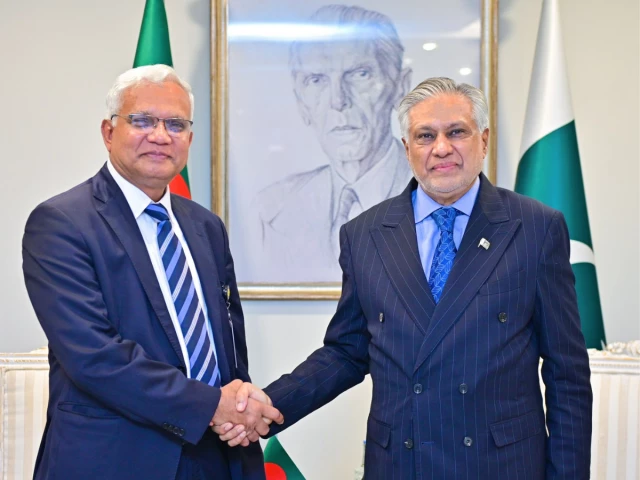
Both leaders are committed to enhancing bilateral cooperation in trade, education, social welfare and people-to-people contacts.
Deputy Prime Minister and Minister of External Affairs Ishaq Dar meets Bangladesh Minister for Women, Children and Social Welfare Dr AZM Zahid Hossain. PHOTO: FO
Deputy Prime Minister and Foreign Minister Ishaq Dar on Tuesday reaffirmed Pakistan’s commitment to strengthening ties with Bangladesh during a meeting with Bangladesh Minister for Women, Children and Social Welfare Dr AZM Zahid Hossain in Islamabad, according to a statement issued by the Ministry of External Affairs (FO).
Dr Hossain was visiting Pakistan to attend the 9th Ministerial Conference on Women of the Organization of Islamic Cooperation (OIC), which was being held in Islamabad.
Dr AZM Zahid Hossain, Minister of Women, Children and Social Welfare of Bangladesh, called on Deputy Prime Minister and Foreign Minister Senator Mohammad Ishaq Dar @MIshaqDar50 last night.
Welcoming Dr Hossain to Pakistan for the 9th OIC Ministerial Conference on Women… pic.twitter.com/6Y8dLZKOe2
– Ministry of Foreign Affairs – Pakistan (@ForeignOfficePk) July 14, 2026
Welcoming the Bangladesh minister, Dar appreciated Bangladesh’s participation in the conference and reaffirmed “Pakistan’s commitment to promoting cooperation for women empowerment within and outside the OIC framework,” according to the FO.
Recalling his visit to Dhaka last August, Dar also reaffirmed “Pakistan’s commitment to further strengthening bilateral relations” and underlined “its readiness to expand cooperation in various fields of mutual interest.”
The two leaders also exchanged views on enhancing bilateral cooperation in trade, education, social welfare and people-to-people contacts, the FO said.
The Ninth Ministerial Conference on Women of the Organization of Islamic Cooperation (OIC) on Monday adopted the Islamabad Declaration, reaffirming member states’ commitment to the social, economic and political empowerment of women and girls, while launching a new initiative to promote the digital inclusion of women across the Muslim world.
Read: OIC Collusion Adopts Islamabad Declaration
According to the Islamabad Declaration, available on the official website of the OIC, ministers and heads of delegations committed to further strengthen policies and institutional mechanisms to ensure the effective and meaningful participation of women in political, economic and public life.
The declaration urged member states to remove barriers to women’s education and employment, expand access to quality education, technical and vocational training and leadership development opportunities, and promote women’s economic stability by improving access to jobs, financial resources, business support and social protection systems.
It also highlighted the need to promote inclusive financial systems, including Islamic finance, microfinance and digital financial services, while recommending better access to capital, innovation and business opportunities for women-led small and medium-sized enterprises (SMEs).
The statement called women’s participation in science, technology, engineering and mathematics (STEM), artificial intelligence (AI) and emerging technologies critical.


