
Making a century-old game more engaging and easier to play as a group has already generated big business for the Topgolf golf simulator experience, which at its peak was sold in a deal valued at around $2 billion.
The British entrepreneurs who created Topgolf are now betting they can apply the same playbook to billiards.
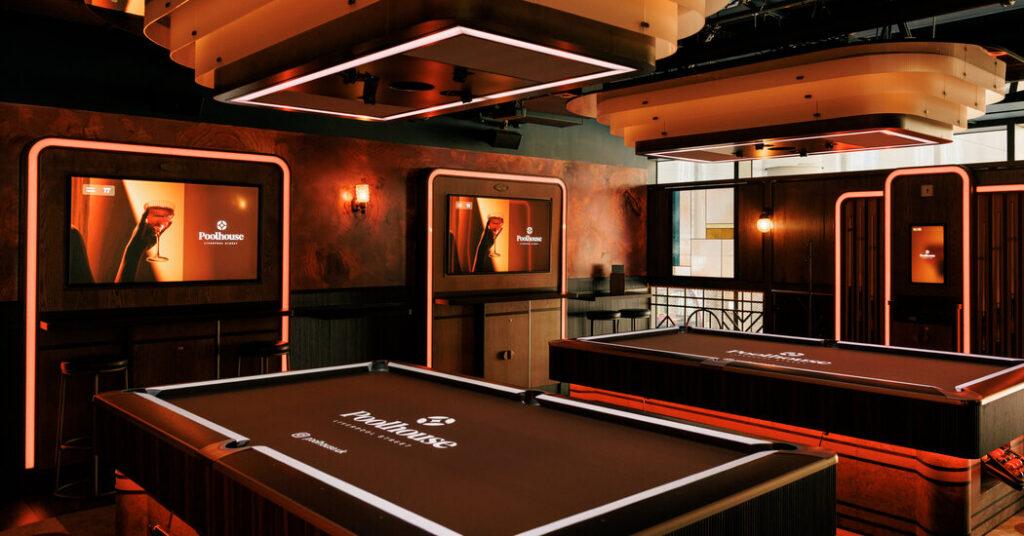
The result is Poolhouse, a two-year-old startup that two months ago opened a two-story, 21,000-square-foot bar in London but aims to make its technology available far beyond its own pool halls.
The startup plans to announce Friday that it has raised $55 million in a new round of financing to fund that growth, led by investment firm Bluestone Equity Partners. (The financing values the startup at more than $100 million, according to a person with knowledge of the matter who was not authorized to publicly disclose the information.)
Behind Poolhouse’s business is a bet that marquee sports, which the company says attract hundreds of millions of players around the world each week, are ripe for an overhaul, just as golf was.
“If we could emulate what Topgolf accomplished, then I think we’d certainly be on the right path to making our own dent in the sport,” Poolhouse CEO Andrew O’Brien said in an interview.
Poolhouse’s technology platform, called BillyQ, uses artificial intelligence, tracking cameras and projectors to turn an analog pool game into a kind of arcade experience.
It is on display in the company’s bar in London, in the heart of the city’s historic financial centre. In the middle of a Las Vegas-themed sports bar and restaurant, with a chef who worked for Gordon Ramsay, there is a fleet of pool tables with thick projectors above them.
Groups can play traditional pool or compete in a variety of shootout competitions. BillyQ devices project interactive graphics onto the tables, including blocks that the ball must “break” and performance bonuses that players can use.
Among BillyQ’s big selling points, according to O’Brien, is its ability to assign handicaps to players, called Q ratings, to match skill builds. (On a recent visit, this journalist’s level of play deserved an extremely high one.)
The foundation of BillyQ is technology Poolhouse developed with the team behind Hawk-Eye, the computer vision system that tracks ball movement in Major League Baseball, tennis’ ATP Tour and soccer’s Premier League.
Poolhouse’s roots lie in the same idea that the new company’s founders, twins Steve and Dave Jolliffe, had when creating Topgolf and PuttShack, a similar concept built around miniature golf. Traditional games could be combined with technology to make them more exciting and accessible, especially by adapting the game to different people’s abilities.
The inspiration for the company came during the pandemic, Steve Jolliffe said in an interview, when the brothers’ local pool hall filed for bankruptcy. The Jolliffes eventually developed a technology and business model that could make pool halls more attractive to non-professionals.
The brothers then hired Mr. O’Brien, a former Credit Suisse banker who is on the board of F1 Arcade, which runs bars with car racing simulators. He introduced the Jolliffes to Hawk-Eye’s creator and has taken particular interest in perfecting BillyQ, even hiring a statistics professor to make performance tracking more sophisticated.
“We’re always trying to build a competitive moat around us,” Steve Jolliffe said.
Poolhouse’s efforts eventually caught the attention of Bluestone, whose executives had heard about the new company and were quickly impressed by its approach. Bluestone has agreed to lead the new investment round, which aims to help fund Poolhouse’s international expansion.
One question is whether Poolhouse can reach the heights of Topgolf at its peak, while avoiding the problems that brought it back to earth. Callaway Golf, which bought Topgolf in 2021, sold a majority stake in the business this year at about half the valuation of the original deal amid slowing growth and high costs.
(Steve Jolliffe noted that the expense of building Poolhouse bars was much less than that of Topgolf venues, which cost up to $40 million.)
But for all the luxury of Poolhouse’s pool hall aesthetic, company executives and investors say selling BillyQ devices to other operators is the company’s real future. O’Brien said executives from a billiards company had flown to London to test the technology and were pondering the possibility of improving their tables.
Bobby Sharma, founder and managing partner of Bluestone, said BillyQ-equipped pool tables could be sold to cruise ships, for example, while Steve Jolliffe said cinemas and other hospitality venues could fill empty spaces with one or two tables. The company would then collect subscription revenue from those customers.
Poolhouse has focused on making BillyQ devices smaller and lowering their cost (roughly to that of a Peloton bike, according to O’Brien) with the goal of reaching people’s homes as well.
He said the company was close to negotiating a “major” distribution deal in the United States and that the goal was to start selling BillyQ there and in Europe next year.
“It’s understandable to think of this as Topgolf for pool, but I think that underestimates the opportunity,” said Bluestone’s Sharma. “Poolhouse is a bigger story in the sense that it’s not just about the format of the place, but about the technology.”


