
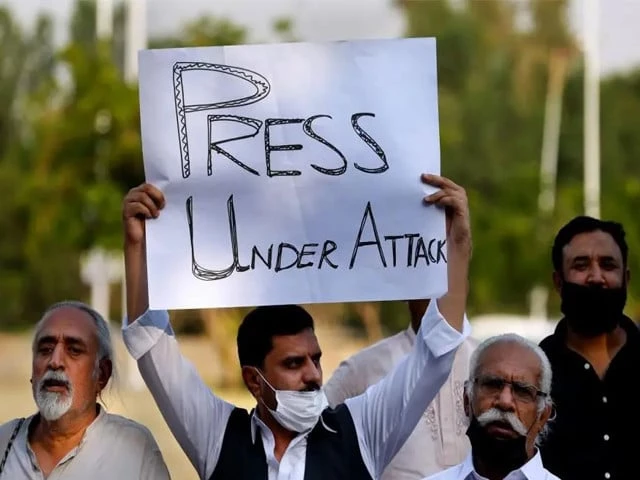
Freedom Network report blames PECA and legal and economic pressures for worsening press freedom and safety of journalists
ISLAMABAD:
Pakistan’s media landscape witnessed a significant contraction of the space for free expression over the past year, driven by an escalation of legal, regulatory and economic pressures, among others.
This has been revealed in media watchdog Freedom Network’s latest annual report on the state of media freedoms and the safety of journalists.
The report, titled “Regulatory Crackdown on Freedom of Expression: Legal Controls and PECA Undermine Media and Journalism in Pakistan,” identified the amended Prevention of Electronic Crimes Act (Peca) as the “most consequential instrument” used to restrict journalists and freedom of expression practitioners.
Originally enacted in 2016 to combat cybercrime, the draconian 2025 amendments to the law’s provisions have been increasingly used in 2025-26 to criminalize legal expression, attack dissent and intimidate journalists, lawyers and political commentators, according to the report.
Freedom Network released the report to mark World Press Freedom Day, which is celebrated globally and in Pakistan on May 3 every year.
“The weaponization of PECA has created a climate of fear in which journalists are forced to self-censor to avoid legal repercussions,” said Freedom Network Executive Director Iqbal Khattak. “This represents one of the most serious threats to press freedom in Pakistan today.”
The report, according to a press release issued by the organization, highlighted high-profile convictions of human rights lawyers, including Imaan Mazari and Hadi Ali Chattha, as examples of how custodial sentences are used to deter dissent.
Additionally, dozens of journalists have faced charges under expanded Peca provisions, while defamation lawsuits, regulatory suspensions, and internet shutdowns have further limited independent journalism.
“Pakistan’s broader legal and regulatory framework reinforced these challenges. Although right-to-information laws exist, their implementation remains inconsistent, and federal institutions are particularly resistant to disclosure. The persistence of secrecy through outdated laws continues to weaken transparency and accountability,” reads one of the report’s conclusions.
The report also notes that state-led efforts to counter disinformation and hate speech are often accompanied by increased surveillance and targeted law enforcement. Regulatory bodies that monitor online content, along with vague definitions of “made-up news,” blur the line between misinformation and legitimate dissent.
According to the report, the risks associated with disinformation became particularly evident during the brief war between India and Pakistan in May 2025, when manipulated images and recycled footage circulated widely on media platforms, distorting public understanding of the events.
In terms of journalist safety, the report documented at least 129 verified incidents of violations during the period analyzed, ranging from April 2025 to March 2026. Legal threats and physical violence accounted for almost two-thirds of these cases.
These violations include two murders, five cases of threats of murder, 58 court cases (mostly invoked by Peca), 16 cases of assault, 11 cases of threats of harm, and two cases of kidnapping and forced disappearance.
Punjab and Khyber-Pakhtunkhwa emerged as the most dangerous regions for journalists, while killings in Sindh and Balochistan underlined persistent risks. State authorities were suspected of being the main perpetrators, responsible for more than 60 percent of the violations, mainly through judicial and custodial actions. Non-state actors, including militant groups and criminal networks, also contributed to threats, assaults, and killings.
The arrest of three female journalists in Islamabad attempting to cover the Aurat March in March 2026 highlighted the gender dimension of these risks. Across Pakistan, journalists also faced economic pressures, including delayed salaries, job insecurity, and dependence on government advertising, which further undermined editorial independence.
Women journalists, according to the report, remain particularly marginalized within the media sector. Harassment, online abuse, and workplace discrimination continued to create a hostile environment. Cases of deepfake abuses and arrests further illustrate these challenges.
Despite these limitations, some progress was seen, including leadership initiatives and the appointment of Ambreen Jan as the first female head of the Pakistan Electronic Media Regulatory Authority (Pemra).
The report also examines the changing role of technology in Pakistani journalism. While AI adoption remains limited due to infrastructural and linguistic barriers, concerns around misinformation and lack of oversight remain. However, some initiatives indicate early steps towards the responsible integration of technology into media practices in the country.
The report concludes that the cumulative impact of these developments has significantly reduced the space for free expression in Pakistan, where journalists, citizens and rights defenders operate in an increasingly restrictive environment.
The report emphasizes urgent reforms, including reviewing restrictive Peca provisions, strengthening the implementation of journalist safety laws, and ensuring transparency through effective enforcement of RTI frameworks. It also calls for providing legal and institutional support to journalists and promoting the ethical use of emerging technologies.
“Without such measures,” the report warns, “Pakistan’s media will remain trapped in a cycle of coercion, censorship and economic fragility, with serious implications for democratic accountability and freedom of expression.”


