
ISLAMABAD:
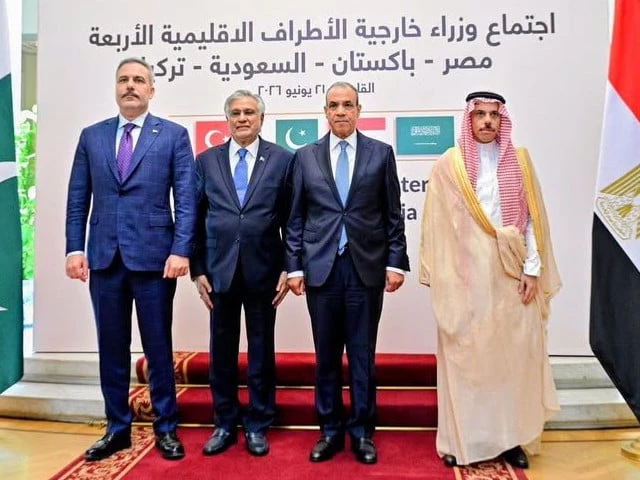
The foreign ministers of Pakistan, Saudi Arabia, Turkiye and Egypt met in Cairo on Sunday for the fourth consultative meeting of the R-4 group, as Iran and the United States opened a new round of talks in Switzerland aimed at consolidating the recently signed Islamabad Memorandum of Understanding (MoU).
The meeting was attended by Pakistan’s Deputy Prime Minister and Foreign Minister Ishaq Dar, Saudi Arabia’s Foreign Minister Prince Faisal bin Farhan Al Saud, Turkish Foreign Minister Hakan Fidan and Egyptian Foreign Minister Dr. Badr Abdelatty.
In a joint statement issued after the meeting, the ministers welcomed Islamabad’s recent MoU and emphasized that future negotiations must address the security concerns of regional states, particularly the countries of the Arab Gulf and the Levant, while advancing efforts towards a lasting and verifiable solution.
The timing of the Cairo meeting increased its diplomatic weight, as it occurred just days after the understanding between Iran and the United States that has eased tensions in a region that had long been in suspense. But beyond the immediate developments, the joint statement made clear that its members increasingly view the R-4 mechanism as a structured consultative platform designed to respond to regional crises and shape a coordinated Muslim global position on issues of war, de-escalation and security, particularly in the Gulf.
According to Egypt’s Foreign Ministry, the ministers expressed their deep gratitude to President Abdel Fattah El-Sisi for sharing his vision of regional stability, which they said continues to guide the group’s efforts to promote peace, security and prosperity in the Middle East.
The statement said the four countries held a “comprehensive exchange of views” on regional and international developments and reaffirmed the importance of sustained consultation and coordination among them in support of regional stability.
Indeed, officials described the R-4 as evolving from an informal dialogue channel to a more regularized framework for crisis coordination at a time of increasing geopolitical flux.
A central theme of the discussions was the Islamabad MoU signed on June 18, 2026, which ministers welcomed as a “constructive step” towards de-escalating a conflict that had threatened not only regional peace but also energy flows, maritime security, global supply chains and international trade.
Crucially, the ministers emphasized that any follow-up negotiations must ensure a “durable, verifiable and mutually acceptable solution”, explicitly taking into account the security concerns of regional states, in particular the stability and security of the countries of the Arab Gulf and the Levant, a formulation that diplomats say reflects the core strategic anxiety driving the R-4 consultations.
The meeting also praised the role of regional and international actors in facilitating understanding between Iran and the United States, with particular praise for Pakistan’s “instrumental efforts” and Qatar’s diplomatic commitment of support.
Reaffirming longer-term positions, the ministers stressed that the Palestinian cause remains fundamental to any lasting peace in the region. They reiterated their support for Palestinian self-determination and an independent state based on the June 4, 1967 borders with East Jerusalem as its capital, while expressing concern about the humanitarian situation in Gaza, the West Bank and East Jerusalem.
Diplomatic observers say the R-4 group is gradually positioning itself as a mid-level stabilizing platform, uniting perspectives from the Gulf, South Asia and the Eastern Mediterranean, at a time when traditional alliances are being recalibrated after the Iran-US conflict.
The coincidence of the Cairo meeting with the start of talks between Iran and the United States in Switzerland, they add, underscores how regional diplomacy is now operating on multiple interrelated tracks, with Gulf security, detente frameworks and the Palestinian issue forming the central pillars of a reformed Middle East order.


