
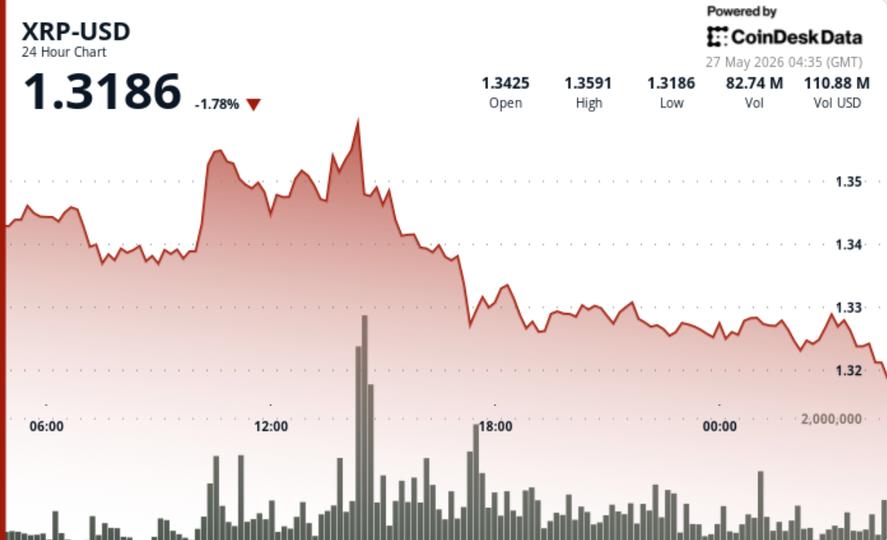
XRP continues to circle around the same range that has controlled price action for months, and the latest failed breakout near $1.36 only reinforced how difficult it has become for buyers to build sustained momentum. The market is still compressing below resistance, although the lack of aggressive selling below $1.30 also suggests that large holders are not yet fully pulling out.
News background
• Sentiment in crypto markets weakened during the session, with fear-driven positioning reaching the highest levels in approximately three weeks.
• On-chain data still shows XRP leaving major exchanges, a pattern some traders interpret as longer-term accumulation rather than active distribution.
• Analysts also continued to highlight a larger symmetrical triangular structure that has compressed XRP’s price action since early 2025.
Price Action Summary
• XRP traded between $1.3039 and $1.3429 before settling near $1.32 during the May 27 session.
• The highest volume event occurred during a failed breakout attempt near $1.36, where over 62 million XRP was traded before the price fell.
• Late session selling pushed XRP briefly below $1,324 before buyers stabilized the move near support towards the close.
Technical analysis
• XRP remains stuck within a tightening consolidation structure between approximately $1.30 and $1.38.
• Repeated failures near $1.36 continue to reinforce that area as the market’s main resistance zone.
• Momentum still looks weak in the near term after price failed to reclaim broken support levels near $1,337.
• At the same time, support near $1.30 continues to hold despite multiple tests, keeping the broader compression structure intact for now.
What traders should keep in mind
• $1.30 remains the key support floor. Losing it would likely shift the focus to deeper bearish targets in the mid-$1.20 range.
• Between $1.36 and $1.38 remains the critical breakout zone that XRP needs to overcome before momentum can improve significantly.
• The tighter the range becomes, the greater the odds of a steeper expansion in volatility once the price finally breaks out of consolidation.


