
A judge issues a dissenting note in favor of maintaining the previous restriction on the right of defense
ISLAMABAD:
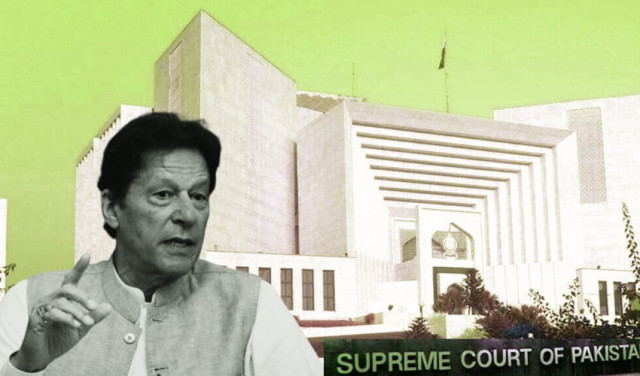
The Supreme Court on Thursday restored Pakistan Tehreek-e-Insaf (PTI) founder Imran Khan’s right of defense in a long-running defamation case filed by Prime Minister Shehbaz Sharif, in a majority verdict that also set aside earlier orders of lower courts.
The case arises from allegations made in 2017, when the PTI founder accused Prime Minister Shehbaz of offering money to drop the Panama Papers case. In response, the prime minister filed a defamation suit, which has remained pending before the lower court for eight years.
The trial court had previously closed the right of defense of the PTI founder, a decision later confirmed by the Lahore High Court (LHC). The PTI founder then approached the SC against the order.
Earlier, a three-member bench headed by Justice Mansoor Ali Shah, along with Justice Amin-ud-Din Khan and Justice Ayesha Malik, had heard the appeal against the LHC decision.
In that earlier ruling, Justice Mansoor Ali Shah and Justice Amin-ud-Din Khan had upheld the closure of the right of defence, while Justice Ayesha Malik had dissented.
On December 29, 2022, Justice Mansoor Ali Shah and Justice Amin-ud-Din Khan also confirmed the High Court’s decision to close the right of defence.
However, the Supreme Court admitted an appeal for review against that order and restored the right of defense, ordering the court of first instance to proceed with the case in accordance with the law.
The majority verdict was announced in open court by Justice Ayesha Malik, who also headed the review court. According to the court file, the decision was made by a majority of two judges. At the same time, a judge issued a dissenting note in favor of maintaining the previous restriction on the right of defense.
The court also took note of the procedural history of the case, including repeated delays at the trial stage. Court documents indicated Khan requested more than 70 adjournments and submitted his written response after a four-year delay.
Read: Defamation: the SC will accept the review appeal of the former prime minister
Meanwhile, it was noted that Shehbaz had appeared in the proceedings via video link during multiple hearings while in office.
The previous decision to block the right of defense had been challenged before the Supreme Court, where a three-member court had initially confirmed the restriction by majority. At that stage a dissenting note was also recorded.
2017 defamation lawsuit
Shehbaz Sharif filed a defamation suit against the then opposition leader Imran Khan. The case, initially filed in 2017, accuses Khan of making defamatory statements about Sharif that allegedly damaged his reputation and mental well-being.
Sharif’s defamation suit arises from Khan’s allegations that Sharif offered him 10 billion rupees through a mutual friend in exchange for withdrawing from the Panama Papers case, which was then pending before the Supreme Court.
According to the lawsuit, these “baseless and malicious” statements were widely circulated in the media, damaging Sharif’s public image and causing “extreme mental torture, agony and anxiety.”
Sharif’s legal team has asked the court to issue a decree for the recovery of Rs 10 billion in compensation for the defamation as well as the damage caused by the statements. The prime minister maintains that the allegations were false and caused significant damage to his reputation.
In response, Khan filed a response in 2021, claiming that the information had been conveyed to him by a friend, who had allegedly been approached by a member of the Sharif family to offer to stop pursuing the Panama case.
Khan claimed that he revealed the incident in the public interest and argued that his statement did not specifically attribute any part of the allegation to Sharif.


