
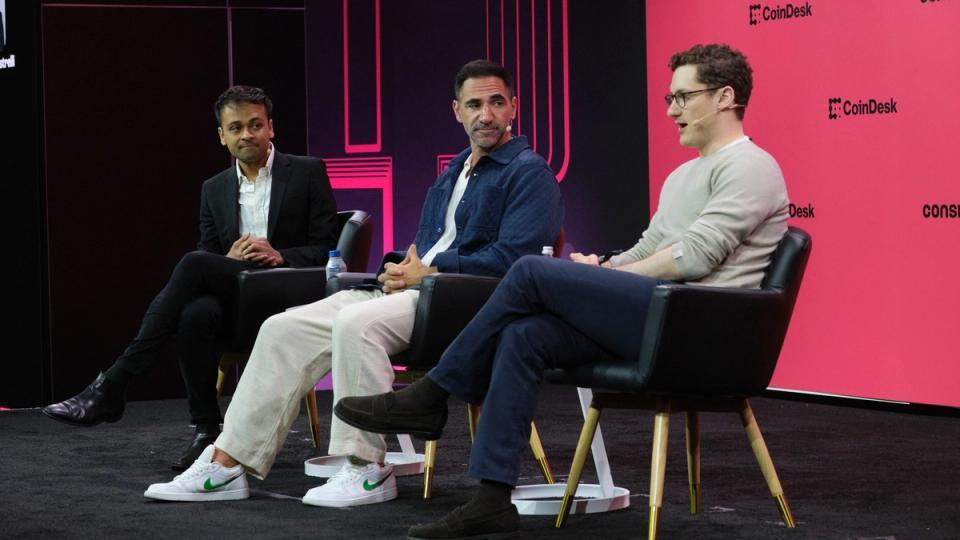
MIAMI BEACH, Fla. — Sports betting should be regulated as a federal financial product rather than a state-licensed casino product, two panelists said Thursday.
Appearing at Consensus Miami 2026, Jacob Fortinsky, co-founder and CEO of sports betting platform Novig, said the legacy sports betting model is structurally broken because it treats winning bettors as cheaters.
“Sports betting is really the only industry in the country that regularly limits and bans its power users,” Fortinsky said. He framed sporting event contracts as binary financial instruments that “have long been treated as a gambling product and should instead be treated as a financial product.” Globally, he said, sports betting is “a $2 trillion asset class still dominated by these brick-and-mortar casinos.”
Adam Mastrelli, founder of 57 Maiden, a company that creates AI-based trading strategies for prediction markets, validated the criticism with personal experience.
“My partner and I got kicked out of two big bookmakers two months after the trade because we were smart,” he said. It’s like “kicking LeBron James out of the NBA for being too good,” he added.
Mastrelli said the team turned to Novig, which he said charges no fees and allows traders to create synthetic positions.
Mastrelli said his company’s advantage declined rapidly, and of 154 proposed trading strategies, only three are currently profitable.
“This advantage will disappear,” he said, “so if you can build systems that can keep up with that advantage and that alpha… then it becomes really, really intriguing.” Her most profitable season, she said, was the WNBA.
Fortinsky said Novig is on track to transition this summer from a live draw model in 35 states to a federal DCM framework that will allow it to operate in all 50 states. An earlier attempt to be regulated at the state level in Colorado, he said, was a wake-up call. “Regulators told us that we are essentially naïve if we think we care about consumer protection, innovation or market efficiency. In reality, we only care about our tax revenues,” he said.
The federal-state fight, Fortinsky added, “will reach the Supreme Court in the next two to three years,” with 15 lawsuits pending between the Commodity Futures Trading Commission, Kalshi, Robinhood and several states. Within prediction markets, he argued that sports are “counterintuitively, actually, the safest vertical,” given the heightened concerns about insider trading and manipulation around political and event-related contracts.
Mastrelli, who said he avoids offshore platforms altogether, compared prediction markets to stock markets: “When I see a strong stock market now, this is AQR versus SIG. It doesn’t go away.”


