
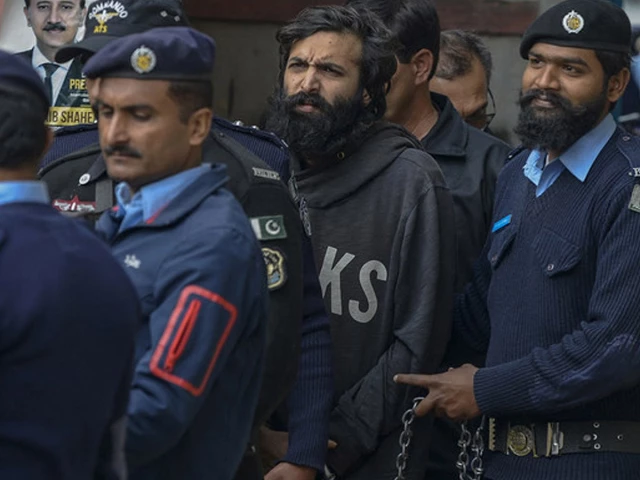
The defense argues that Jaffer believed himself to be a spiritual leader and considered the victim a sacrificial offering.
Pakistani-American Zahir Jaffer (center), convicted of rape and murder, arrives at an Islamabad court. Photo: AFP
ISLAMABAD:
The Supreme Court on Thursday dismissed the review petition filed by Zahir Jaffer, the main convict in Noor Mukadam’s murder, and upheld its earlier verdict upholding his death sentence.
Noor Mukadam, 27, daughter of former diplomat Shaukat Mukadam, was murdered and beheaded in a posh locality in Islamabad in July 2021. Police had charged Jaffer, a US citizen and heir to the Jaffer Group of Companies, with the crime.
A three-member bench headed by Justice Hashim Kakar announced the decision after hearing arguments for nearly four hours. The court also rejected a petition seeking the formation of a medical board to evaluate Jaffer’s mental health.
During the hearing, Jaffer’s lawyer, Khawaja Haris, admitted that Noor had been subjected to grave injustice and apologized to her family.
He said his arguments focused on his client’s mental condition at the time of the incident rather than questioning his presence at the crime scene. “I accept that my client was present at the scene,” Haris said. “I’m not going to argue that my client didn’t commit the murder.”
Haris argued that his client was mentally ill and unable to properly understand or participate in court proceedings.
Referring to material presented during the trial, Haris told the court that reports suggested Jaffer believed himself to be a spiritual leader and considered the victim a sacrificial offering. “My client is mentally ill. He can’t even sign correctly,” he argued.
The defense contended that Jaffer suffered from mental health disorders, including bipolar disorder, schizophrenia and depression, and had been taking medication for those conditions.
Haris argued that the convicted man’s mental state was not adequately examined during the trial and noted that he had continued to be administered medication in prison. “My question is why the prosecution didn’t perform a narcotics test on the defendant,” he said.
Read more: Noor Mukadam case: SC to hear Zahir Jaffer’s review petition on April 8
He further argued that extensive media coverage and public commentary during the trial created pressure that deterred investigators from conducting such tests.
“At the time, social media was full of claims that proving the defendant was addicted to drugs would be used to save him,” he said. He also suggested that the trial court had been influenced by media scrutiny, prompting a response from the court.
“This court does not decide cases based on news reports nor is it under pressure from social media,” Justice Kakar responded. The judges repeatedly questioned the defense’s position, asking for evidence showing when Jaffer began treatment, whether he was receiving treatment at the time of the murder and what doctors had diagnosed him.
Justice Salahuddin Panhwar observed that the defense seemed to be based on assumptions rather than documented evidence. “You are saying that your mental state was not normal at the time of the incident,” Justice Panhwar said. “That would mean that you are effectively validating the same comment on social media that you are criticizing.”
The court also questioned a letter from London’s Harley Street Clinic submitted by the defence. Judge Panhwar noted that the document was dated 2022, after the murder took place. “It is strange that the defendant could not get a lawyer of his choice and yet a letter arrived from London,” the judge commented.
The court also noted that the applications to form a medical board had already been rejected during the process and were not subsequently challenged before the Islamabad High Court. “That matter has now reached its finality,” Justice Ishtiaq Ibrahim observed.
“Suppose we accept that the defendant’s mental condition was not normal. What relief do you want on review?” Justice Kakar asked. “If you had been tested for drugs, what benefit would it have given you?”
Read more: Noor Mukadam murder: Supreme Court dismisses Zahir Jaffer’s appeal, upholds death sentence
Haris responded that he was not seeking a new trial but rather a reduction in sentence, arguing that all relevant facts should have been considered before imposing the death penalty. At one point, Judge Hashim Kakar commented that if Jaffer had hired a lawyer of Haris’ caliber from the beginning, “the defendant might not have had to see this day.”
Lawyer Shah Khawar, representing Noor’s parents, opposed the plea and defended the earlier conviction and sentence.
During the hearing, the defense attorney also referred to media coverage of the case during the trial, prompting observations from the court about the role of journalistic reporting. “We are not sitting here to listen to news,” Judge Ibrahim commented.
Justice Kakar noted that media reports and social media comments often differed from actual court proceedings. “Sometimes we say one thing and it is reported another way,” he observed. “Newspapers report one version, while vloggers present something completely different.” Justice Panhwar added that “everyone expresses his own opinion.”
At one point in the hearing, Justice Kakar commented that the court had adjourned other cases to hear the matter and said: “Today we have adjourned all our other cases.”
The hearing included a brief recess, and the court indicated its intention to conclude the proceedings that same day. After hearing arguments, the court dismissed the review petitions and upheld Jaffer’s death sentence.
the case
In February 2022, a district and sessions court convicted Jaffer of murder and sentenced him to death, along with 25 years of rigorous imprisonment and a fine of Rs 200,000. His house staff, Iftikhar and Jameel, were sentenced to 10 years in prison, while other defendants, including Jaffer’s parents and TherapyWorks employees, were acquitted.
On March 14, 2023, the Islamabad High Court upheld Jaffer’s death sentence and converted his 25-year prison sentence into another death sentence on rape charges.
Subsequently, a three-member bench of the Supreme Court, headed by Justice Kakar, on May 20 rejected Jaffer’s appeal and confirmed the death sentence in the case. In a detailed verdict delivered in June of the same year, the high court upheld his murder conviction and described him as “a ruthless killer” who was “not worthy of sympathy.”
However, while upholding the death sentence for murder, the court commuted the death sentence imposed for rape to life imprisonment. Jaffer was acquitted of the kidnapping charge, although his sentence for unlawful confinement was upheld.
The court also upheld the sentences of co-accused Iftikhar and Jameel, but ordered their release on the grounds that they had already served sufficient time. The verdict noted that Judge Ali Baqar Najafi would add a supplementary note.


