
SZA denounces ‘Suno’ and musicians who use AI


SZA denounces ‘Suno’ and musicians who use AI

SZA has launched a fierce attack on AI music generators and the artists who support them, specifically criticizing Suno and alleging that producer Diplo has shares in the company and is trying to train it in the work of black musicians.

The Grammy-winning artist took to Instagram on Saturday to make her feelings known in no uncertain terms.

Writing on his private account, he argued that black artists are unfairly vulnerable to having their creative work exploited.

“We make up 13% of the American population, but we influence the world with our sound and our perspective,” he wrote.

“I HAVE NOT HEARD A WHITE AI SONG YET… We have no medical or creative protection in the legislature. The easiest to steal. DON’T GIVE AWAY YOUR VIBRANIUM!!! DON’T TRAIN AI WITH YOUR GENIUS.”

On his main Instagram account, he went further and claimed that a search of his name revealed that artificial intelligence models had been trained on 238 of his songs.

His message to any musician who supports this practice was clear.

“If you’re a musician and you support this degenerate shit? You’re disgusting and there’s nothing you can tell me to make this okay. I hope you get the life you deserve.”

A Suno spokesperson declined to comment directly on SZA’s allegations, instead pointing to a LinkedIn post by the company’s chief product officer, Jack Brody, who stated that Suno’s training metadata does not include artist names, cannot replicate the material she trained on, and that the company is working to improve impersonation detection.

Suno’s approach to platform integrity and music copyright protection

Last week, we shared that we are now testing a new music model developed in partnership with the music industry. We’re really excited about this and it’s a good opportunity to share more about how we think about the integrity of the platform and protecting the people behind the music. At Suno, preserving art and human creativity is as important as product innovation itself. We know it’s easy to be skeptical, especially if you haven’t immersed yourself in our product. But most of the people who build Suno are musicians. Empowering human creativity is why we are here, not just for corporate positioning. We believe that companies building AI have a responsibility to invest in safeguards with the same level of ambition and rigor that they bring to building products. Since our earliest days, we’ve worked to build protections directly into the foundation of our platform. That includes clear rules prohibiting users from uploading or distributing content they don’t own or have the right to use, meaningful enforcement when those rules are violated, and partnerships with industry-standard providers like Audible Magic, Musixmatch, and ACRCloud to help us identify and prevent misuse. It has also determined how we have approached model development itself. One of the most common questions people ask about AI is whether models can reproduce material from their training data. Our answer is simple: no, that shouldn’t happen. Our philosophy has always been that AI should help people create new music, not replicate someone else’s. That’s why we build our models around what we call “Original Creation, by Design” – training strategies aimed at reducing the risk of generating unauthorized reproductions. For example, we don’t use artist names as a training metadata category, which means we made an intentional decision not to teach artist names to models because our goal is to help people create new songs, not music that sounds like existing artists. In addition to those efforts, we are actively developing additional approaches for audio fingerprinting, watermarking, and spam and phishing detection. Additionally, we are engaging in discussions about AI labeling with our users and creatives at all levels, to understand how to best empower them while respecting privacy. We do not treat these issues as a compliance exercise. It’s a core part of how we build and has led us to implement more copyright safeguards than traditional music software, not just compared to AI music tools, but compared to all music tools that came before them. We are in active dialogue with artists, songwriters, producers, labels, distributors and partners across the music industry, and those conversations will continue to shape the safeguards we build and the investments we make going forward. We will launch our associated models in the coming months. We will soon have much more to share 31 comments on LinkedIn.

It is not yet clear whether Diplo has shares in Suno. A representative for him did not immediately respond to requests for comment, although he spoke positively about his use of the platform.

Diplo’s own position on AI in music is the polar opposite of SZA’s. In an April interview, he stated that there was “no AI fighting” and that he no longer needed human voices for his tracks.

“The customer and accessibility is what will always triumph,” he said.

“99% of people will want to love the best product, made faster and cheaper; that’s what the American economy is.”

In a follow-up post about X, he told artists to “adapt or just give up and become super drivers.”
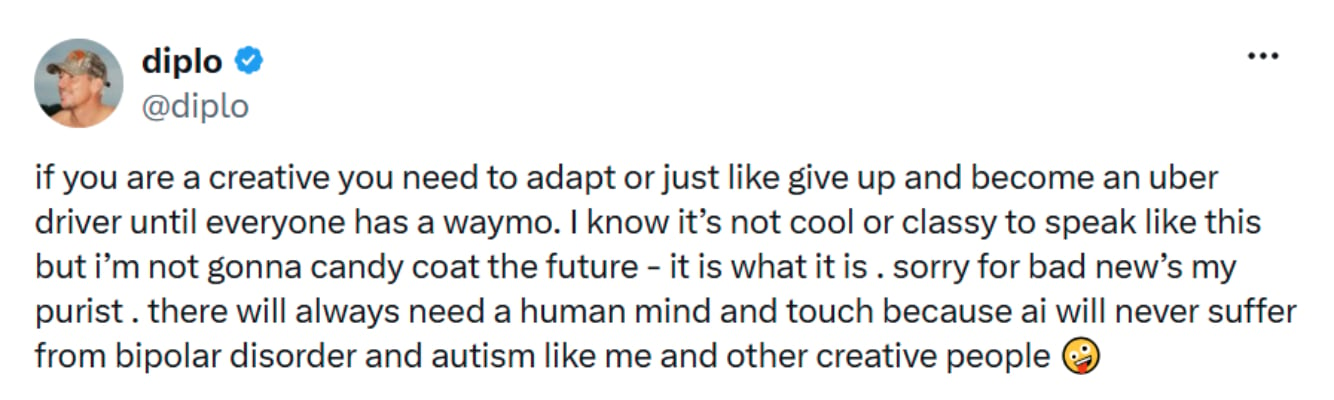
X/Diplo
X/Diplo

The dispute reflects a deepening fault line in the music industry.

Producer Jack Antonoff recently called those who make music with AI “godless bastards” and “bad actors,” while Will.i.am and Timbaland have invested in AI companies.

SZA’s own label, RCA Records, is owned by Sony Music, which is currently in active litigation against Suno and its competitor Udio.

Warner Music Group and Universal Music Group have settled their own lawsuits against the platforms, a move that has since sparked a new lawsuit against the labels by the American Federation of Musicians.

Suno recently completed a $400 million investment round, and CEO Mikey Shulman said contributors included prominent figures from across the music industry, although the company declined to name them.


Leave a Comment

Your email address will not be published. Required fields are marked *