
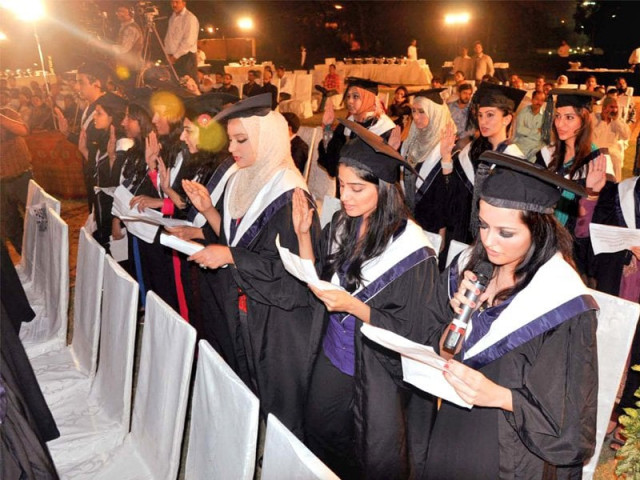
The first group of 25 foreign students graduated Thursday night at Dow International Medical College. Flanked by their professors and the vice chancellor, the students took the Hippocratic Oath at the ceremony held at the Governor’s House. PHOTO COURTESY: ARIF HUSSAIN
LAHORE:
An unusual drop in admissions to private medical and dental colleges has exposed a growing affordability crisis in the country, prompting the Pakistan Medical and Dental Council (PMDC) to allow a one-time relaxation of merit to fill dozens of vacant posts.
According to a notification, the minimum merit for MBBS admissions has been reduced from 55 per cent to 52 per cent, while for BDS programs it has been reduced from 50 per cent to 47 per cent. The decision will apply only to vacant positions and will not become a permanent policy.
The move comes after several private universities, particularly in Lahore and other major urban centres, failed to fill their allotted seats despite completing regular admission rounds.
Sources in the education sector revealed that institutions had been struggling to attract students mainly due to high tuition fees, which had placed medical education out of reach for many middle-income families.
A PMDC official, requesting anonymity, said the regulator had limited options as the situation risked causing financial strain on institutions and reducing opportunities for aspiring doctors. “This is not about lowering standards permanently, but rather a one-time, specific adjustment to ensure that available places are not wasted while maintaining a reasonable academic threshold,” the official explained.
Research suggests that the cost of pursuing an MBBS degree from private universities has increased significantly in recent years. Annual fees running into millions of rupees, combined with additional expenses, have deterred even academically eligible candidates from applying.
Educational analysts argue that the issue has less to do with merit and more to do with financial accessibility.
A senior official at the Punjab Higher Education Department said this reflects a deeper imbalance in the system. “We are seeing a clear mismatch between supply and affordability. Private universities have capacity but students cannot pay the fees. This forced the regulator to intervene, but long-term solutions will require rationalization of fees,” the official said.
The PMDC has made it clear that the relaxed merit will be applied only after exhausting the existing pool of qualified candidates. Universities will not be allowed to bypass standard procedures and all admissions must be done strictly on merit and in a transparent manner.
In its directive, the council also recommended private medical and dental colleges to review their fee structures and consider reductions to make education more accessible. The regulator has warned that the entire admission process will remain under strict monitoring to avoid misuse of relaxation.
Stakeholders believe the decision highlights growing concerns about the commercialization of medical education. In recent years, rising operating costs and growing demand for quality facilities have driven up tuition rates, but critics argue that the lack of effective regulation has allowed prices to rise uncontrollably.
Parents and students have expressed mixed reactions. While some see merit reduction as a good opportunity for those who narrowly missed the previous threshold, others fear that it could affect the quality of future healthcare professionals if not handled carefully.
Punjab Department of Medical Education and Specialized Healthcare has sent a letter to PMDC Chairman regarding 3% reduction in MDCAT threshold.
The PMDC notification was reviewed by the Provincial Admissions Committee, which expressed reservations over the reduction in merit percentage for admission to MBBS and BDS.


