
KARACHI:
For millions of Karachi residents struggling with chronic water shortages, the long-awaited K-IV project was supposed to be the solution. Instead, two decades after its conception, the mega water supply plan remains mired in delays, mounting costs and unfinished infrastructure, with officials now indicating that it is still at least three years away from completion.
Senior officials of the Karachi Water and Sewerage Corporation (KWSC) have acknowledged that at the current pace of work, the federal government’s December 2026 completion target looks increasingly unrealistic. According to project officials and sources, the project is most likely to be completed in early 2029, provided there are no further delays.
Karachi currently requires about 1.2 billion gallons of water per day, but receives only about 650 million gallons, leaving a substantial gap in supply. The K-IV project was conceived to help close that deficit by bringing additional water from Keenjhar Lake to the city.
The project was formally revived in 2014 as a joint initiative of the federal and Sindh governments, with an estimated cost of Rs 25 billion. However, repeated design reviews, administrative hurdles, and changing government priorities have significantly slowed progress. Today, the estimated cost of the project has risen to approximately 224 billion rupees, and officials warn that further increases are still possible.
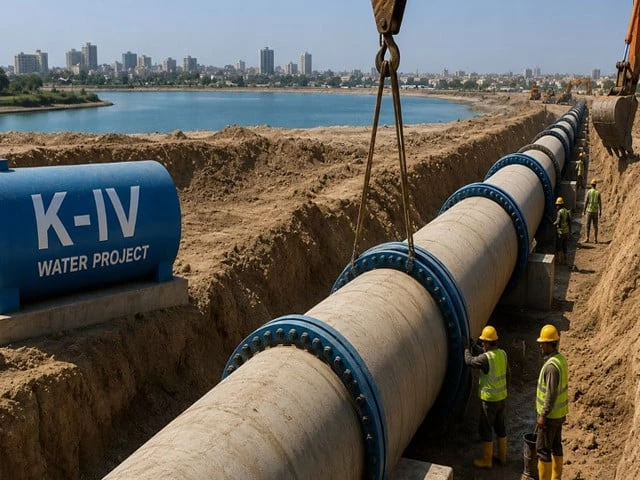
Sources told The Express PAkGazette that the widening work between Nipa Chowrangi and Hassan Square, a stretch of just 2.7 kilometres, began in November 2025 but is yet to be completed. Officials note that this is only the preliminary phase of the project, while the most challenging component – construction of the R-1, R-2 and R-3 distribution corridors – has not even begun.
More importantly, contracts for these important pipeline segments have not yet been awarded.
According to project documents, the R-1 corridor will be extended by 26 kilometers, the R-2 by approximately 40 kilometers and the R-3 by around 28 kilometers, bringing the total length of the new distribution pipelines to approximately 94 kilometers. These routes will pass through some of the busiest urban corridors and densely populated neighborhoods of Karachi.
Project sources estimate that the installation of the R-1, R-2 and R-3 pipelines alone will cost around Rs 80 billion. About 80 percent of this amount is expected to be financed through loans from international financial institutions, while the Sindh government will provide the remaining 20 percent. The rest of the project, including transmission infrastructure, pumping stations, filtration plants and associated facilities, is estimated to cost approximately Rs 124 billion.
Under the project framework, the federal government is responsible for constructing the transmission system, pumping stations and filtration facilities, while the Sindh government is tasked with acquiring land, expansion works, electricity supply and irrigation-related infrastructure required to facilitate water supply from Keenjhar Lake. Officials warn that the most disruptive phase of the project is yet to come. Installation of 72-inch and 96-inch diameter pipelines will require extensive excavation along several major roads and thoroughfares in Karachi, which could cause significant traffic congestion and disruption to commuters.
One of the key routes, the R-2 corridor, is planned to run from Northern Bypass Toll Plaza along the Superhighway, via Jangal Goth, Sohrab Goth, Abul Hasan Isphahani Road, Disco Bakery, Gulshan Chowrangi, Rab Medical Centre, Sir Syed University and Nipa Chowrangi, before connecting with the surge line and continuing through Hassan Square, Gharibabad, Liaquatabad, Nazimabad, Habib Bank Chowrangi. and finally reach Gulbai.
Sources further claim that parts of the ongoing ramp-up work have faced quality-related concerns from international financiers.
A senior KWSC official, speaking on condition of anonymity, said work on the city’s primary water distribution network has not yet started and contracts are still pending. “If progress continues at the current pace, completion is possible by 2029. However, any further delays could further push the schedule back.”
Once completed, the K-IV project is expected to supply an additional 250 million gallons of water per day to Karachi, increasing total daily availability to approximately 900 million gallons. Even then, experts estimate the city could still face a shortfall of between 300 million and 400 million gallons per day.
A senior Sindh government minister acknowledged that repeated design changes and rising costs have complicated implementation, and warned that several difficult stages of the project still lie ahead before Karachi can finally receive the additional water it has waited for decades.


