
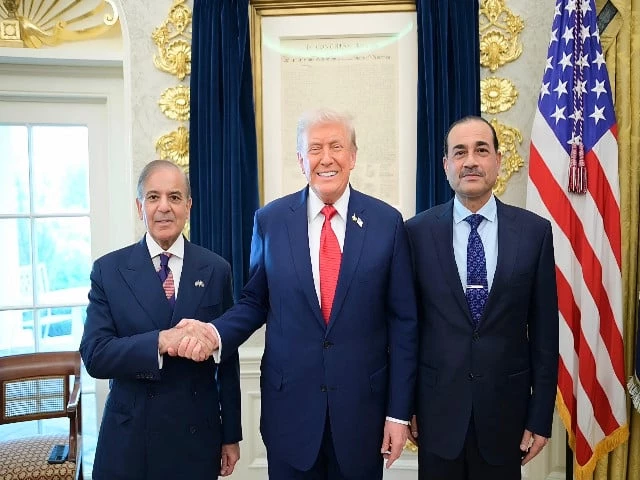
The country sees improving ties with the United States as it emerges as a key party taking on mediation efforts in the Middle East amid regional tensions.
Prime Minister Shehbaz Sharif and Field Marshal Asim Munir meet with US President Donald Trump at the White House in Washington DC on September 25, 2025. Photo: Handout
A year after the military standoff between Pakistan and India triggered by the Pahalgam attack in Indian illegally occupied Jammu and Kashmir on April 22, 2025, Pakistan’s international profile has seen a notable change, according to an article in The diplomat.
Following the attack, which New Delhi had blamed on Pakistan and Islamabad repeatedly refuted the allegation, India launched “Operation Sindoor” on the night of May 6-7, saying it would target militant training sites in the country in an 88-hour military operation. Pakistan responded with ‘Operation Bunyan-un-Marsoos’, which escalated tensions between the two nuclear-armed neighbors and triggered global concern.
While India subsequently stepped up efforts to diplomatically isolate Pakistan over allegations of cross-border militancy, the report noted that Islamabad’s global standing had since undergone an unexpected recalibration.
Read more: Pakistan exposes Indian aggression and lies in historic victory, releases dossier
In recent months, Pakistan has drawn international attention for its involvement in mediation efforts between Iran and the United States amid the Middle East crisis. The report stated that Islamabad had hosted an indirect meeting between the two sides on April 11 and 12, with The economist describing Pakistan as a “skilled handler of global power politics” in April 2026.
The publication suggested that Pakistan’s renewed diplomatic relevance had been shaped in part by shifting global priorities, including less international focus on the dynamics of post-9/11 terrorism and competing crises such as the Russia-Ukraine war and instability in the Middle East.
He noted that although Pakistan had long faced accusations of allowing militant groups to operate within its territory, the international response to India’s accusations after the Pahalgam attack had been comparatively muted, reflecting changing geopolitical priorities.
Also read: Pakistan never requested ceasefire: DG ISPR
The diplomat He further noted that the fallout from Operation Sindoor also contributed to internal political consolidation in Pakistan, strengthening the position of Chief of Army Staff General Asim Munir. Following the conflict, he was elevated to field marshal in May 2025 and subsequently appointed Chief of the Defense Forces in December 2025 under a constitutional amendment aimed at unifying military command.
The report further stated that Pakistan’s engagement with the United States had improved under the current administration, with Islamabad credited with facilitating diplomatic rapprochement during ceasefire discussions in West Asia. Pakistan was also included in international diplomatic initiatives related to Gaza stabilization efforts.
According to the report, relations between Pakistan and the United States were further influenced by growing strategic interests, including critical minerals and regional security cooperation.
Read more: French intelligence official confirms Pakistan’s downing of Rafale
However, The diplomat He underlined that Pakistan continued to face significant internal challenges, including political instability, economic pressure and security threats. He noted current tensions between civil institutions and the military, restrictions on political dissent and the imprisonment of former Prime Minister Imran Khan since 2023.
The report added that while Pakistan had secured continued financial support from the International Monetary Fund, economic vulnerability persisted, particularly amid regional instability and challenges in resource-rich regions like Balochistan.
A Washington-based assessment cited in the report warned that Pakistan’s strategy of leveraging international diplomatic prominence to stabilize domestic conditions remained uncertain, adding that future political and economic pressures could intensify if current trends reverse.


