
ISLAMABAD:
The federal government’s plans for a 28th constitutional amendment appeared to run into early political resistance on Thursday after the Pakistan People’s Party (PPP) said it had not been consulted on any proposed constitutional changes, signaling fresh tensions within the ruling coalition over key legislative issues and the upcoming federal budget.
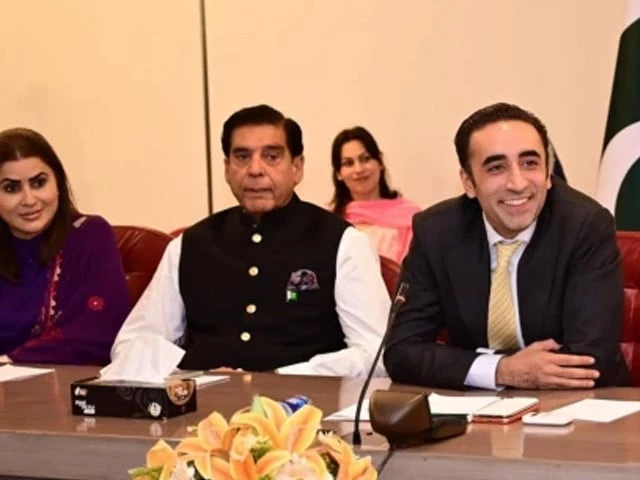
Speaking to reporters at the National Assembly after chairing a meeting of the PPP parliamentary party, PPP Chairman Bilawal Bhutto Zardari said that while he and President Asif Ali Zardari remained in touch with Prime Minister Shehbaz Sharif, the government was yet to formally engage the PPP on any new legislative plan.
He also underlined the party’s central role in the coalition’s parliamentary strength, warning that constitutional amendments and budget approval would not be possible without the PPP’s support.
“The government has not approached the PPP regarding any new constitutional amendment,” Bilawal said, adding that the party had not been given confidence on the matter.
Bilawal stressed that the PPP remained indispensable to the coalition’s parliamentary strength, stating that no major laws could be passed without the party’s support.
“The PPP has not been consulted on the 28th amendment. The public is being crushed by inflation and the upcoming budget will bring more difficulties. Without the support of the PPP, constitutional amendments and passage of the budget are impossible. The PPP will not support any amendment without my approval,” Bilawal added.
His comments come at a time when any constitutional amendment would require a two-thirds majority in Parliament, making support from coalition partners critical to the government’s legislative agenda.
In this context, the PPP Chairman’s statement has added uncertainty to speculation surrounding the proposed 28th Amendment and has highlighted the importance of internal coalition consensus before moving forward with sensitive constitutional changes.
Although the details of the proposed 28th amendment have yet to be formally shared, discussions around the reported proposal have largely been seen through the lens of center-province relations and fiscal distribution issues.
The PPP has historically opposed any measures perceived to undermine provincial autonomy or reduce the proportion of constitutional protections available to smaller provinces in the post-18th Amendment framework.
Referring to the 26th and 27th constitutional changes, Bilawal said the PPP had played a central role in previous constitutional reforms while ensuring the protection of provincial rights.
“We did not allow the rights of the provinces to be reduced, but expanded them,” he said, citing greater representation of Balochistan in the Senate.
The PPP chairman also warned that the country was facing worsening economic pressure amid rising inflation, and said the next federal budget would likely bring more hardship for the public. He said the PPP had consistently pressured the government to adopt relief-oriented measures and raised inflation-related concerns at both the federal and provincial levels.
In a move reflecting the party’s growing interest in budget negotiations, Bilawal announced the formation of a four-member PPP committee to hold talks with the government on the upcoming federal budget proposals.
The committee comprises former Prime Minister Raja Pervaiz Ashraf, Senator Saleem Mandviwalla, Sherry Rehman and Naveed Qamar, and is expected to come up with the party’s recommendations aimed at easing economic pressure on the public.
Bilawal also reiterated the PPP’s long-standing position on accountability reforms, stating that the party had historically supported the abolition of the National Accountability Bureau (NAB).
However, he said the PPP had backed recent amendments to the NAB Act due to political and legislative duress, while warning that the party could review its position if commitments made by the government were not met.


