A historically strong earthquake struck off the northwest coast of Cuba on Monday, according to official reports, shaking parts of Cuba, Mexico and Florida that are not normally prone to earthquakes.
The United States Geological Survey (USGS) measured the earthquake as having a magnitude of 6.1 at a depth of 26 kilometers (16 miles) and its epicenter 104 kilometers west-northwest of Mantua, Cuba, about two to four hours’ drive from the capital, Havana.
Monday’s earthquake was unusual for this area of the Caribbean, said Paul Earle, a USGS seismologist, noting that the quake occurred within a tectonic plate, where earthquakes tend to be more dispersed and less frequent than when they occur along plate boundaries.
An earthquake of this strength had not occurred within 200 miles (322 kilometers) of Monday’s quake since 1880, when a 6.0 tremor struck near San Cristobal, Cuba, Earle said.
Authorities have not yet reported major damage or casualties, but the earthquake raised concern in Cuba, where decades of economic crisis have left buildings in serious disrepair. Continuing widespread blackouts across the region have made communications difficult.
“I felt strong. I had never felt anything like this,” said Yusmila Hernández, 44, at her home in Pinar del Río, western Cuba.
“People ran away, all scared. I can’t even explain it. It was like an earthquake had never been felt here before,” Hernandez said.
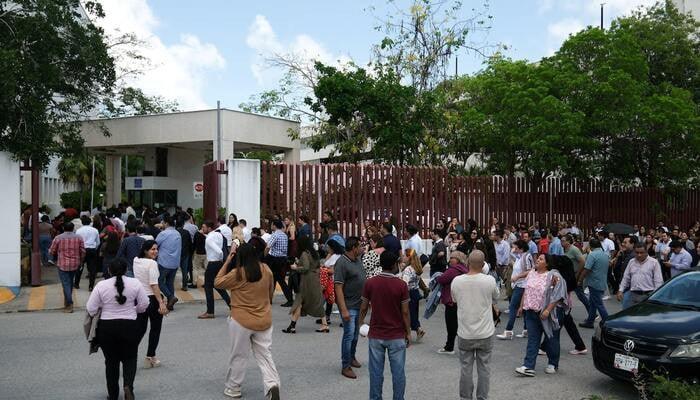
The USGS reported that tremors were also felt in Florida. In Mexico, the earthquake was felt in the resorts of Cancun, Playa del Carmen and Tulum on the Yucatan Peninsula. Residents and workers in the Cancun city center, not accustomed to strong earthquakes, evacuated buildings.
Emergency protocols were activated in the Mexican states of Yucatán and Quintana Roo, but there were still no reports of damage, both state governors said on social media.
According to the U.S. National Weather Service, no tsunami watch or warning was issued after the earthquake.