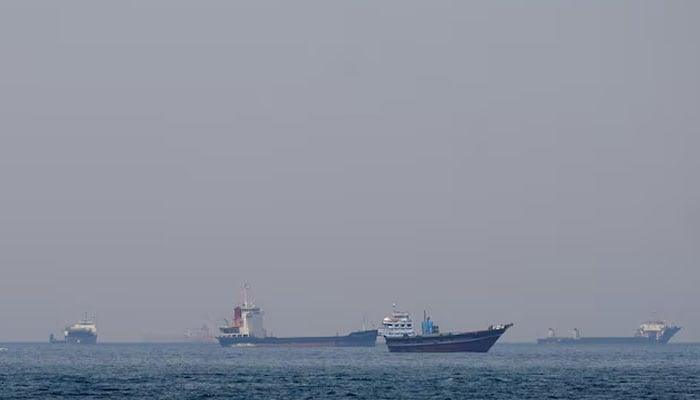
- The Pentagon says US forces boarded a tanker carrying Iranian oil.
- It says it will continue with the application of maritime measures against illicit networks.
- The ceasefire only makes sense if it is not violated by the blockade: Ghalibaf.
TEHRAN: President Donald Trump on Thursday ordered the U.S. Navy to destroy any Iranian ships caught laying mines in the Strait of Hormuz, putting more pressure on a fraying ceasefire as the breakdown in the Gulf standoff hits the global economy.
Trump’s announcement came after the U.S. fleet boarded a ship in the Indian Ocean carrying oil from Iran and after a senior Iranian official said Tehran had banked its first revenue from tolls it imposes on shipments through the strait.
With plans to resume peace talks in Pakistan on the line, more fuel-hungry airlines canceled flights, oil prices rose once again and S&P’s closely watched Global PMI index showed eurozone business activity contracting for the first time in 16 months.
“I have ordered the United States Navy to shoot and kill any ship, no matter how small… that is putting mines in the waters of the Strait of Hormuz,” Trump posted.
Iran promised it would keep the strait closed to all but a few approved vessels as long as the US Navy blockades its ports, ignoring Trump’s demands to reopen Hormuz and hand over its enriched uranium.
The United States responded to Iran’s action by imposing its own blockade of Iranian ports, and on Thursday the Pentagon announced on social media that US forces had “conducted a maritime interdiction and boarding with right of visitation of the sanctioned stateless ship M/T Majestic
The post included images of US military personnel rappelling from helicopters onto the deck of a large tanker truck.
The statement said the United States would “continue to pursue global maritime measures to disrupt illicit networks and interdict vessels providing material support to Iran, wherever they operate.”
‘It’s not possible’
While attacks in the region have mostly ceased since the two-week truce began, there has been no let-up in the confrontation over Hormuz, with both sides seeking economic leverage, only for Trump to announce an indefinite ceasefire to create space for more talks.
“A complete ceasefire only makes sense if it is not violated by a naval blockade,” said Iranian parliament speaker Mohammad Bagher Ghalibaf, who led Tehran’s delegation to a first round of talks in Pakistan.
“Reopening the Strait of Hormuz is not possible in the midst of a flagrant violation of the ceasefire.”
Ghalibaf’s deputy, Hamidreza Hajibabaei, said Iran received its first revenue from tolls it is imposing on ships trying to cross Hormuz, a route that in peacetime accounts for a fifth of global flows of oil and gas and other vital products.
Analysts said Tehran, particularly its hardline leaders associated with the Islamic Revolutionary Guard Corps (IRGC), believes Iran’s blockade gives it enough economic leverage to force Washington to back down on its main demands in peace talks.
And some, like Danny Citrinowicz of the Tel-Aviv Institute for National Security Studies, criticized Israel and the United States for misinterpreting the Iranian government’s position.
“Tehran has consistently demonstrated its willingness to absorb economic pain while standing firm on what it views as core national interests. There is little reason to believe this time will be different,” he said in a social media post.
“Rather than moving toward a concession, Iran is positioning itself for escalation.”
A report by the Soufan Center think tank said Iran hardliners “argue that a prolonged rise in global energy prices and growing global shortages of some goods will put increasing pressure on Trump to accede to Iran’s positions, end the war and eventually withdraw U.S. forces from the region.
“Trump and his team calculate the opposite: that the US blockade of Iran’s maritime trade, which carries all of its oil exports, will quickly cripple Iran’s economy and force Iran to accept US demands.”
peace talks
On Wednesday, Trump told New York Post that talks could resume in Pakistan within two or three days, even though Iran has not confirmed its participation and Vice President JD Vance suspended his trip to Islamabad on Tuesday.
Iran’s Revolutionary Guard said Wednesday it forced two ships to reach the Iranian coast from the Strait of Hormuz.
The US military’s Central Command said before Thursday’s announcement that its forces blockading Iran’s ports had so far “ordered 31 ships to turn around or return to port.”
After agreeing to a ceasefire with Iran, the United States helped broker a truce between Israel and Lebanon, including Hezbollah.
Despite the declared truce, Israeli strikes killed five more people on Wednesday, Lebanese media said.
Israel and Lebanon will hold a second round of talks in Washington on Thursday, during which Beirut will ask during the meeting for a one-month extension of the ceasefire, according to a Lebanese official.
Israeli attacks on Lebanon have killed more than 2,450 people since the start of the war, according to Lebanese authorities.