
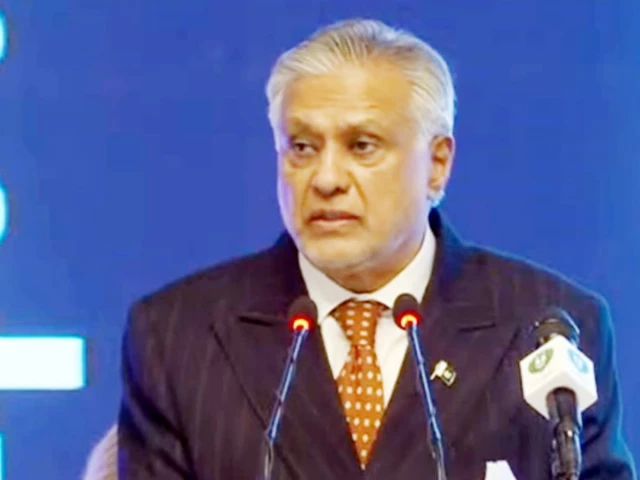
Deputy Prime Minister and External Affairs Minister Mohammad Ishaq Dar on Tuesday warned India against any attempt to undermine the Indus Waters Treaty (IWT), saying it could have serious consequences for the region and the broader international order.
For more than six decades, India and Pakistan amicably managed the Indus river system through the IWT cross-border water sharing agreement signed on September 19, 1960. In April last year, India suspended the treaty in the wake of the Pahalgam attack.
Addressing the inaugural session of an international seminar titled “The Indus Waters Treaty: A Key Instrument for Regional Peace and Stability” at the Jinnah Convention Center in Islamabad, Foreign Minister Dar said any attempt to deprive Pakistan of its legal water rights under the treaty would have profound consequences for peace and security in South Asia, home to nearly two billion people.
“If international agreements can be ignored whenever they are politically inconvenient, confidence in the international legal order is inevitably weakened. The sanctity of treaties is one of the foundations on which peaceful relations between States are built.”
He explained that the implications extended “far beyond South Asia.”
Read: “We are talking about our lifeline, not a treaty,” says Tarar at IWT seminar
Detailing the fears Pakistan had over non-compliance with the IWT, he said that since April 2025, the country had seen a pattern of objectionable measures taken by India, including “abrupt variations” in the flow of the Chenab and Jhelum rivers, as well as continued efforts to expand infrastructure capable of regulating the flow of the western rivers.
“Such transgressions in international relations set dangerous precedents, damage national credibility and challenge the foundations of interstate cooperation.”
For Pakistan, he said, this is not simply a legal debate, as water is the livelihood of more than 250 million people.
Foreign Minister Dar emphasized that agriculture, food security, energy production and broader economic development depend on the uninterrupted flow of the three western rivers allocated to Pakistan.
“Protecting these waters is a matter of vital national interest,” he stressed.
The deputy prime minister advised India to avoid actions that could escalate tensions and said New Delhi should refrain from “sowing the seeds of war” and putting the peace and stability of more than 2 billion people at risk.
Also read: Zardari urges India to fully restore inland navigation, warns against ‘weaponizing water’
He said lasting peace in the region could only be achieved through dialogue, diplomacy and treaty mechanisms established to resolve outstanding disputes, rather than through the use or threat of force.
Highlighting Pakistan’s efforts to ensure peace in the region, Dar said the country had consistently adhered to those principles and would continue to do so; However, lasting peace depends on mutual respect, sovereign equality and faithful compliance with international obligations.
He reiterated that any attempt to deprive Pakistan of its legitimate river rights under the treaty would be met with stiff opposition.
The treaty, negotiated over several years, was aimed at ensuring fair and effective use of water resources shared by both countries, the DPM said, while maintaining that Islamabad did not seek confrontation or war, but would not accept any illegal diversion or encroachment on its share of water bodies.
Pakistan will use all legal and diplomatic avenues available under international law to safeguard its rights and interests, he further stated.
“We respect international law and treaties.”
Recalling India’s illegal suspension of the IWT, Foreign Minister Dar said the National Security Committee, comprising civil and military leaders, had unanimously decided to term any attempt to divert Pakistan’s share of water, stop its flow or curtail its legal water rights as “an act of war”.
He said the decision reflected national consensus and reaffirmed the country’s determination to protect its water rights.
Read more: Dar writes to UN Security Council calling for action on India’s attempts to alter river flows
Dar also said Pakistan had consistently sought to promote peace and stability in the region and had supported efforts to reduce tensions and foster dialogue during the recent US-Iran conflict.
“At a recent Oslo forum, a US envoy called Pakistan the provider of network security in the region,” he noted.
Pakistan’s foreign policy is based on mutual respect, equality and peaceful relations with all countries, Minister Dar said, adding that the United Nations Security Council has the responsibility of maintaining international peace and security.
He also reminded India that the country held the presidency of the UN Security Council and continued to support multilateralism and peaceful resolution of disputes.
Foreign Minister Dar stated that the government would continue to seek peaceful, legal and diplomatic means to protect its interests.
“Shared waters should never become weapons,” he concluded.


