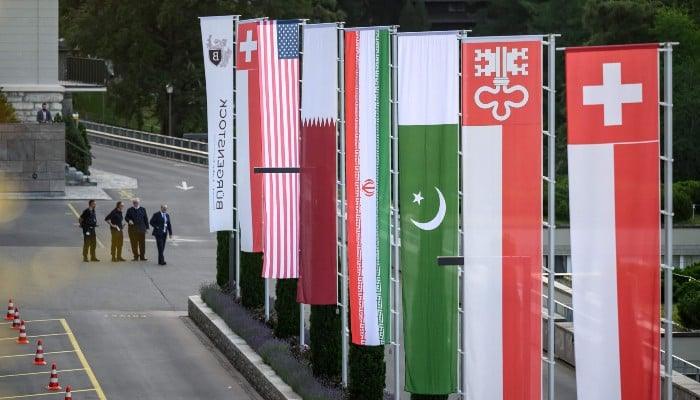
Technical-level talks between the United States and Iran will begin in Switzerland as the parties seek to advance the implementation of the Pakistan-brokered Islamabad Memorandum of Understanding.
Iran demands progress on US commitments and Washington seeks progress on Tehran’s nuclear program and a ceasefire in Lebanon.
The talks in Burgenstock are the first formal engagement since the Islamabad MoU was signed on June 17. The Foreign Ministry said the discussions aim to support the implementation of the agreement and sustain dialogue between Tehran and Washington.
Who represents Iran?
Iran’s delegation is led by Parliament Speaker Mohammad Bagher Ghalibaf and includes Foreign Minister Abbas Araghchi as well as senior security, central bank and oil officials, according to Iranian media.
Tehran says it will push for the United States to implement commitments under the interim deal and seek clarity on how Washington intends to carry them out.
Iranian Foreign Ministry spokesman Esmaeil Baqaei warned that the broader understanding could run into trouble unless the other side takes necessary steps promptly.
Lebanon is also expected to remain a major issue, as Iran argues that continued Israeli attacks threaten the ceasefire framework agreed upon under the broader US-Iran understanding.
Who represents the United States?
US Vice President JD Vance leads the US delegation. He is joined by President Donald Trump’s special envoy Steve Witkoff and Jared Kushner.
Before leaving for Switzerland, Vance said Washington hoped to make progress on Iran’s nuclear program and the ceasefire in Lebanon, two issues he described as central to the talks.
The talks follow a 60-day ceasefire agreement under the interim agreement, and the two sides are expected to address unresolved issues surrounding Iran’s nuclear program and reducing regional tensions.
Why are Pakistan and Qatar attending?
Prime Minister Shehbaz Sharif and Chief of Defense Forces and Chief of Army Staff Field Marshal Asim Munir participate as Pakistan continues its facilitating role in the process that led to the Islamabad MoU.
The Ministry of External Affairs says Pakistan will continue to support the understandings reached between Iran and the United States and the prime minister is expected to hold bilateral meetings with delegations from Iran, Qatar, Switzerland and the United States.
Qatar is also participating in the talks. Doha has supported the diplomatic effort around the US-Iran deal and remains involved in efforts to sustain the regional detente process.
What could derail the talks?
The central challenge remains implementation.
Iran says it needs proof that Washington is complying with the interim deal, while the United States wants progress on the nuclear issue and a ceasefire in Lebanon.
The talks are also taking place amid renewed uncertainty over the Strait of Hormuz. Iran’s Revolutionary Guard has declared the waterway closed, although the US military says commercial traffic has continued.
Continued Israeli attacks in Lebanon and the risk of new exchanges with Hezbollah also remain a major threat to the broader ceasefire framework.