
Focus increasingly shifts towards improving social and human development outcomes in meeting with World Bank: Aurangzeb
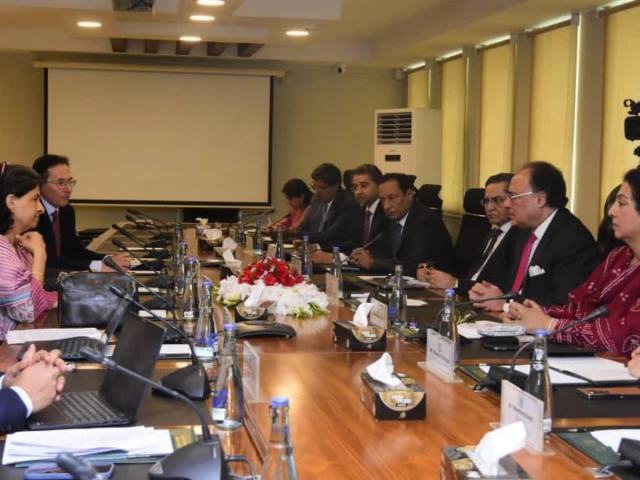
Finance Minister Muhammad Aurangzeb and World Bank delegation discuss human capital development, skills, health outcomes and technology-based service delivery in Islamabad. PHOTO: X
Finance Minister Muhammad Aurangzeb said on Wednesday that improving employability, particularly among youth, would remain central to the government’s economic transformation agenda, as he met a World Bank delegation to discuss technology-driven skills development, healthcare, education and public services.
According to a statement issued by the Ministry of Finance, the minister held talks with a delegation led by World Bank Vice President for Human Development Mamta Murthi on Pakistan’s human capital development priorities, workforce readiness and social sector reforms.
Aurangzeb said Pakistan had made significant progress in restoring macroeconomic stability and was increasingly shifting its focus towards improving social and human development outcomes through investments in health, education, skill development and social protection.
Finance Minister and World Bank discuss human capital development, skills, health outcomes and technology-based service delivery
Federal Minister for Finance and Revenue, Senator Muhammad Aurangzeb held a meeting at the Finance Division with a delegation from the World Bank Group led by Ms… pic.twitter.com/ghcf3IE9o4
– Ministry of Finance, Government of Pakistan (@Financegovpk) June 3, 2026
Describing Pakistan’s large youth population as a huge opportunity and a key policy priority, he highlighted the need to improve human capital indicators, increase labor force participation and equip youth with skills aligned with changing labor market demands.
The Finance Minister underlined the importance of upskilling and reskilling the workforce to meet emerging economic requirements, improve job readiness and create pathways to higher-value jobs. He said sustained economic growth and competitiveness would require continued investment in people along with reforms aimed at boosting productivity, improving service delivery and creating jobs.
Aurangzeb also emphasized the need to maintain a strong focus on measurable results and effective implementation under the World Bank’s Long-Term Country Partnership Framework for Pakistan.
The meeting reviewed key elements of Pakistan’s human development agenda, including maternal and child health, nutrition, immunization, early childhood development, educational outcomes and population-related challenges.
Also read: US proposes tariffs on goods from 60 economies, including Pakistan
Murthi said long-term development progress would depend on improvements in critical human capital indicators, particularly child nutrition, reduction of stunting, fundamental learning and access to quality healthcare and education.
He said the World Bank’s engagement in Pakistan focused on supporting measurable outcomes and strengthening service delivery systems to ensure that essential interventions effectively reached mothers and children across the country.
The two sides also discussed strengthening primary health care systems, expanding access to essential services for mothers and children, and leveraging artificial intelligence and digital technologies in healthcare, education and workforce development.
Aurangzeb said Pakistan must prepare its workforce for a rapidly evolving global economy, while the World Bank delegation shared international experiences in technology-based service delivery, healthcare financing and private sector engagement.
Read more: Government approves Rs 4.3 trillion development plan
Discussions also focused on workforce development, technical and vocational training, and employment-oriented skills programs. Participants highlighted the importance of stronger industry links, greater private sector involvement in training initiatives and better alignment of skills programs with labor market needs.
The meeting also explored opportunities for broader collaboration between the government, the World Bank Group and the private sector to advance Pakistan’s human capital objectives.
Murthi invited Pakistan to participate in a global forum on Universal Health Coverage, scheduled to be held in Japan later this year and jointly supported by the Japanese government, the World Bank Group and the World Health Organization.
Both sides reaffirmed their commitment to continue cooperation in health, education, social protection, workforce development and technology-based service delivery.


