
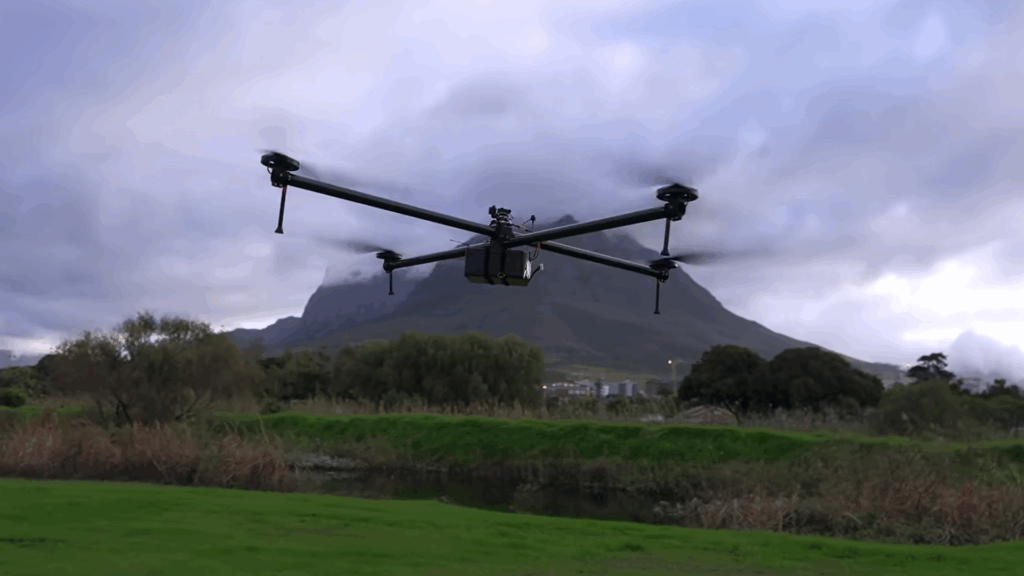
- Custom drone achieved 261-minute flight after months of engineering improvements
- Guinness World Records recognizes Cape Town pilot for record-breaking multirotor endurance flight
- Software tweak unlocked crucial efficiency gains during historic flight
A YouTuber and drone pilot from Cape Town has achieved a new Guinness World Record after keeping a custom multi-rotor drone in the air for 4 hours, 21 minutes and 39 seconds.
The achievement came after months of redesigns, repeated testing and engineering refinements that transformed an earlier prototype into an officially recognized endurance aircraft.
Rather than relying on a single breakthrough, the record was achieved through a series of hardware and software improvements that steadily extended flight time beyond previous attempts.

Weight reduction and stronger construction allowed for greater strength
Luke Bell had already surpassed the previous resistance point with an earlier version that remained in the air for 3 hours, 31 minutes and 6 seconds, although that attempt was never officially recognized.
Instead of presenting that result, Bell continued to refine the plane with the goal of securing a greater margin and obtaining formal recognition from Guinness World Records.
One of the simplest improvements came after viewers suggested replacing the two-piece clamp mounts with one-piece C-style clamps, reducing the overall weight by about 26 grams.
Bell also rebuilt the airframe using 1.88 meter continuous carbon fiber tubes for each rotor arm, eliminating weak connection points that plagued the previous design.
Additional reinforcement connected the front rotor arms, while a custom mounting system secured the approximately 5kg high-density SMC battery pack rated at 380Wh/kg throughout the extended flight.
The drone also received a specially designed 3D printed landing gear that incorporates thermoplastic polyurethane joints to absorb landing forces more effectively.
Live software tweak helped extend record flight
Mechanical improvements alone did not cut it because early test flights revealed vibrations severe enough to interfere with the flight controller’s inertial measurement units.
Bell replaced the original controller with a Cube Orange Plus system with isolated internal IMUs before installing an external antenna connected to a Here4 base unit for real-time kinematic positioning with 1-centimeter accuracy.
Other adjustments focused on the autopilot, where tuning the notch filter removed the resonant frequencies responsible for instability while reducing unnecessary power consumption during flight.
Bell also monitored live performance via a Wi-Fi connection connected to a RadioMaster transmitter, allowing power logs and flight settings to be reviewed while the aircraft remained in the air.
The data showed that the drone consumed about 500W during straight flight, compared to about 450W while turning, resulting in a mid-flight course change with more frequent turns.
Flying at about 5.5 meters per second, or about 20 km/h, the drone finally returned after 4 hours, 21 minutes and 39 seconds before hovering until almost all of the remaining watt was consumed.
This feat shows that larger batteries alone may not determine endurance, as careful engineering, software refinement, and efficiency improvements also played important roles.
Via Luke Máximo Bell (YouTube)
Follow TechRadar on Google News and add us as a preferred source to receive news, reviews and opinions from our experts in your feeds. Be sure to click the Follow button!
And of course you can also follow TechRadar on TikTok for news, reviews, unboxings in video form and receive regular updates from us on WhatsApp also.


