
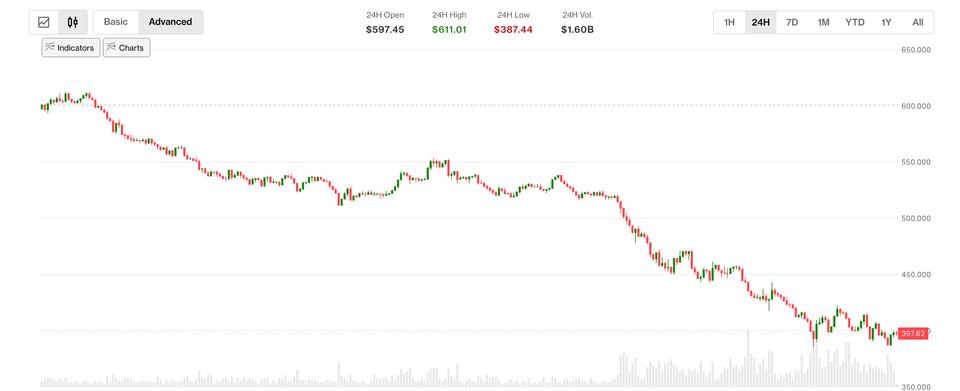
Privacy-focused Zcash (ZEC) has taken a beating in the past 24 hours, falling roughly 30% to $400 amid broader market weakness. The sale was accelerated after Shielded Labs, a nonprofit Zcash developer, disclosed a critical vulnerability in blockchain privacy group Orchard that could have threatened the integrity of the token’s supply.
Late Thursday, Shielded Labs published a detailed disclosure about X, revealing a vulnerability that, if exploited, could have allowed an attacker to create an unlimited number of counterfeit ZEC tokens, undetected. Think of it like someone secretly gaining access to the Federal Reserve’s dollar printing press, except in this case, not even the Federal Reserve would be able to know that those extra dollars were printed.
The vulnerability was discovered on May 29 by Taylor Hornby, a security engineer hired by Shielded Labs in April 2026 specifically to identify protocol vulnerabilities before malicious actors could do so. Working with Anthropic’s recently released Opus 4.8 AI model, Hornby conducted a very specific review of the Orchard circuit, which is the cryptographic system underpinning Zcash’s most advanced privacy pool.
Shielded Labs said Hornby wrote a complete exploit that, when tested in a local test environment, generated unlimited and undetectable spoofed ZEC. Shielded Labs added that if the same tool had been run on the Zcash mainnet, it would have generated unlimited and undetectable counterfeit tokens in your mainnet wallet.
Imagine an attacker silently printing unlimited counterfeit ZECs and retaining them undetected. The damage to confidence in supply and, by extension, the market value of the token could have been severe.
Hornby immediately disclosed the vulnerability to the Zcash Open Development Laboratory (ZODL), which coordinated an emergency fix on June 1 and closed it within days of its discovery.
Undetected error for four years
Still, what appears to be a proactive approach to correcting mistakes has not impressed markets. This is possibly because, as Shielded Labs itself admitted, the bug had been present since the activation of Orchard in May 2022. In other words, it existed, undetected, for four years.
Making the situation even more complex for markets is Shielded Labs’ admission that it cannot say with certainty whether the bug was exploited before the fix.
“What makes this particularly challenging is that, due to the privacy properties of Orchard and the nature of the bug, there is no definitive way to determine using cryptography alone whether such an exploit occurred before the vulnerability was discovered and fixed. We believe it is important to be transparent about that uncertainty,” the firm said.
Still, he emphasized that the exploitation probably did not occur for several reasons. First, the bug had eluded years of scrutiny by experienced cryptographers. It came to light only with the help of cutting-edge artificial intelligence tools and highly skilled researchers who deliberately worked to find it. And once discovered, it was quickly fixed, leaving little time for anyone to exploit it.
“We think he probably succeeded,” Shilded Labs said of Hornby’s efforts to find the vulnerability before malicious actors could.
However, the organization was careful to add that users should not rely solely on its assessment and proposed a network upgrade that would allow anyone to independently verify the integrity of the ZEC supply. The proposal involves implementing a new protected pool and enforcing turnstile accounting on all coins in the Orchard pool. The firm said it could publish a detailed post on the same topic next week.
He also said he is accelerating security efforts, including continued work with Hornby, a formal verification project aimed at writing a mathematical proof that there are no undiscovered bugs in the Orchard circuit, and new hires for a Chief Security Officer and Cryptographer.


