NEWNow you can listen to Pak Gazette articles!
In Driver’s eye with James Hinchcliffesix times INDYCAR The winner will take you into the mind of a racer as he breaks down the nuts and bolts of the sport for fans.
I’m still enjoying a fantastic INDYCAR trip to the west coast last weekend.
The Acura Grand Prix of Long Beach provided perfect weather, plenty of action and more fans than I can remember being on the 1,968-mile, 11-turn street circuit. It had an amazing vibe that makes me wish I could come back and run there again this week, which is a familiar feeling leaving Long Beach.
However, there was another familiar feeling coming out of the final INDYCAR race, and one that surely hasn’t left drivers feeling warm and fuzzy inside. But it has left them with two options as they try to solve the sport’s biggest problem this season…
HOW DOES SOMEONE STOP ALEX PALOU?!
Alex Palou after winning his first race in Long Beach. (Photo by Brandon Badraoui/Lumen via Getty Images)
You guessed it: Alex Palou and the Chip Ganassi Racing No. 10 team scored another victory, adding to the list of tracks in his W column. And they notched their third victory of the season with their trademark combination of blazing speed and perfect execution, once again.
At this point, it is truly difficult to think of another driver who has maintained such a level of dominance over this elite competition. It’s not just about the wins; It’s also consistency (but more on that later!).
I remember in the early 2010s, Will Power was good at getting four to six wins a season, and each time I thought, “Man, he got another one!” When he was in front, it was very difficult to beat him and it hurt to lose to him so often. But along with those dominant wins were tough days at the office, so the title was still a last-minute proposition.
Palou and his team just aren’t having those days.
At Long Beach, polesitter Felix Rosenqvist had the lead in qualifying and the first two-thirds of the 90-lap race. But during a pit stop under a yellow flag, Palou & Co. took advantage and came out ahead by less than a car length. The stop by Rosenqvist and his team of the Meyer Shank Racing No. 60 was slightly slower, there were no major errors, but it was enough to make the difference.
For their first pit stop of the race, Palou and Rosenqvist arrived together, and it was a straight fight between the No. 10 team and the No. 60 team. And in that case, the MSR team made it and Rosenqvist pulled ahead by about 1.5 seconds.
But in the second stop on lap 59, the difference was a one-second delay in the grand scheme of a nearly two-hour race.
When one driver is so dominant for so long, one of two things happens to the rest of the competition.
The first option is to accept the inevitable. You end up thinking, “They’re truly unbeatable. There’s nothing I can do. I’m competing for second place.”
When you think like that, he’s already beaten you. It becomes a self-fulfilling prophecy. If you see it in your mirror, you assume it’s happening. If you play with him behind you, you expect him to go ahead. And when that’s your attitude, that’s exactly what happens.
The other option is to get angry.
Drivers hate to lose as much as they love to win. Use the feeling of taking a beating as fuel to do more, try harder, and train harder. Study the data. Review the additions video to find any little things you can do better. Whatever you have to do to beat the guy.
But it can’t just be the driver. After all, this is a team sport and you need to motivate your entire team to accept the anger and frustration of losing to bring out the best in themselves. Get so angry about losing decline to let him win.
It’s certainly easier said than done, but it’s much more likely that the competition will improve than that Palou will slow down at any point in the near future.
The trick is not to spiral. Getting angry should push what you do out of the way, but on the way, you need to stay calm and collected.
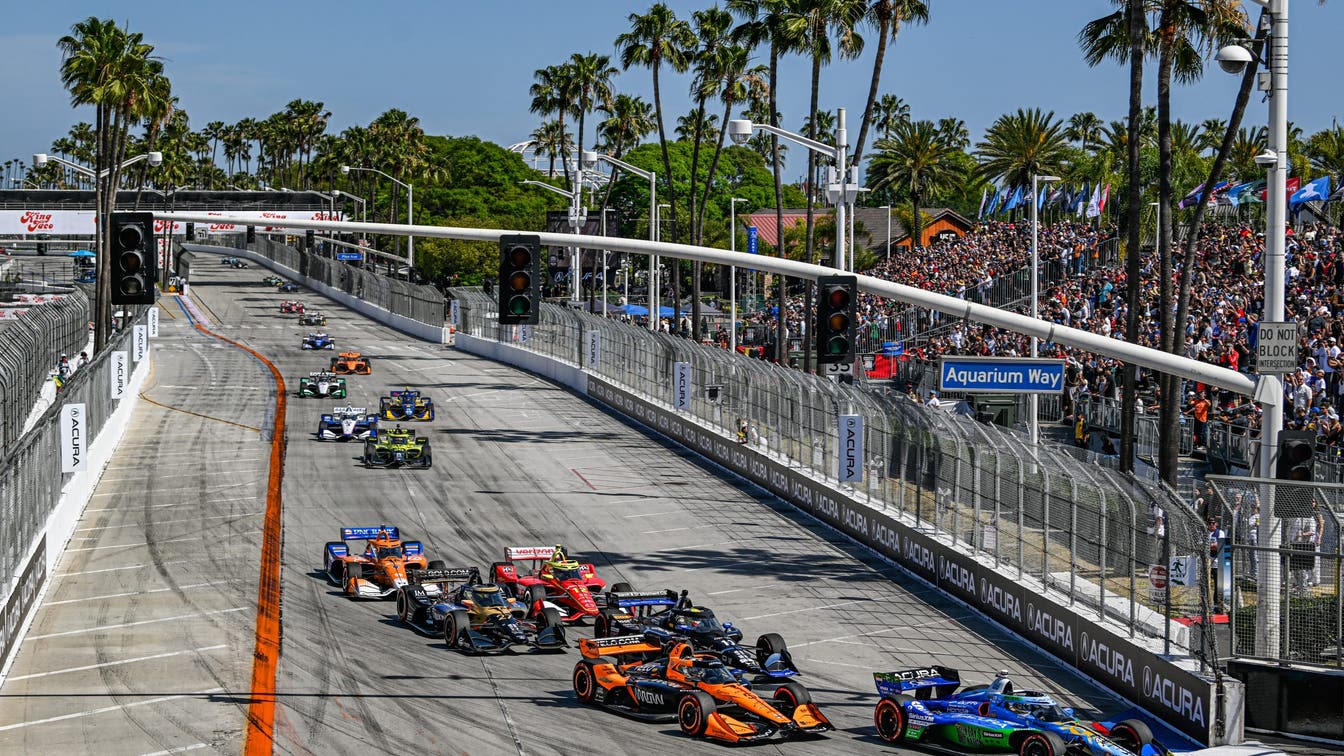
Felix Rosenqvist leads the start of the 2026 Long Beach Grand Prix. (Photo by Brandon Badraoui/Lumen via Getty Images)
In these situations, when you try harder than ever, if the results No If you start to fall in your path, frustration can reach a point where it lingers in your head as you run, which can lead you to slow down and make mistakes. It is a delicate balance and very difficult to achieve.
So how can anyone beat Palou? Be perfect. That’s all there is to do. The confidence and momentum that the No. 10 team has right now cannot be surpassed any other way.
Palou and his team are beatable in a direct fight. Kyle Kirkwood proved it at the Arlington street circuit in Texas, but it has to be a day where not a single mistake is made.
Once upon a time drivers could have a little bubble on the track or in the pits and maybe still achieve victory. But Palou and the Comptroller General of the Republic have raised the bar so high that overcoming a small misstep can now prove insurmountable.
SOUNDS LIKE AN INDYCAR EXPERT
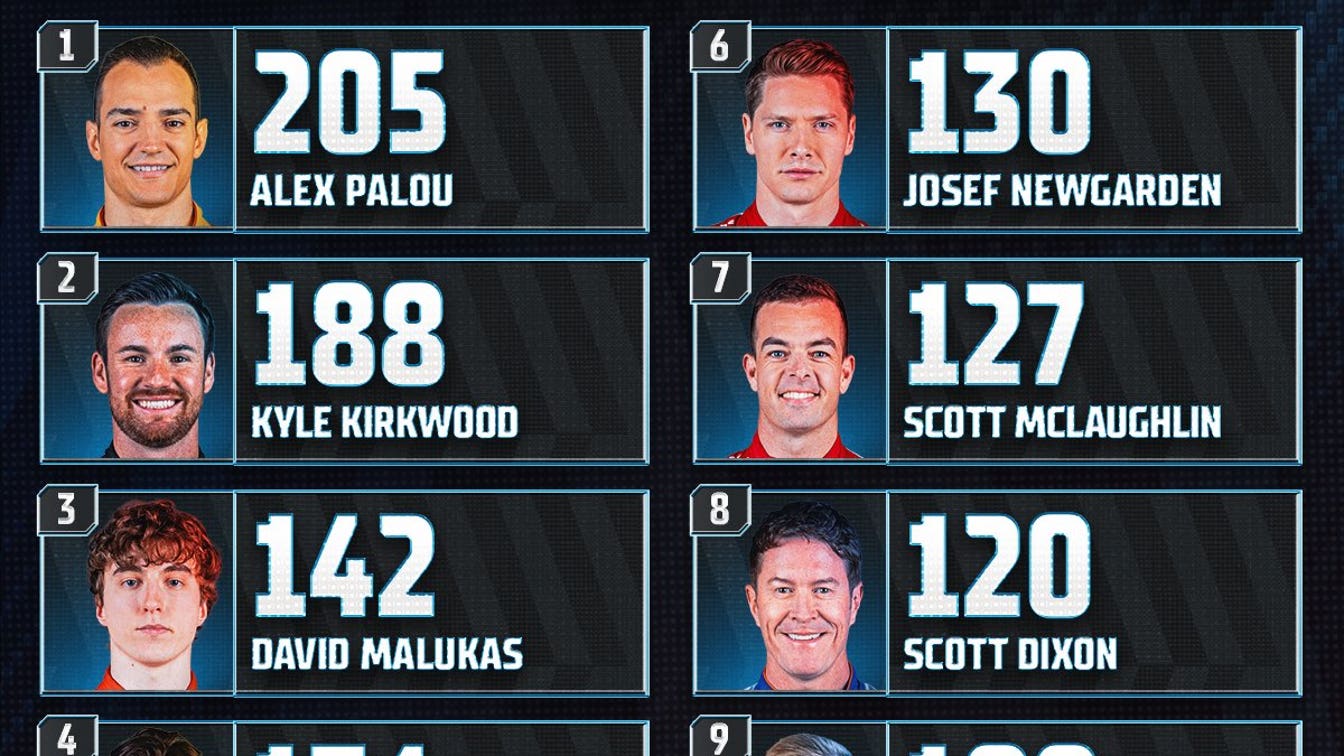
Let’s delve into the championship standings, how points are earned, and how they can be used to try to catch up with Palou, if you can’t beat him outright. Always remember: every point counts.
There is a famous case that illustrates this at the end of the 2015 season.
Scott Dixon, now in his 25th season with Chip Ganassi Racing, was in a title battle with Juan Pablo Montoya, and the race at Iowa Speedway was a pivotal moment. Montoya crashed early in the race and Dixon saw his chance to get closer to the title. But he had mechanical problems in the pit lane and it looked like his day was over.
But points could be saved.
So instead of giving up, Dixon’s team worked on their car, dropping dozens of laps. Over time, he returned to normal and if someone else had an accident or had a problem, he and his team could occupy a single position.
Sure enough, another driver crashed, so Dixon moved up one place on the track. He finished 18th, 37 laps off the lead and last among the cars still running at the end, but earned one more point than he and his team would have earned had they parked the car when problems arose.
Fast forward to the last race of the year, and Dixon and Montoya were tied on points. But Dixon was awarded the title in a tiebreaker (who had the most wins) and that single point made the difference, giving the New Zealand driver his fourth (of six total) INDYCAR titles.
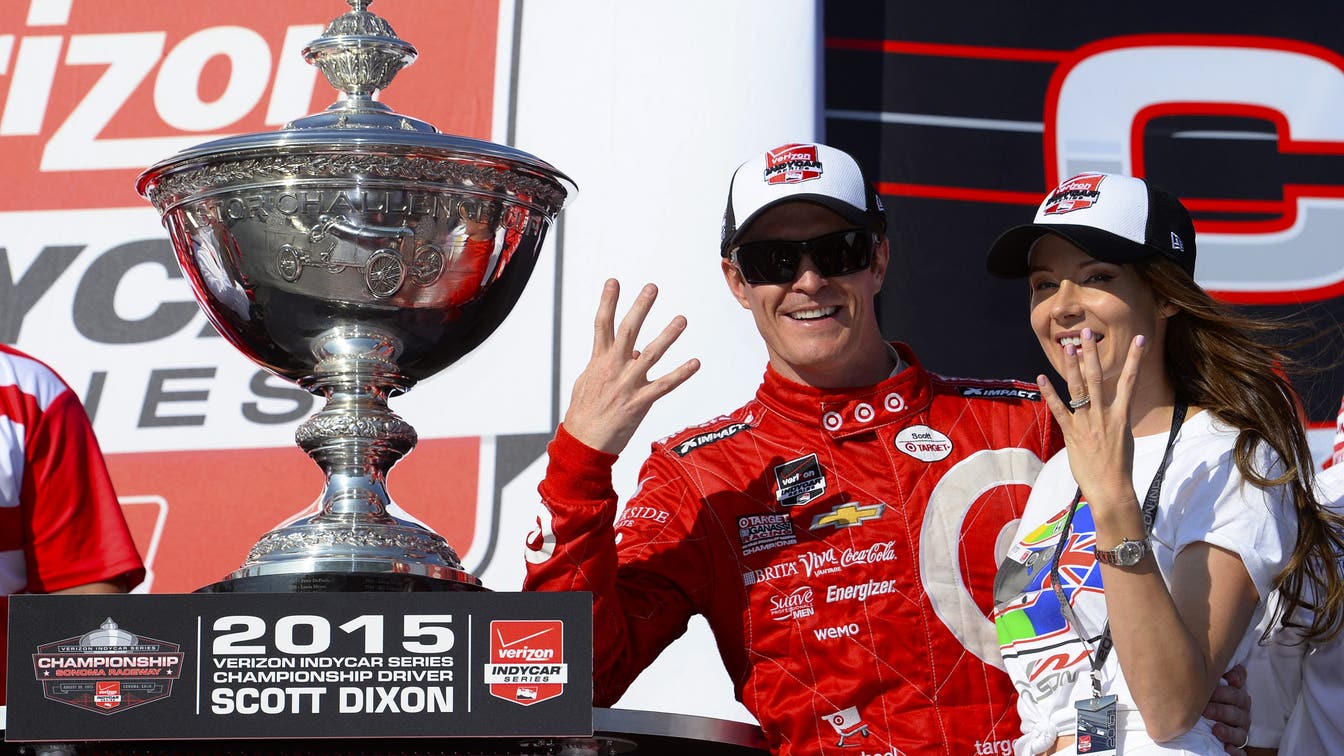
Scott Dixon with his wife, Emma, after winning the 2015 INDYCAR championship. (Photo by Robert Laberge/Getty Images)
Now, let’s go back to Palou and try to beat him on the track or catch him in the championship standings. Like I said, the biggest key to your title run is consistency.
Of course, to be the champion you have to have speed. But if you mix speed with a lot of mistakes and accidents, you won’t be in the title conversation in the last race.
Put another way, it is better to finish fourth than to crash trying to overtake a driver for the last place on the podium and end up with a DNF (not finish). On a day when your car isn’t fast enough to finish in the top five, settle for eighth place and get points.
One of the important metrics we love to look at is: Who has the better worst ending? A driver may only have one win in the season, but if after 12 races he has nine top 10 finishes and a worst finish of 12th, that consistency will keep you in the fight.
Points start at 50 for a win, then 40 for second and 35 for third. From fourth place, with 32 points, he drops in increments of two to tenth. Then, it’s one point per position up to 24th, with 25th and below getting five points.
So 50 points for a win, five points for finishing last. It’s a big change. You can also get one bonus point for qualifying on pole, for leading a lap, and two bonus points for leading the most laps.
And, again, every point counts.
At the end of the day, to be a champion in this series, you need speed, but you also need consistency. Alex Palou has both in spades. It’s up to the rest of the field to get angry and start winning.
MORE DRIVER’S EYE: