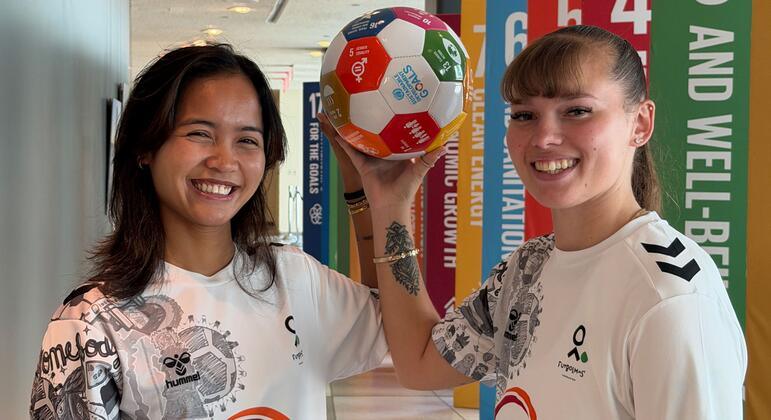
The two young leaders, both former students of Street Child United (SCU), were presenting the United Declaration of the Street Children World Cup 2026, a document developed around football and around the campaign message “I am someone”.
A release, not a pity party
Ms Richards grew up facing difficulties at home that affected her mental health and left her, at times, in risky situations.
Street Child United’s Samantha Richards addresses a UN meeting on football and mental health.
Football changed that trajectory. “When I was a child I had some difficulties at home,” she said. “But football gave me friendships, leadership skills and an outlet to talk.”
Through SCU she met other soccer players seeking an education and followed them, becoming the first in her family to earn a college degree. “Sport is a catalyst for mental health advocacy and it’s okay to speak up when you’re struggling, just like I did,” she said.
Ms. Hifume’s path to New York began in the Philippine foster care system, where isolation led to sadness and loneliness.
“In foster care, it’s very easy to think that you’re just a foster child,” she said. SCU gave him something else: a team to lead, a stage to speak from, and eventually a scholarship to study in the United States and a PhD offer from Oxford University. “Football gave me the gift of curiosity about the rest of the world beyond the game,” he said.
Twenty-eight teams, one declaration
The declaration itself was forged far from the halls of the UN, in Oaxtepec, Mexico, where 28 teams competed in this year’s Street Children’s World Cup.
Delegates from each side drafted and endorsed the text during the tournament, distilling their demands into five priorities: legal identity, education, protection from violence, gender equality and genuine voice in decisions that affect their lives.
SCU is part of the UN’s Football for the Goals initiative, which uses sport to promote the Sustainable Development Goals (SDGs).
Bringing the declaration to New York, co-hosting the World Cup final, days after Ms. Richards spoke on a panel in the General Assembly Hall, gave that grassroots process rare access to a global stage.
The Street Child United organization created the Street Children World Cup. The event brings together children in vulnerable situations to practice sports in the same city or continent where the official World Cup takes place.
It is no longer invisible
For Richards, the moment came full circle. “Being in the Hall of Flags and in the General Assembly was not just about me,” he said. “This was about all the young people who have ever been made to feel invisible. Through football I found my voice and today we showed that our voices belong in these spaces.”
Ms. Hifume formulated this as an argument for investment rather than negligence. “This Declaration aims to ensure that all street-connected children know that they matter,” he said. “When we invest in children, they become leaders.”
Both insist that the real test begins now, once the applause in the Hall of Flags fades.
They want governments and agencies to treat the declaration’s five demands as a checklist, not a souvenir, and to continue listening to street-connected children well beyond the tournament that produced it.
As Ms. Richards said, the statement is based on a simple recognition: “everyone is someone.”
Members of Street Child United visit the UN headquarters.