
KP IG says NATO weapons are used in southern districts that cannot be obtained without help from Afghan government
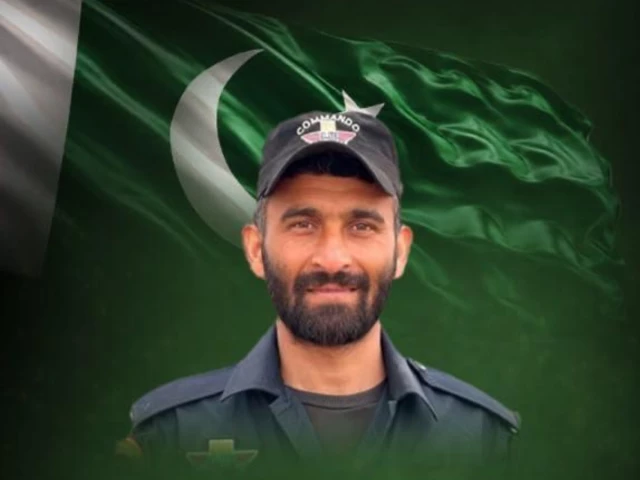
Martyred Elite Force officer Gulfam, who was killed by terrorists during a joint operation in Swat.
PESHAWAR:
An Elite Force constable was martyred while five terrorists were killed during a joint operation of police and Counter Terrorism Department (CTD) in Matta area of Swat district of Khyber-Pakhtunkhwa, Inspector General (IG) of Khyber-Pakhtunkhwa Police Zulfiqar Hameed said on Wednesday.
Addressing a press conference in Peshawar, IG Hameed said the police had received prior information about the movement of terrorists into the area from Afghanistan.
“There were reports of terrorists arriving from Afghanistan,” Hameed said, adding that Afghan terrorists also accompany terrorist groups entering these areas.
Referring to the recent suicide attack in Tank, the police chief said that between 1,200 and 1,400 kilograms of explosives were used in the attack.
On July 23, at least 15 security personnel and a government official were martyred after terrorists belonging to the “India-sponsored” group Fitna al Khwarij” attacked a joint police checkpoint in KP’s Tank district.
Hameed said that the four terrorists killed in the tank attack were Afghan nationals, adding that “according to the investigation so far, none of the four have been established as Pakistanis.”
The IG also drew parallels between the attack on a school in Dera Ismail Khan and the suicide tank attack, saying that “the modus operandi in both attacks was not different.”
He further said that weapons and technology left by NATO are being used in the southern districts, adding that “terrorists cannot obtain all this without the help of the Afghan government.”
Earlier, security sources said that during the Swat operation, four terrorists had taken shelter inside a house and were using members of the house as human shields, complicating security forces’ efforts to clear the area. “The use of civilians as human shields is clear proof of the cowardice and failure of the terrorists,” the sources said.
Security sources further said that the forces had successfully secured control of a strategically important position after engaging the terrorists.
Fitna al-Khawarij is the term that the State uses to refer to terrorists belonging to the banned Tehreek-e-Taliban Pakistan (TTP).
According to the Associated Press of Pakistan (APP)Constable Gulfam Khan Bangash, a resident of Fateh Khan Khel area of Kohat district, was part of an Elite Force unit carrying out an operation against terrorists when he was fatally wounded in an exchange of fire.
Following the clash, security forces cordoned off the area and launched a search operation to locate the terrorists who had fled the scene.
Officials said steps were being taken to transport Bangash’s body to his native village in Kohat, where he would be buried with full official honours.
The recent incidents in KP reflect the continuing security challenges facing the region.
Read: 12 soldiers among 15 martyrs in terrorist attack on security checkpoint at KP’s Tank
On July 13, two police officers were killed and two others injured when a suspected remotely controlled improvised explosive device (IED) hit a police armored personnel carrier during a routine patrol on the Wana-Jandola highway in KP’s Tank district.
On July 3, unidentified attackers carried out two separate acts of sabotage in Bannu district, targeting a government girls’ secondary school and a key link bridge.
Explosives planted inside the Government Girls’ High School in Mama Khel damaged parts of the building, cracked classroom walls and broke windows and doors.
In another incident in the Bachki area of Jani Khel, terrorists placed a drum full of explosives under a major bridge, apparently trying to disrupt transport links. Security forces and the Bomb Disposal Unit defused the device before it could cause damage.
On June 20, at least seven people were killed when a passenger vehicle was attacked with an improvised explosive device in the region.
UN Security Council confirms increase in TTP attacks from Afghanistan
Terrorism has increased significantly in Pakistan, particularly in Khyber-Pakhtunkhwa and Balochistan, in recent days. The rise in terrorist activity has raised growing concerns about the security situation in these regions. In response, security forces have been carrying out intensive operations to counter the threat, targeting terrorist groups.
The United Nations Security Council (UNSC), in a report published in February, also drew attention to a series of attacks by the banned Baloch Liberation Army (BLA) on Pakistani security forces and projects linked to the China-Pakistan Economic Corridor (CPEC).
Read more: Three more terrorists killed in ongoing Operation Shaban: security sources
“On September 16, 2025, the BLA ambushed a Pakistani military convoy patrolling the corridor, killing 32 soldiers. Although Pakistan’s counterterrorism operations restricted the BLA’s operational space, it remained active.”
The report added that some member states reported that the BLA collaborated with the TTP and ISIL-K through training camps and shared resources, coordinating attacks and meetings between commanders. Some Member States assessed that there was no association or growing links between the BLA and Al Qaeda or ISIL.
He further highlighted that several groups in Afghanistan had acquired modern weapons and equipment through cross-border smuggling and black market trade. “TTP used advanced assault rifles, night vision devices, thermal imaging devices, sniper systems and drone strike systems. Most of these were provided by de facto authorities along with weapons permits and travel documents,” he said.
In August 2025, the annual report of the follow-up team of the UN’s 1988 Taliban sanctions committee said that the illegal terrorist groups: BLA, including its Majeed Brigade, and TTP had “close coordination”.
The UNSC report said that “some BLA attacks showed a high degree of complexity and brutality”, citing the Jaffar Express hijacking in Balochistan on March 11, 2025, in which 31 people were killed, including 21 hostages.


