
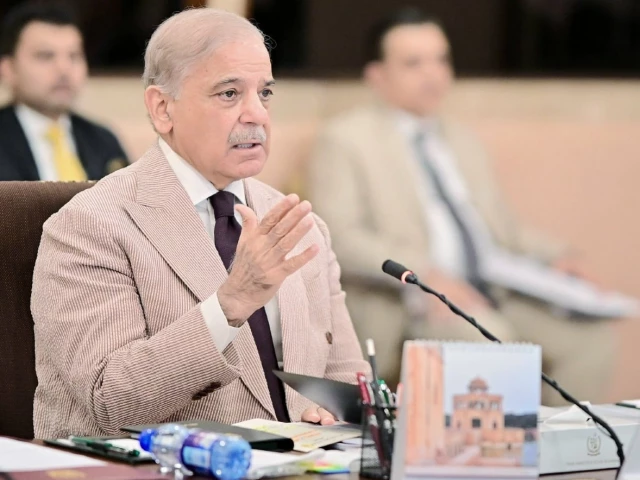
Prime Minister Shehbaz Sharif. Photo:
ISLAMABAD:
The federal government will bear the cost of a 100-megawatt solar power project for Gilgit-Baltistan (GB), Prime Minister Shehbaz Sharif said on Tuesday while chairing a review meeting in Islamabad on the initiative, according to a statement issued by the Prime Minister’s Office (PMO).
The prime minister directed officials to expedite work on the project and ensure its completion at the earliest. It also mandated independent third-party validation at all stages of implementation to ensure transparency.
The meeting was attended by Planning Minister Ahsan Iqbal, Economic Affairs Minister Ahad Khan Cheema, Energy Minister Awais Leghari, Kashmir and Gilgit-Baltistan Affairs Minister Amir Muqam and senior government officials.
During the meeting, officials briefed the Prime Minister on the progress of the federal government’s solar energy initiatives in GB.
According to the report, an 18 megawatt (MW) solar power project is being implemented for government buildings across the region.
Solarization of government buildings in Gilgit and Diamer divisions is expected to be completed by December 2026, while work in Baltistan division is scheduled for October 2026.
The officials also informed the meeting that an 82 MW solar power project was being worked on for homes in Gilgit, Skardu, Chilas and Khaplu.
Natural resources
The Prime Minister reaffirmed Pakistan’s commitment to addressing land degradation, desertification and drought, and emphasized the need for collective action to protect and restore the country’s natural resources in the face of growing climate challenges.
In a message issued on the occasion of World Day to Combat Desertification and Drought, celebrated this year under the theme “Pastoralists: Recognize. Respect. Restore”, the Prime Minister said Pakistan joined the international community in renewing its resolve to address environmental degradation and promote sustainable land management.
He noted that rangelands play a crucial role in ensuring food security, conserving biodiversity, strengthening climate resilience, managing water resources and supporting sustainable agricultural livelihoods.
The Prime Minister described Pakistan’s vast grasslands as valuable natural assets that support livestock-based livelihoods and rural economy, while contributing to biodiversity conservation and ecological balance.
Highlighting the country’s vulnerability to climate change, he said rising temperatures, prolonged periods of drought, water scarcity and land degradation posed significant threats to agricultural productivity and national food security.
“The Government of Pakistan is fully committed to addressing these challenges through a comprehensive strategy focused on land restoration, sustainable rangeland management, afforestation, ecosystem restoration initiatives, drought mitigation and active participation of local communities,” he said.
Shehbaz also highlighted the federal government’s ‘Zarkhaiz Plan’, launched to strengthen and modernize the agricultural economy. Under the initiative, farmers receive interest-free loans to help improve and protect the productivity of agricultural land.
He said substantial resources had been allocated under the scheme to benefit millions of smallholder farmers across the country. In addition to financial assistance, the program offers subsidies for farm machinery aimed at improving productivity while encouraging sustainable land management practices.
The Prime Minister urged the federal and provincial governments, relevant institutions, academia, civil society organizations, the private sector and local communities to intensify collaboration for the protection, restoration and sustainable management of the earth’s resources.
He said that through afforestation, collective action and close cooperation, Pakistan could strengthen its resilience to climate change and ensure a stable and prosperous future for generations to come.
The Prime Minister concluded by urging all stakeholders to renew their commitment to safeguard and restore the country’s fertile lands, forests and natural grasslands.


