
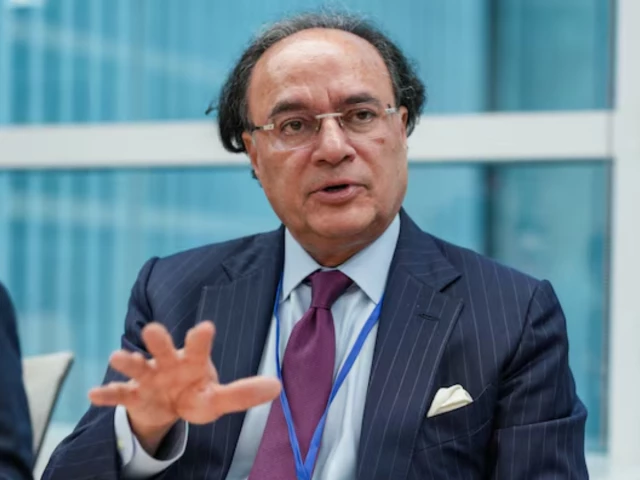
Pakistan’s Finance Minister Muhammad Aurangzeb. Photo: Reuters/ Archive
ISLAMABAD:
Finance Minister Muhammad Aurangzeb said on Saturday that provincial contributions to federal spending had been partly reflected in next year’s defense budget, adding that talks were underway on a three-year contribution framework.
In his post-budget press conference, the Finance Minister explained the use of over one trillion rupees given by the provinces to the Centre, enabling it to meet pressing financial needs that exceeded the available federal fiscal space.
The Finance Minister was accompanied by Information Minister Attaullah Tarar, Minister of State for Finance Bilal Azhar Kayani, Finance Secretary Imdadullah Bosal, FBR Chairman Rashid Langrial and Head of Fiscal Policy Bureau Najeeb Memon.
Aurangzeb said the deal was in place for next year, after the government increased defense spending by 18% amid regional uncertainty.
The provincial grants will be used for defense purposes and to provide a fiscal cushion against the second and third round inflationary effects of the Middle East war, as well as to meet the country’s broader security needs, the finance minister said.
Expressing hope that the conflict “will come to an end sooner rather than later,” Aurangzeb said energy infrastructure has been affected and that “expecting the Strait of Hormuz to open, for things to normalize, or for the LNG or other affected resources to normalize in a week or two, that’s not going to happen.”
“Therefore, it will be extended to the next fiscal year,” he added.
The minister said talks were ongoing with the International Monetary Fund on some major fiscal relief measures as the government also approved a series of relief measures worth Rs 20 billion for civil servants.
In an effort to calm disgruntled employees, who had been protesting for the past few days, the government accepted more than a dozen of their demands, including merging two subsidies and increasing compensation for other subsidies.
Along the same lines, the Minister of Finance stated that the government is “in constant consultations with the IMF (on aid measures).”
The government has proposed relief measures of Rs 360 billion, but sources said the IMF had objections to halving withholding tax on real estate transactions that would cost the exchequer Rs 115 billion.
Sources said the government and the IMF will resolve these issues in the coming days.
When asked about the IMF’s objections to the tax relief and whether the government will withdraw the relief or impose more taxes to offset the hit of over Rs 100 billion, the finance minister said “whatever is done, it will be done with its consultation.”
The government has also set aside cash reserves of Rs 430 billion in the budget to deal with exogenous shocks.
Replying to a question on protecting cash reserves of Rs 430 crore in case of revenue shortfall, the minister said the government would try to protect these reserves, hoping that all targets would be achieved.
Payments and allowances
To a question, the Finance Secretary said that the government has merged the ad hoc relief subsidy of 15% of 2022 and 10% of 2025 in the basic salary. This was one of the main demands of federal government employees. The 7% increase has occurred after merging these two subsidies, which represents a higher increase than the 7% announced.
The total cost of these relief measures, including the ad hoc subsidy, is estimated at just over Rs 20 billion.
Under another relief, the government has provided disparity reduction allowance of 5% of basic salary to all employees of BPS-1 to 22 as per existing terms and conditions for those already receiving disparity reduction allowance.
It has increased the rate of transfer compensation by 50% of the existing amount, which had been frozen for the longest time. Likewise, the government has revised the ongoing allowance for the Civil Armed Forces by increasing it from Rs 7,000 to Rs 30,000 per month.
The government also revised the special area compensatory allowance for Pakistan Coast Guard troops and provided 10% allowance by suspending the existing allowance admissible at the rate of 40% but at 1994 salary level.
The government has provided 100% IMPAS subsidy for basic pay to the Department of Immigration and Passports as per terms and the special pay for officials and staff of Cabinet Wings and Cabinet Committees of Cabinet Division has been revised from Rs 6,000 to Rs 20,000 per month.
It has also provided a special 150% NACTA/NIFTAC allowance to NACTA/NIFTAC employees, but has discontinued the 100% risk allowance.
A provisional allocation of 150% has also been approved for police officers assigned to the Border Police.
The special subsidy for grade 22 employees of the National Highway and Highway Police has increased from 10% to 50%. The government provided a special 50% National Police Academy allowance to officers posted at the National Police Academy.
The special transfer allowance has also been revised from Rs 6,000 to Rs 10,000.
NFC
The Minister of Finance once again said that it was necessary to review the formula for distributing resources between the four provinces, since giving 82% of resources based on population contributed to increasing the country’s population.
To a question, the minister said Prime Minister Shehbaz Sharif’s commitment to Khyber-Pakhtunkhwa to pass legislation to increase the provincial ratio due to the population of the merged districts would be fulfilled.
The Finance Minister also expressed his gratitude to the provinces for “the way they have stepped up to help us with some of our most pressing needs.”
“Some of them have been reflected in the defense budget,” he added, noting that for this year that agreement is in force and “from our perspective, it is a three-year discussion and we will carry it forward with the provinces also for the next two years.”
salaried class
Cabinet ministers called the budget pro-wage earners and pro-people, saying the budget would also stimulate growth.
“If we were to run this budget in favor of business, of growth, of construction, obviously, housing construction plays a very important role, and the transaction taxes that we have reduced, you have already seen that,” he said.
Regarding agriculture, he said: “This has increased by 15% year on year, and has exceeded 2 trillion, which is the general agricultural financing.”
Finance Minister Kayani noted that “at its core, this is the budget of the wage class, this is the budget of industrialists, this is the budget of exporters, this is the budget of the construction sector.”
Kayani added that “this is the budget of the person who wants to build his own house and who does not have the means to do so.”
“Wage class is at the top of the list,” Kayani said, adding that “that’s why it has always been said that the government will give relief to wage class when it gets the chance.”
Kayani also referred to the reduction of minimum and advance taxes for exporters, “either by eliminating the first six brackets of the supertax and the last bracket had to be reduced from 500 million to 10% or 8%.”
“These were basically the main demands of our exporters and our formal industry,” he stated.
Information Minister Attaullah Tarar termed the budget as “relief-oriented” and said the FBR reforms are unprecedented and historic. “There have never been such important reforms in the history of the country,” Tarar said.
When talking about the tax on oil, the Minister of Finance clarified that “the amount of the tax does not increase.”


