
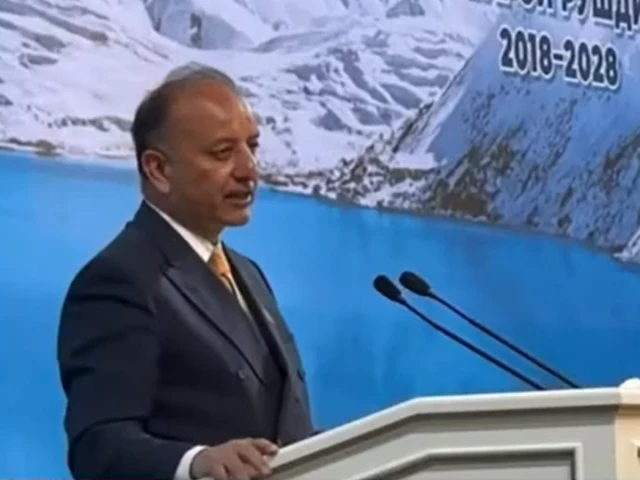
Climate Change Minister Musadik Malik addresses the Fourth International High-Level Conference on Water for Sustainable Development in Dushanbe on Tuesday. SCREEN CAPTURE
Climate Change Minister Musadik Malik warned on Tuesday that India’s reported decision to put the Indus Waters Treaty on hold could set a dangerous precedent for downstream countries around the world, warning that the weaponization of water threatened the foundations of global treaty systems and multilateralism.
Addressing the Fourth High-Level International Conference on the International Decade for Action “Water for Sustainable Development” in Tajikistan’s capital Dushanbe, Malik accused India of politicizing shared water resources and said climate change should lead to greater cooperation, transparency and compliance with international agreements, not unilateral actions.
“There was no legal provision in the treaty to take unilateral measures and yet this treaty was left in abeyance,” Malik said. “It was not suspended because it was legally defective. It was suspended, or so it is suggested, because it did not serve the politics of a country.”
Read: Pakistan wins Hague ruling in IWT dispute
He warned that such actions could undermine the water rights of lower-lying coastal states globally.
“After this, no downstream country in the world will have water rights,” he said. “Mark my words: once this precedent is set, no downstream country in the entire world would have water rights.”
The minister said the issue was not simply about Pakistan, but about the future of international treaties and transboundary water governance.
“If this treaty is not fulfilled, then all the treaties in the world are not worth the weight of the paper on which they were printed,” he said.
Last year, India put the Indus Waters Treaty on hold following the April 22 attack in the Pahalgam area of Indian Illegally Occupied Jammu and Kashmir (IIOJK), in which 26 people were killed by unidentified assailants.
Malik said climate change demanded “more compliance, not less”, as well as greater transparency, data sharing and early warning systems.
“Climate change means all of these things, not to use it as an excuse to unilaterally suspend or reinterpret or circumvent a legally binding treaty,” he added.
Referring to a recent ruling by an arbitration court, Malik said the ruling had clarified the limits on water retention and hydropower design for upstream countries, but lamented the absence of binding mechanisms to enforce the law.
“Rules-based regimes are collapsing,” he said. “Multilateralism is weakening and new doctrines of unilateralism are emerging.”
Also read: FM Dar urges UN Security Council president to pressure India to restore Indus Water Treaty
“I can tell you that even water is being used as a weapon,” he added.
Calling for stronger international mechanisms, the minister urged the conference to work towards binding global pacts on transboundary water management and mandatory third-party dispute resolution mechanisms between upstream and downstream countries.
“Pakistan would like to convene this conference to reach binding international agreements for transboundary waters,” he said. “Pakistan would like to call for political, economic and diplomatic consequences for violators.”
The minister also highlighted the human cost of climate change and water insecurity, saying vulnerable communities were paying the price for global inaction.
“The woman who wakes up at dawn and walks four hours to get a bucket of water is not looking forward to a conference results framework,” he said. “The child who is dead or dying does not ask for another voluntary hospitalization.”
Malik called for stronger legal and institutional mechanisms to protect water rights, saying the world needed enforceable laws, institutions with the courage to implement them, and leadership that recognized access to water as a fundamental right that requires justice and accountability.
Speaking about Pakistan’s climate vulnerability, Malik said the country contributed less than 1% of global greenhouse gas emissions but continued to suffer from devastating floods, droughts and melting glaciers.
“We didn’t cause it. Why do we pay for this?” asked.
Malik said recurring cycles of floods and droughts were pushing farming communities back into poverty and damaging agricultural land.
“These are not tragedies,” he said. “These are the consequences of the decisions that people like us make at these conferences.”
Read also: Zardari urges India to fully restore inland water shipping, warns against ‘weaponization’ of water
Describing water scarcity as a growing global crisis, the minister said almost two billion people lacked drinking water, while billions more faced seasonal water shortages.
“This water bankruptcy we are talking about is not a water bankruptcy; it is a food security issue,” he said. “People are going to deal with hunger.”
Malik argued that the political architecture surrounding water resources disproportionately harms downstream nations.
“Water flows downhill, but energy does not,” he said. “Country after country, basin after basin, the downstream countries have less political power, less influence and less economic power.”
He concluded by urging world leaders to go beyond declarations and voluntary commitments.
“We shouldn’t talk about how we think and what we think,” he said. “We should talk about what we’re going to do.”
The 1960 IWT stands as one of the most carefully negotiated and legally sound transboundary water agreements in modern international law. The treaty, concluded between Pakistan and India with the good offices of the World Bank, was designed to remove the water from the volatility of politics and conflict and anchor it firmly in law, engineering discipline and neutral dispute resolution. It is a binding international instrument governed by the fundamental principle of pacta sunt servanda: that treaties must be respected in good faith.
Read: Pakistan accuses India of violating the Indus Waters Treaty
At the heart of the IWT is a permanent and unconditional allocation of rivers. Article II grants the eastern rivers (Ravi, Beas and Sutlej) exclusively to India, while Article III grants Pakistan exclusive rights over the western rivers: Indus, Jhelum and Chenab. This assignment was the founding agreement of the treaty.
India’s access to the western rivers is permitted only within the narrow limits of Article III(2) of the Indus Waters Treaty, read together with Annexes D and E, which allows limited, non-consumptive uses such as run-of-the-river hydroelectric projects. These permits are subject to strict design and operational restrictions, including watertight limits, prohibition of storage to regulate flow, and prohibition of engineering elements that control water flows into Pakistan.
These safeguards were aimed at protecting Pakistan as a lower riparian and preventing water from becoming a strategic tool. Pakistan’s objections to projects such as Kishanganga and Ratle arise from concerns about excessive ponding, closed spillways and drawdown mechanisms, which it claims violate treaty provisions and could affect downstream flows, particularly during lean seasons.
The dispute entered a more worrying phase in April 2025, when, following a terrorist incident in Pahalgam, India announced that it would leave the Indus Waters Treaty “on hold”.
Read more: India skips IWT case procedure in The Hague
Earlier this year, India unilaterally approved the Dulhasti Stage II Hydroelectric Project on the Chenab River, a move that violates treaty provisions governing western rivers and infringes on Pakistan’s legally protected rights under the binding international agreement.
The unilateral suspension and accelerated approval of upstream projects, including withholding hydrological data, diverting river flows and altering natural regimes, constitutes a deliberate weaponization of water, endangering Pakistan’s agriculture, food security, hydropower generation and ecological stability. Under the IWT, customary international law and Article 51 of the United Nations Charter, Pakistan has clear legal avenues to respond.
International law expressly prohibits the use of water as a weapon against downstream populations, making strict implementation of the IWT essential not only for bilateral stability but also for the integrity of global water governance norms.


