
Participants express concern over decline in government advertising in newspapers
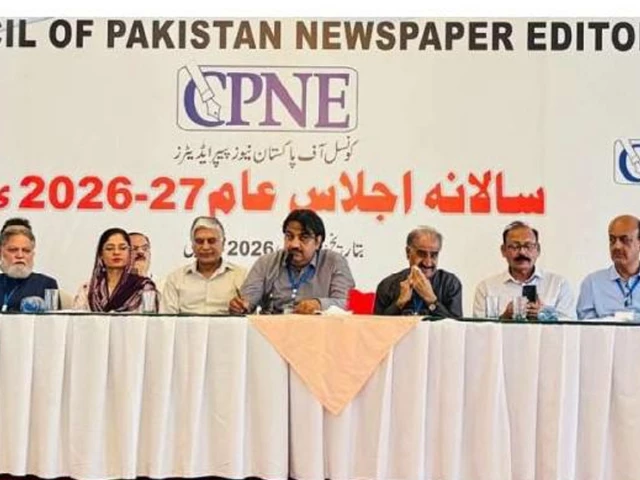
Newly elected CPNE President Kazim Khan addresses the annual general meeting for 2026-2027 in Karachi. Photo: CPNE
Prominent journalist Kazim Khan was once again elected unopposed as president of the Council of Pakistan Newspaper Editors (CPNE) during its annual general meeting held on the eve of World Press Freedom Day on Saturday, while Ayaz Khan was elected senior vice-president.
During the meeting, Ghulam Nabi Chandio was elected general secretary and Tanveer Shaukat was elected joint general secretary. The announcement was made by the chairman of the election committee, Ali Raza Lehri, who congratulated the newly elected members.
The annual general meeting discussed the future of print media, the growing influence of digital platforms and the economic challenges facing the media industry.
1 – منتخب ہو گئے ۔
روزنامہ پاک سندھ کے ایڈیٹر غلام نبی خان چانڈیو سیکرٹری جنرل منتخب ۔
2-سال 27-2026 کو “ مزاحمت “ کا سال قرار دینے کا اعلان۔ صدر سی پی این ای
3- کاظم خان
4-… pic.twitter.com/HjEmp4mEwk— Kazam Khan (@presidentCPNE) May 2, 2026
In his speech at the meeting, Kazim said that World Press Freedom Day will be celebrated as a year of “resistance and protection of press freedom in 2026,” adding that “resistance will begin at home.”
He said efforts would be made to counter fake news propagandists, fictitious newspapers and those who shape narratives on the payroll of political parties and institutions.
“Every writer, every speaker and everyone who sits in front of a camera is not a journalist. The journalism I once respected is now under threat,” he said, adding that powerful forces were trying to control journalism.
He also said that we must resist those who summon journalists to their offices and make threats in broad daylight.
Meeting participants noted that although digital media was expanding rapidly, print media would continue to retain its position as a credible documentary source.
Concerns have also been raised about a sharp reduction in government advertising, which has created financial difficulties for newspapers and magazines. The decrease in budgets and the percentage of advertising in regional newspapers was considered a serious problem.
Speakers called on the government to provide subsidies or financial support to print media, ensure fair distribution of advertisements, restore quotas for regional newspapers and formulate a clear and transparent media policy.
Suggestions were also made on digitalization, including establishing an effective digital platform under the CPNE, expanding digital reach and adopting modern technology.
Participants emphasized the need to counter the growing trend of fake news by promoting credible journalism, calling both print and electronic media a source of public trust.
The meeting also discussed organizational reforms, media policies and financial structures, and it was agreed that the CPNE must modernize its strategy in accordance with current challenges.
It was further emphasized that the integration of print and digital media was necessary to build a strong, sustainable and credible media system to uphold journalistic standards and promote democratic values.
A special condolence session was held in memory of the late former CPNE General Secretary Amir Mahmood where his services to press freedom and the organization were recognized by his son Taimur Aamir, President Kazim Khan, General Secretary Ghulam Nabi Chandio and other members.
Concluding the meeting, Kazim and Chandio thanked all the participants and appreciated the services of the CPNE secretariat staff.
President Asif Ali Zardari, Prime Minister Shehbaz Sharif and Punjab Chief Minister Maryam Nawaz congratulated the new officials.
صدرِ مملکت کی صحافتی تنظیم کاؤنسل آف نیوز پیپرز ایڈیٹرز کے نو منتخب صدر کاظم خان، سیکریٹری جنرل غلام نبی چانڈیو، سینئر نائب صدر ایاز خان، نائب صدور شکیل احمد ترابی اور انور ساجدی، سیکریٹری اطلاعات منزہ سہام سمیت دیگر عہدیداران کو مبارکباد۔
صحافتی اقدار، حقائق پر مبنی رپورٹنگ اور… pic.twitter.com/pgqSzqCb3L
– PTV News (@PTVNewsOfficial) May 2, 2026
وزیراعظم کا صدر کاظم خان، سیکریٹری جنرل غلام نبی چانڈیو، سینئر نائب صدر ایاز خان، نائب صدور شکیل احمد ترابی اور انور ساجدی، سیکریٹری اطلاعات منزہ سہام سمیت دیگر عہدیداران کے لیے نیک تمناؤں کا اظہار
آزاد، ذمہ دار اور باخبر میڈیا جمہوری معاشرے کا بنیادی ستون ہے،
امید ہے سی پی… pic.twitter.com/AsDxrVl6xe
– PTV News (@PTVNewsOfficial) May 2, 2026
وزیراعلی مریم نواز شریف خان، نائب صدور شکیل احمد ترابی سیکریٹری جنرل غلام نبی چانڈیواور دیگر کے لیے نیک تمنائیں
امید منتخب عہدیدار آزاد، ذمہ دارانہ صحافتی اقدار کے لئے بھرپور کردار ادا کریں گے.
سی پی این ای قیادت سے قومی مفاد… pic.twitter.com/6OZ9RXBiNe
– PTV News (@PTVNewsOfficial) May 2, 2026
Other elected officials
Other elected officials include Arif Baloch as finance secretary and Manzah Saham as information secretary. Qazi Asad Abid (Sindh), Shakeel Turabi (Rawalpindi/Islamabad), Mian Ahmad Hassan (Punjab), Tahir Farooq (Khyber-Pakhtunkhwa) and Anwar Sajdi (Balochistan) were also elected regional vice-presidents.
The joint secretaries include Munir Baloch (Balochistan), Maqsood Yousufi (Sindh), Tanveer Siddiqui (Khyber-Pakhtunkhwa), Babar Nizami (Punjab) and Yahya Sadozai (Rawalpindi/Islamabad).
Other members of the standing committee include Hamid Hussain Abadi, Sardar Muhammad Siraj, Sher Muhammad Khawand, Abdul Rehman Mangrio, Zia Tanoli, Mudassar Iqbal, Shehzad Amin, Irfan Athar, Zulfiqar Ahmed Rahat, Abdul Salam Bhatt, Mumtaz Ahmed Sadiq, Faqir Manthar Mangrio, Ayaz Ali Memon, Nisar Khattak, Akmal Chauhan, Dr. Zubair Mehmood, Masood Khan, Fazl Haq, Ali Ahmed Dhillon, Abdul Khaliq Ali, Taimur Aamir, Syed Intizar Hussain Zanjani, Mian Aslam, Hamza Ali Afghan and Mehmood Alam Khalid.
Bilal Aslam and Obaid Aleem were also appointed members of the committee, while the two-member arbitration committee consists of chairman Hassan Abbas and member Wazir Zada.


