
Says sectarian differences cannot justify excluding Muslims from public mosques
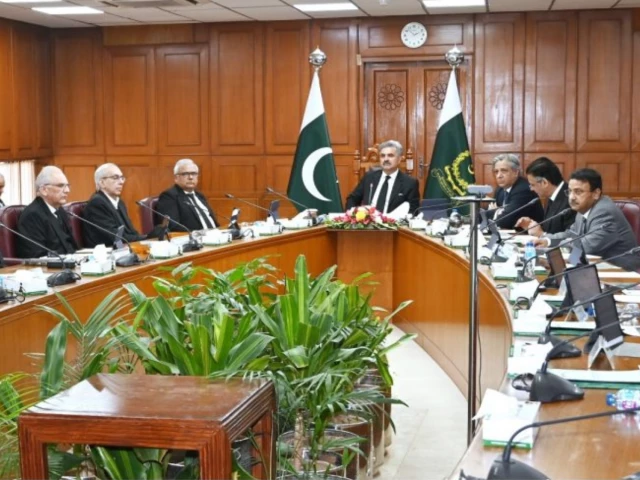
Chief Justice of Pakistan Yahya Afridi presides over a meeting of the Judicial Commission of Pakistan at the High Court in Islamabad on Thursday, January 15, 2026. Photo: Supreme Court of Pakistan
ISLAMABAD:
The Supreme Court has urged restraint on unnecessary judicial intervention in mosque-related disputes that may disturb public peace and order, while noting that sectarian differences cannot normally deprive Muslims of their right to worship in public mosques.
In a detailed four-page order written by Justice Shakeel Ahmed, the SC observed that disputes relating to mosques involve not only private claims but also broader public rights and therefore require sensitivity towards communal harmony and sanctity of places of worship.
The observations occurred during the proceedings of a dispute between two sects over the management and use of a mosque.
“We consider it appropriate to note that disputes relating to mosques involve not only private claims but also public rights, and the courts have consistently discouraged multiplicity of litigation in matters where an amicable or administrative settlement is feasible. It is desirable that differences relating to the management, use or administration of mosques be resolved with sensitivity to the community at large, in order to maintain harmony, protect the sanctity of places of worship and avoid unnecessary judicial interventions that may disturb the public peace and order,” the order reads.
The ruling further held that mere sectarian qualification does not automatically convert a public mosque into an exclusive confessional property, and that disputes over management should not deprive Muslims of their right to worship.
A division bench of the SC headed by Justice Shahid Bilal Hassan observed that the controversy raised important legal and constitutional issues relating to the status of a mosque in Islam, the right of worship of different sects, the scope and application of Section 11 of the Code of Civil Procedure dealing with res judicata, and the role of the administration in maintaining peace and public order.
The court further noted that in Islam, a mosque is not simply a physical structure but a sacred institution that represents the principles of Tauheed, unity, brotherhood and equality among believers.
“The concept of a mosque reflects the collective spiritual life of the Muslim community, where distinctions of lineage, wealth or social status dissolve in the shared act of worship. The Holy Quran repeatedly emphasizes unity and cohesion among believers.”
The order further observed that Islamic injunctions demonstrate that a mosque is not reserved for any particular group but is dedicated to the worship of Allah and the spiritual fellowship of the Muslim community.
“The importance of congregational worship is emphasized in the traditions of the Holy Prophet Muhammad (PBUH), who stated in Sahih Bukhari and Sahih Muslim that prayer offered in congregation is twenty-seven times superior to prayer offered individually.
Historical practice during his lifetime further illustrates the inclusive character of the mosque: Masjid al-Nabawi in Medina was open to all Muslims without distinction of color, lineage or tribal affiliation, while Masjid al-Haram in Mecca welcomes Muslims of different schools of thought, who, despite legal differences in matters of jiqh, stand shoulder to shoulder in prayer within the same sacred precincts.
The court categorically stated: “Islam does not recognize sectarian segregation in places of worship. All major schools of thought, including Sunni (Hanafi, Shafi’i, Maliki, Hanbali) and Shia (Jafri), share the same Qibla, the Quran and the same fundamental pillars of Islam.”
He further observed: “Minor ritual differences, such as raising the hands (Raf’ ul-Yadain), saying Amin loudly or silently, or crossing the arms during prayer, are legal differences {ik.htilaf-e-fiqhi}, not creedal differences, and are insufficient to exclude any believer from access to the mosques.”
Referring to constitutional protections, the order states that under Article 20 of the Constitution, every citizen has the right to profess, practice and propagate religion, subject to law, public order and morality, while every religious denomination has the right to establish and maintain its religious institutions.
“However, once a mosque is dedicated as a waqf, it normally becomes a public place of worship, unless it is specifically shown to be a private mosque. The general principle is that mosques are for Allah and for all Muslims, and normally no Muslim can be prevented from offering prayers in them unless their presence creates a clear and imminent breach of the peace.”
The court also clarified that: “The mere inscription of ‘Masjid Able Tashi’ on the façade of a mosque does not, by itself, confer legal authority to exclude other Muslims, unless the dedication and use of the mosque specifically demonstrates that it is a private confessional waqf.”
At the same time, the order recognized the role of civil administration in conflict prevention.
“Where differences in the method or practice of prayer may give rise to serious disturbances, the district administration may, in exercise of the powers conferred on it by sections 144, 145 and 107 of Cr.PC, temporarily regulate the use of the mosque to preserve public order and tranquility.”
Regarding the issue of res judicata, the court observed that the doctrine applies only when the matter directly and substantially in question is the same, involves the same parties, and has already been finally decided by a competent court of law.


