
ISLAMABAD:
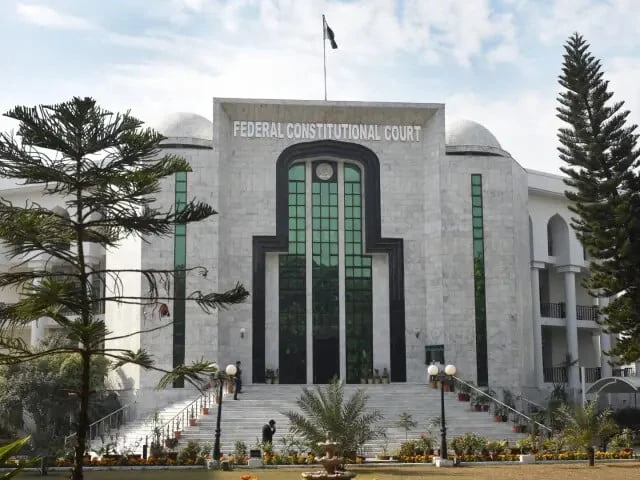
The Federal Constitutional Court (FCC) has ruled that appointments to important public offices must demonstrably conform to constitutional standards of fairness, transparency, institutional integrity and merit-based governance, holding that executive authority cannot be exercised on the basis of undisclosed considerations or without taking into account established selection procedures.
Upholding a judgment of the Peshawar High Court (PHC) quashing the appointment of the petitioner as Chairman of the Board of Intermediate and Secondary Education (BISE), Bannu, the FCC underlined that the legitimacy of public administration depends not only on the existence of power but on its transparent and disciplined exercise in accordance with law.
A twelve-page judgment written by Justice Rozi Khan Barrech stated that public authority cannot be exercised on the basis of undisclosed considerations, nor can structured procedures be reduced to empty formalities.
“The legitimacy of public administration depends not only on the existence of power, but on the disciplined and transparent exercise of that power in accordance with the law,” the ruling states.
Commenting on the FCC ruling, attorney Abdul Moiz Jaferii said he agreed “wholeheartedly that appointments to important public offices, such as those of superior court judges, must demonstrably conform to constitutional standards of fairness, transparency and institutional integrity and must be based on merit.”
“And that such appointments cannot be exercised on undisclosed considerations nor can structured procedures such as the judicial commission be reduced to empty formalities,” he added.
Jaferii also welcomed the ruling and said that “when the tide turns, it will be a suitable precedent for the nullification of the 26th and 27th amendments by the courts.”
The matter was heard by a three-member FCC bench headed by Justice Hasan Azhar Rizvi.
According to the judgment, the record shows that following the call for the post of BISE Bannu chairman, the government constituted a Search and Scrutiny Committee on February 8, 2021 to evaluate the candidates and recommend three names in accordance with the terms of reference.
The committee vetted the shortlisted candidates and sent three names for consideration by the prime minister.
However, the court noted that the original summary, which had been duly processed through the administrative hierarchy, was subsequently altered without any further deliberation by the committee, without any reasons recorded, and without any legal justification emerging from the file.
“The petitioner, who was not among the candidates recommended by the Committee, was subsequently inserted in the summary dated 28.01.2025 and finally appointed by the competent authority vide notification dated 13.05.2025,” the order said.


