
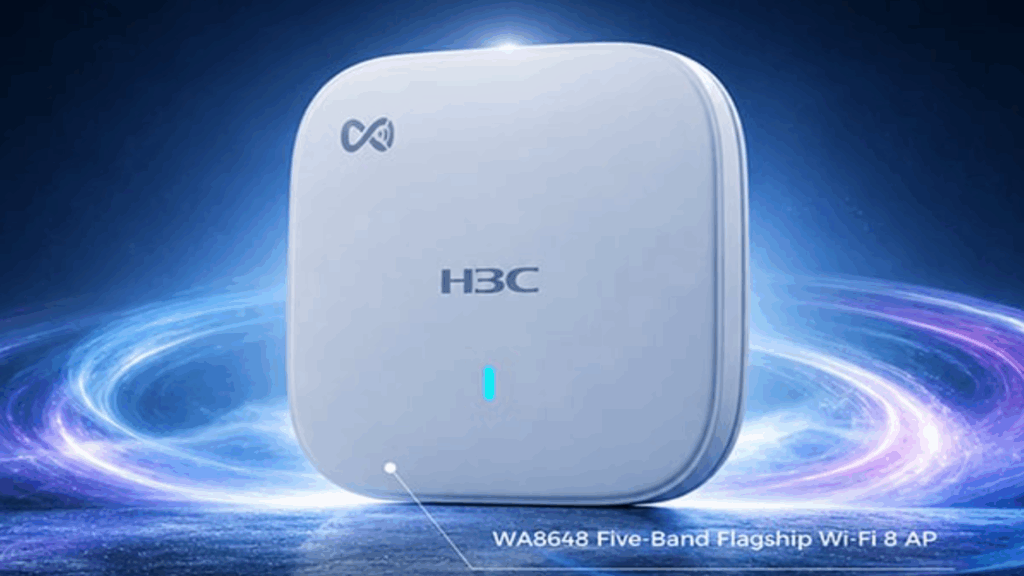
- H3C introduces world’s first Wi-Fi 8 enterprise access point
- Device prioritizes stability over raw wireless speed improvements
- AI systems continually adjust network behavior in real time
H3C, widely considered one of Huawei’s strongest competitors in enterprise networking, has unveiled what it describes as the first enterprise-grade Wi-Fi 8 access point.
This marks a first step toward next-generation wireless deployment in enterprise environments.
The device is designed for environments such as factories, campuses, and dense office buildings where stable connectivity is often more important than full-speed performance.

A shift in enterprise wireless design priorities
H3C moves away from traditional speed-focused upgrades toward consistent performance under congestion, interference, and high mobility conditions.
The company maintains that emerging edge applications powered by AI require networks that can maintain predictable latency and seamless connectivity.
At the center of the system is a five-band Wi-Fi 8 architecture that combines the new standard with AI-assisted network management.
The company claims this combination enables continuous adjustment of wireless parameters based on real-time environmental feedback.
This includes interference detection, traffic balancing, and dynamic spectrum coordination between multiple access points operating within the same area.
H3C claims that its coordinated spatial reuse system and dynamic spectrum scheduling improve spectral efficiency by approximately 30%.
These benefits are achieved through rapid coordination between access points, allowing them to reduce channel conflicts in dense deployment scenarios.
The company also reports that performance in weak signal areas improves significantly, with performance increases of over 25% in challenging areas.
Regarding latency, its design reduces latency by approximately 25% while prioritizing critical traffic through structured resource allocation mechanisms.
This prevents network congestion from disrupting high-priority operations, such as industrial automation systems, remote medical tools, and immersive communication platforms.
Roaming efficiency is another key point, particularly for environments where devices frequently move between access points.
The system aims to reduce package loss during deliveries and maintain stable connections for mobile users such as warehouse robots and inspection systems.
According to H3C, these improvements contribute to smoother transitions and fewer interruptions during movement through large facilities.
The access point also integrates an AI-based operating system that automates network tuning and monitoring tasks.
Analyzes spectrum conditions, detects irregularities, and modifies configuration settings without requiring constant manual input.
H3C describes this as a way to reduce operational complexity while improving responsiveness in large-scale enterprise deployments.
Broader ecosystem transition towards Wi-Fi 8 adoption
A notable element of the product is its reliance on silicon supplied by Broadcom, an American semiconductor company.
The network platform includes Broadcom’s BCM4918 system-on-chip architecture.
It combines processing cores, security features, network acceleration and AI-related logic designed for high-density wireless environments.
The chip also supports 10 gigabit Ethernet connectivity to address the growing demand for high-speed wired backhaul in enterprise networks.
In addition to the new access point, H3C has introduced transitional Wi-Fi 7+ solutions that incorporate select Wi-Fi 8 capabilities ahead of full ecosystem maturity.
This approach allows companies to adopt incremental improvements while maintaining compatibility with existing infrastructure.

Follow TechRadar on Google News and add us as a preferred source to receive news, reviews and opinions from our experts in your feeds.


