
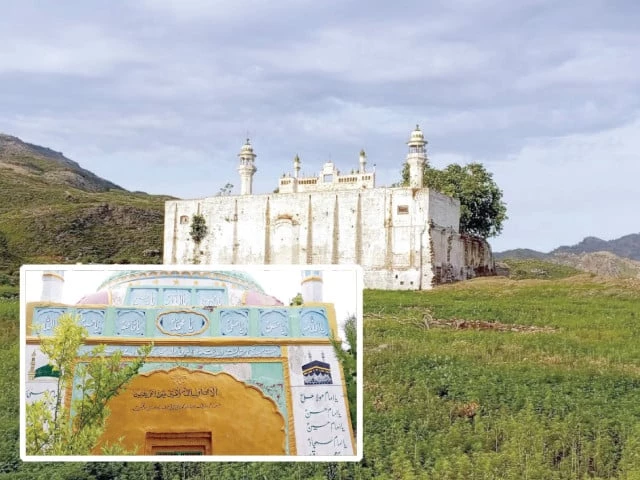
The historic Jamia Rajgan Mosque lies amid the valleys of Old Khanpur, and its eroded walls and decaying grandeur reflect growing concern for the future of one of the region’s most treasured heritage monuments. PHOTOS: EXPRESS
HARIPUR:
Old Khanpur, located along the picturesque banks of the Khanpur Dam, is witnessing growing alarm over the deterioration of its historic Jamia Rajgan Mosque, a structure believed to be more than 150 years old.
The mosque, once a proud symbol of the architectural heritage and spiritual life of the region, is now rapidly falling into disrepair due to prolonged neglect and the absence of systematic conservation efforts.
Locals, historians and visitors alike have raised serious concerns about the condition of the century-old mosque, urging immediate intervention by the relevant authorities.
The structure, widely considered one of the area’s most important cultural landmarks, is reported to be suffering from extensive erosion, structural fatigue and lack of routine maintenance.
Residents lament that despite its historical and religious importance, the mosque has been overlooked by heritage conservation bodies. Set against the once famous natural beauty of the Old Khanpur valleys, the site continues to embody the cultural and spiritual identity of the region, even as visible cracks, eroded surfaces and weakened foundations threaten its survival.
According to local elder Haji Saeed, the area was once famous for its picturesque landscape, traditional settlements and vibrant cultural fabric. He lamented that many of its historical sites are now in decline. “The mosque’s minarets, ancient tombs and the adjoining shrine narrate the story of a glorious past,” he said. “Unfortunately, the absence of effective conservation measures has put this heritage at serious risk.”
Adjacent to the mosque is a historic cemetery containing generations of burial sites and weathered headstones dating back centuries. Residents report deteriorating border walls, faded inscriptions and sunken tombs, all of which have intensified calls for urgent restoration and protection of the entire complex.
The site is also closely associated with the spiritual legacy of Hazrat Syed Sakhi Inayat Bukhari, whose shrine continues to attract devotees and visitors. Locals argue that the mosque, shrine and cemetery should be preserved as a unified heritage complex to safeguard the historical continuity and religious significance of the region.
There are also growing calls directed to descendants of the Rajgan family, whose ancestral tombs are located within the facility, urging them to take a more active role in preservation efforts.
Tourists visiting Khanpur Dam have similarly expressed concern over the deterioration of the mosque, calling on the provincial and federal governments to declare it a protected heritage site and initiate immediate restoration measures before irreversible damage occurs.
Historical accounts indicate that the Jamia Rajgan Mosque was commissioned in 1872 by Sultan Raja Jehandad Khan, great-grandfather of the current Gakhar chief, Sultan Raja Shiraz Haider Zaman. Built from traditional materials such as red brick, stone and lime mortar, the mosque took a decade to complete and was built by skilled craftsmen from across the subcontinent.
For decades, it served as the region’s main center of worship, hosting daily prayers, Friday congregations, and important religious gatherings attended by thousands of people. Although the adjoining palace was demolished during the development of the Khanpur Dam, the mosque remains a powerful reminder of the heritage of old Khanpur.
Local citizens continue to urge Khyber Pakhtunkhwa and the federal governments, along with the archeology and tourism departments, to incorporate the site into a formal conservation programme. They also propose the development of a heritage town to promote cultural tourism.
District administration officials reportedly acknowledged the concerns and assured residents that the matter will be forwarded to higher authorities for consideration. For the community, however, the message remains clear: preserving the mosque is not simply about saving a structure, but about safeguarding an irreplaceable legacy of identity, history and collective memory.


