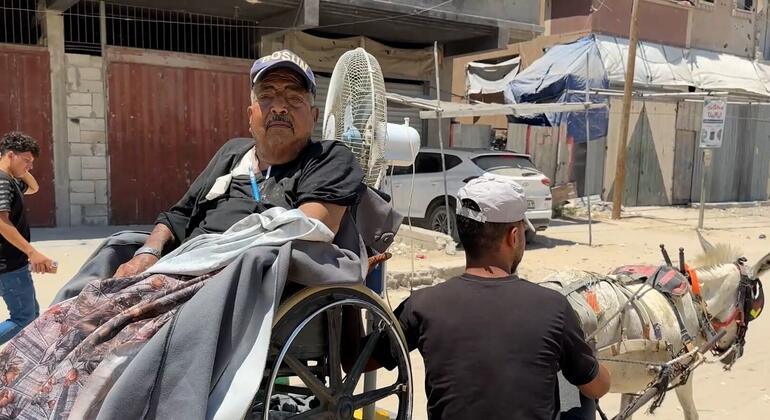
The elderly man is sitting in a wheelchair mounted on a donkey cart, with an oxygen cylinder and a small fan at his side as he makes his way from his tent in the Al-Mawasi area to the dialysis center.
“From January 2024 until now, I undergo dialysis sessions three times a week,” he said. “I suffer a lot from transportation, I travel in a donkey cart under the scorching sun, and thank God, what can we do? I have no other choice.”
Almost daily test
Access to the hospital has become part of their daily struggle, given the destruction of infrastructure, lack of transportation and difficult humanitarian conditions in the Strip since the war between Israel and Hamas broke out in 2023.
Even with the October 2025 ceasefire, Gaza’s health system continues to operate at limited capacity, according to the World Health Organization (WHO).
Israeli attacks and widespread damage to health facilities, along with restrictions on the entry of medical supplies, continue to impede the provision of health care at a time when patients with chronic diseases need regular and uninterrupted treatment, the WHO said.
Mr. Hajji’s suffering reflects the reality of hundreds of kidney failure patients in the Gaza Strip, where obstacles facing health facilities have increased pressure on dialysis services, according to the WHO and other UN agencies.
Hard test of survival
For Mr. Hajji, travel to and from the center remains challenges, where the treatment itself becomes a tough test of survival.
During the trip, his grandson Saif has to stop repeatedly to put the wheelchair back into the stroller because the roads are not paved.
“There is great suffering on the road because of the heat of the sun and the bad roads,” his grandson said. “We have to stop every fifty meters to adjust the position of my grandfather’s wheelchair and we arrive at the hospital exhausted and in immediate need of oxygen.”
Limited resources
After a difficult journey, his grandson helps him transfer from his wheelchair to a bed at the Nasser Medical Complex dialysis center, where patients line up waiting their turn at available machines as medical staff try to cope with increasing numbers and limited resources.
The elder Mr. Hajji then begins his dialysis session while a health worker monitors his condition during the treatment, which lasts between three and five hours.
“It is very difficult, especially with the high temperatures, so I had to wear a ventilator and I also have to fill the oxygen cylinder daily,” Mr. Hajji explained.
Lack of equipment
The lack of equipment aggravates the suffering of patients, said Hamza Abu Raya, one of the center’s employees.
“We are under a lot of pressure on the dialysis machines, many of which are worn out,” he said. “We also suffer from a shortage of treatment materials, including bicarbonate, in addition to the lack of availability of the drug Eprex for a long time, which increases the suffering of patients.”
Shortages of fuel, spare parts and medical supplies are common, according to the latest reports from the UN Office for the Coordination of Humanitarian Affairs (OCHA). They are compounded by reports warning of the continued spread of infectious diseases and increasing pressure on existing health facilities.
In the meantime, health partners continue to operate services to the greatest extent possible.
Another trip home
After the treatment session, Mr. Hajji returns to his wheelchair.
Then wait outside the hospital door.
He will take the same donkey cart back to his tent, in preparation for another trip that will be repeated three times a week.