
Trump says draft deal includes opening of Strait of Hormuz, Fars says Hormuz will remain under Iranian administration
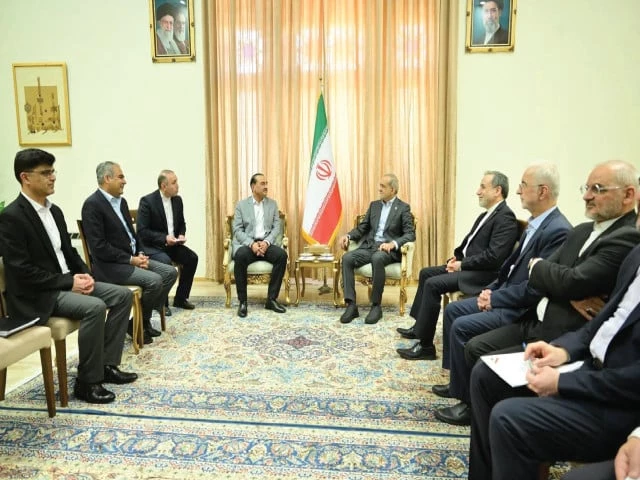
Iranian President Masoud Pezeshkian meets with Defense Forces Chief Field Marshal Asim Munir in Tehran. PHOTO: REUTERS
ISLAMABAD:
Iran and the United States are inching closer to signing an interim agreement aimed at ending the war after Pakistan’s Chief of Defense Forces and Army Chief Field Marshal Syed Asim Munir undertook what is being described as the most momentous trip during ongoing mediation efforts.
While there was still no formal announcement from either side about a breakthrough, there were enough signs to suggest that a tentative deal was not far off.
US President Donald Trump said a deal with Iran had been “largely negotiated”, and the proposal included opening the crucial Strait of Hormuz, although the deal was “subject to finalisation”.
“An agreement has largely been negotiated, subject to completion, between the United States of America, the Islamic Republic of Iran and the other countries,” Trump wrote on his Truth Social platform, listing several Middle Eastern powers along with Turkey and mediator Pakistan.
“In addition to many other elements of the Agreement, the Strait of Hormuz will be opened.”
Among the Middle Eastern countries whose leaders joined a call Saturday to discuss the deal were Saudi Arabia, the United Arab Emirates, Qatar, Egypt, Jordan and Bahrain, Trump said.
He added that he had a separate call with Israeli Prime Minister Benjamin Netanyahu and said that “also went very well.”
“The final aspects and details of the agreement are currently being discussed and will be announced shortly,” Trump said.
Meanwhile, Iran’s Fars news agency reported on Sunday that the Strait of Hormuz would remain under Iranian management according to the latest text exchanged between Iran and the United States.
He dismissed US President Donald Trump’s announcement to reopen the strait as part of a “largely negotiated” deal as “incomplete and inconsistent with reality.”
His upbeat post came after Iranian officials said gaps remained between the sides and that the dispute over its nuclear program would not be part of the initial talks. Tehran said it was finalizing a 14-point framework for an agreement.
Iranian Foreign Ministry spokesman Esmaeil Baqaei highlighted what he called “a trend toward rapprochement” but said it “does not necessarily mean that we and the United States will reach an agreement on the important issues.”
“Our intention was, first of all, to draft a memorandum of understanding, a kind of framework agreement made up of 14 clauses,” he said on state television.
Baqaei added that he hoped the details of a final agreement could be worked out “within a reasonable period of 30 to 60 days” after the framework was finalized.
Iran’s chief negotiator, Mohammad Bagher Ghalibaf, had earlier warned that Washington would face a harsh response if it resumed hostilities, after US media reports raised the possibility of new attacks and Iranian officials accused the US side of making “excessive demands.”
“Our military has rebuilt itself during the ceasefire period in such a way that if Trump commits another act of insanity and restarts the war, it will undoubtedly be more devastating and bitter for the United States than the first day of the war,” Ghalibaf said.
Weeks of negotiations, including historic face-to-face talks hosted in Islamabad, have yet to produce a permanent resolution or restore full access to the Strait of Hormuz, choking off vast amounts of the world’s oil supply.
The stalemate has left ordinary Iranians in limbo.
Iran’s Foreign Minister Abbas Araghchi said in a phone call with U.N. Secretary-General Antonio Guterres that Tehran was committed despite “repeated betrayals of diplomacy and military aggression against Iran, along with contradictory positions and repeated excessive demands” by Washington.
Araghchi made a series of diplomatic calls and spoke with his counterparts from Türkiye, Iraq, Qatar and Oman, Iran’s official IRNA news agency said.
The emir of Qatar, Sheikh Tamim bin Hamad Al Thani, also spoke with Trump on Saturday, as well as the president of the United Arab Emirates and the crown prince of Saudi Arabia, Mohammed bin Salman.
An official statement from Qatar said Sheikh Tamim and the Saudi prince discussed efforts “aimed at calming the situation and promoting political solutions.”
The apparent breakthrough on the likely memorandum of understanding (MoU) was reached during Field Marshal Munir’s visit to Tehran, where he held a series of high-level engagements with Iranian leaders.
His visit was widely seen as the final push to seek a diplomatic solution to the war between Iran and the United States.
Since Pakistan began mediating between Tehran and Washington, Islamabad on Saturday issued perhaps its most positive statement yet, signaling significant progress in the talks.
The international news agency Reuters also reported signs of progress in the talks. Citing Pakistani sources involved in the negotiations, Reuters said the deal being negotiated was “complete enough to end the war.”
Iran further fueled speculation about an imminent breakthrough when the Iranian Foreign Ministry spokesman said Tehran was in the “finalization stage” of the memorandum of understanding.
“We are in the finalization stage of this memorandum of understanding,” the spokesperson said, according to Iran’s official IRNA news agency.
“The issues being discussed at this stage generally focus on ending the war. The issue of ending US naval aggression – what they themselves call a naval blockade – and issues related to the release of blocked Iranian assets are among the main issues addressed in this memorandum of understanding,” the spokesperson added.
Sources close to the negotiations had previously told The Washington Times that top negotiators, including Vice President JD Vance, Special Envoy Steve Witkoff and Jared Kushner, had approved a draft proposal, and sent it to leaders for final approval. Trump’s post appeared to confirm that the process was now in its final hours.
The talks reportedly revolve around a 14-point document proposed by Iran, which has served as the main framework for discussions and messaging between the two sides.
Among other provisions, the framework would involve Iran committing to a moratorium on nuclear enrichment, the United States agreeing to lift sanctions and release billions in frozen Iranian funds, and both sides gradually lifting restrictions on transit through the Strait of Hormuz, a waterway through which about 20 percent of the world’s oil normally flows.
The war itself began in February 2026, when US and Israeli attacks targeted Iranian military infrastructure. Iran retaliated across the region and closed the Strait of Hormuz, causing a global energy crisis. In early April, Trump was threatening to completely destroy Iranian civilization, with deadlines set for March 21, then March 23, then April 7, as diplomats scrambled for a chance.
Pakistan provided that opportunity. On April 8, Islamabad negotiated a two-week conditional ceasefire. Trump confirmed this himself, naming Field Marshal Asim Munir and Prime Minister Shehbaz Sharif as the Pakistanis who had persuaded him to resign. Iranian Foreign Minister Abbas Araghchi was equally warm and publicly appreciated Pakistan’s tireless efforts on behalf of the Islamic Republic.
Once a ceasefire was established, Pakistan moved quickly to host formal negotiations. On April 11 and 12, delegations from the United States and Iran met at the Islamabad Serena Hotel.
The American team was led by Vice President JD Vance, accompanied by Witkoff and Kushner; Iran sent a delegation led by Parliament Speaker Qalibaf.
The talks lasted 21 hours and, while both sides reported progress on most points, two issues proved intractable: the Strait of Hormuz and Iran’s nuclear program. No agreement was reached. No memorandum was signed.
(With contributions from Agencies, News Desk)


