
“India needs to come to terms with Pakistan’s prominence and learn to coexist peacefully with it,” the army says.
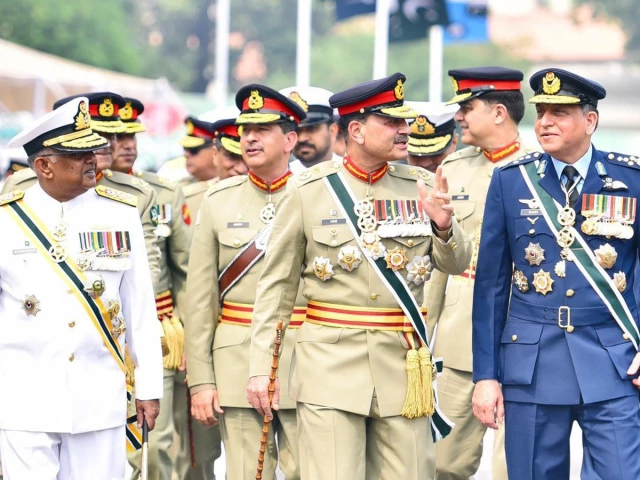
Chief of Defense Forces Field Marshal Asim Munir, Air Chief Marshal Zaheer Ahmed Babar Sidhu and Chief of Naval Staff Admiral Naveed Ashraf attend a ceremony at the Rawalpindi Headquarters marking the completion of one year of Pakistan’s victory at Marka-e-Haq. Photo: ISPR
The Inter-Services Public Relations (ISPR) on Sunday criticized the Indian Chief of Army Staff’s (COAS) comments, saying the statement reflected a “patriotic and short-sighted mentality” and warned against pushing “South Asia towards wars and crises”.
In a statement, ISPR said the Indian army chief had made a “provocative statement” during a recent interview in which he said that “Pakistan should decide whether it wants to be a part of geography and history.”
The military’s media wing said that contrary to what it described as a “delusional and delusional belief system” and “despite the pervasive ill will prevailing in Hindutva-led India”, Pakistan was already “a country of global importance, a declared nuclear power and an indelible part of South Asia’s geography and history”.
“The statement reflects that Indian leaders have failed to reconcile with the very idea of Pakistan nor have they learned the right lessons even after the passage of eight decades,” the statement said.
ISPR said the “arrogant, jingoistic and short-sighted mentality” had repeatedly pushed South Asia towards wars and crises.
“Threatening a sovereign nuclear neighbor with its removal from the geography is neither a strategic signal nor a political brinkmanship; it is pure cognitive failure, madness and warmongering,” the statement said.
The military’s media wing added that any “geographical destruction would certainly be mutual and complete.”
“Responsible nuclear states reflect moderation, maturity and strategic sobriety. They do not speak the language of civilizational supremacy or national elimination,” it said.
Read: CDF Munir warns against any future misadventures and says the response would be ‘far-reaching and painful’
The statement further said that the Indian narrative ignored “India’s historically documented record of being a harbinger of terrorism in the region, a state sponsor of terrorism, a key source of regional instability, a practitioner of transnational assassinations and a focus of disinformation campaigns around the world.”
According to ISPR, India’s “aggressive stance” was “less out of confidence and more out of frustration over its inability to harm Pakistan”, which has been brutally “exposed during Marka-e-Haq”.
The military’s media wing said Indian leaders “would do well not to try to push South Asia into another crisis or war whose consequences would only be devastating for the entire region and beyond.”
“India needs to come to terms with Pakistan’s prominence and learn to coexist peacefully with it,” the statement said.
ISPR warned that “any attempt to attack Pakistan may trigger consequences that will not be geographically limited nor strategically or politically acceptable to India.”


