
New Delhi depends on “manufactured crises” that do not stand up to international scrutiny
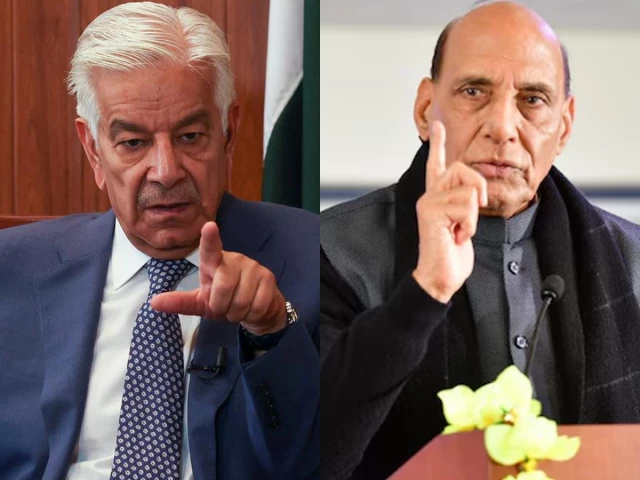
Defense Minister Khawaja Asif and his Indian counterpart Rajnath Singh at a combined photo exhibition. Photo: AFP/File
Defense Minister Khawaja Asif on Thursday warned his Indian counterpart Rajnath Singh against escalating tensions ahead of the anniversary of the deadly Pahalgam attack, dismissing the latter’s recent threatening comments as provocative and politically motivated.
On April 22 last year, 26 tourists were killed in a brutal attack in Pahalgam, situated in Indian Illegally Occupied Jammu and Kashmir (IIOJK). Just weeks before the anniversary, Singh today issued a stern warning to Pakistan against any border misadventure, stating that any hostile action by Pakistan would be met with a decisive and unprecedented response.
In a direct message on Asif accused New Delhi of relying on “fabricated crises” that did not stand up to international scrutiny.
“These threats are not new,” he said, adding that they followed a predictable pattern of externalizing India’s internal vulnerabilities and causing escalation under the guise of baseless accusations by vested political interests.
The repeated rhetoric reflects not strength but visible strategic anxiety as the anniversary of Operation False Flag in Pahlgam approaches, an episode that did not stand up to international scrutiny and exposed New Delhi’s dependence on manufactured crises.
Such…
– Khawaja M. Asif (@KhawajaMAsif) April 2, 2026
Recalling the Pakistan Armed Forces’ response in May last year during Operation Marka-e-Haq, Asif warned that the story served as a stark reminder of the consequences of miscalculation. “Marka-e-Haq is still fresh in our minds. Next time, our response will be even more forceful and decisive. Let there be no ambiguity,” he said.
Asif emphasized that Pakistan remained committed to regional peace and stability but was fully prepared to defend its sovereignty with a swift, calibrated and decisive response if provoked.
“Let me remind Rajnath Singh that the illusion of space for war between two nuclear states is inconceivable and will have drastic consequences,” he warned, urging India to focus on addressing growing unrest within its own strategic and diplomatic circles rather than resorting to aggressive posturing.
Tension between Pakistan and India increased after the April 22 Pahalgam attack.
In response, India took a series of hostile actions the next day, April 23, including suspending the 65-year-old Indus Waters Treaty (IWT), canceling visas for Pakistani citizens, closing the Wagah-Attari border crossing, and ordering the closure of the Pakistan High Commission in New Delhi. India and Pakistan subsequently reduced diplomatic staff at their respective embassies in each other’s countries.
Pakistan strongly rejected the allegation, calling it baseless, but took reciprocal action through its National Security Committee. These included stopping trade with India, closing Pakistani airspace to Indian aircraft and other countermeasures.
On the night of May 7, the Indian Air Force launched an unprovoked attack on civilian targets in Pakistan. The Pakistan Air Force (PAF) immediately retaliated and shot down at least six IAF aircraft, including three French-made Rafales.
In an even further escalation, on the night of May 9-10, India launched another round of attacks against Pakistan, but this time against military sites and air bases.
In retaliation, Pakistan launched Operation Bunyanum Marsoos, counterattacking Indian military installations, including missile storage sites, air bases and other strategic targets. The early morning attacks came as a shock to Indian military leaders, who had underestimated Pakistan’s response to their unprovoked attacks.
As the conflict escalated, US President Donald Trump announced on May 10 that a ceasefire had been reached after intense diplomatic efforts overnight. The two sides gradually reduced the number of troops from the international border in the following weeks.


