
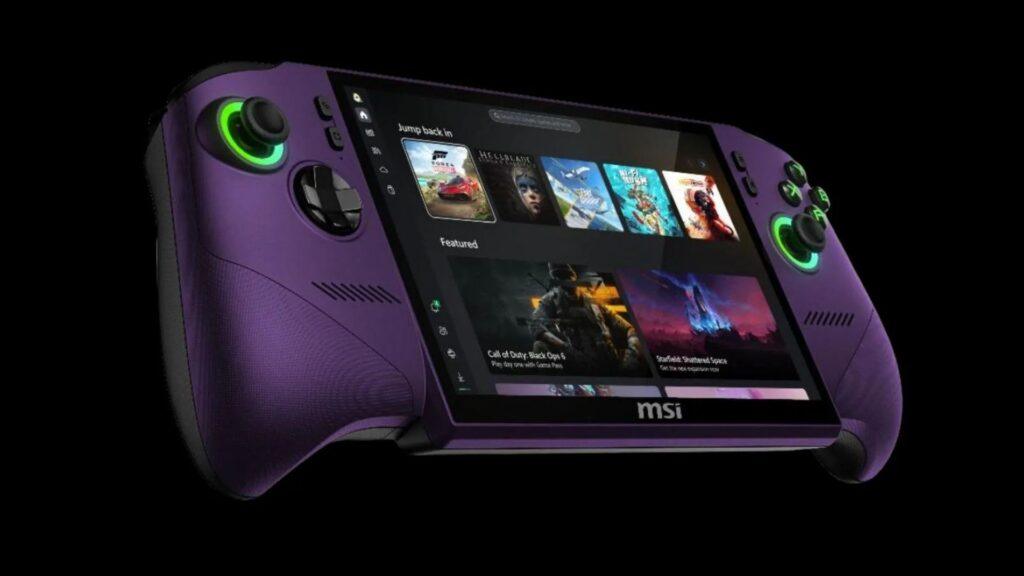
- The MSI Claw 8 EX AI+ uses the new Intel Arc G3 APU, one of the first portable gaming devices to use this chip, similar to the recently introduced Acer Predator Atlas 8.
- This new Intel Arc B370-powered iGPU supports multi-frame rendering via XeSS 3, allowing the hardware to achieve higher frame rates.
- Ergonomically, the MSI Claw 8 EX AI+ takes inspiration from the Asus ROG Ally X with its new gamepad-style grips, with Hall effect joysticks and RGB lighting.
The MSI Claw 8 EX AI+ was announced at Computex 2026, billed as the “world’s first portable gaming device” powered by the Intel Arc G3 processor. It is joined by recently announced competitors, such as the Acer Predator Atlas 8, leading the charge for the next generation of mobile gaming hardware.
This third-generation MSI Claw gaming handheld features Intel XeSS 3 Multi-Frame Generation, enabled by the latest Intel Arc iGPU standard. Specifically, the Arc G3 is built on the B390 chip, with 12 Xe cores and a TDP range of up to 30W.
Pricing for the MSI Claw 8 EX AI+ has yet to be announced; However, it is expected to be a gaming handheld on the premium end of the spectrum. We can calculate a rough estimate by looking at the current generation of the MSI Claw 8 AI+, with its cheapest 1TB variant selling for $899/£899 and its most expensive option (which doubles the storage) selling for $1,129/£999. As such, we expect this new model to follow a similar pricing strategy.

Ergonomics have also changed drastically for the upcoming MSI Claw 8 EX AI+ compared to the previous generation MSI Claw 8 AI+ and MSI Claw A1M. The Taiwanese company has taken notes from the Asus ROG Ally Xbox
The Xbox mode seems to directly rival what its competition presents. Like the Xbox Series
Another novelty of the MSI Claw 8 EX AI+ is the incorporation of haptic motors for vibration when playing. It’s described as a “high-end linear motor” that simulates “tactical textures” in a similar way to what the PS5’s DualSense wireless controller can do. It appears to be a massive improvement over the weaker noise feature found on the two previous-generation models.
Instead of opting for the same usual black or gray color of its contemporaries, the MSI Claw 8 EX AI+ features a purple aesthetic, with red face buttons, RGB lighting around the joysticks, and the same solid 8-inch 120Hz VRR display in the center. At a time when the best gaming laptop PCs repeat the same design trends from four years ago, it’s nice to see some degree of innovation implemented here.
How does the MSI Claw 8 EX AI+ compare to its predecessors?
| Row 0 – Cell 0 |
MSI Claw 8 EX AI+ |
MSI Claw 8 AI+ |
MSI Claw A1M |
|
Processor |
Intel Arc G3 Extreme |
Intel Core Ultra 7 258V |
Intel Core 7 155H |
|
Show |
8 inch 1920 x 1200 120 Hz touch screen |
8 inch 1920 x 1200 120 Hz touch screen |
7 inch 1920×1080 120Hz touch screen |
|
Graphics |
Intel Arch B390 |
Intel Arc 140V Graphics |
Intel Xe-LPG Architecture |
|
Memory |
32GB LPDDR5x-8533 |
32GB LPDDR5x-8533 |
16GB LPDDR5-6400 |
|
Battery |
80Wh |
80Wh |
53Wh |
How would the MSI Claw 8 EX AI+ fare in the wearable market of 2026?
The meteoric rise of Valve’s Steam Deck four years ago set in motion a path that would see dozens of different and remarkably similar handheld devices hit the market. Most of the competitors of the MSI Claw 8 EX AI+ use the AMD Z2 Extreme or the old Z1 Extreme, and the lesser-known brands go for Intel. We’ve seen this with OneXPlayer X1 and AOKZOE A2 Ultra, both using the older Intel Core 7 Ultra 155H and integrated 140V Arc graphics.
As mentioned above, the MSI Claw 8 EX AI+ is among the first portable gaming devices to use the recently introduced Intel Arc G3 chipset, although it is not the first to be announced on the market.
The Acer Predator Atlas 8 appears to be similar to what MSI offers. It has the same Intel Arc G3 processor, XeSS 3 Multi-Frame Generation, 80 Wh battery, 120 Hz screen and also Xbox controller-style ergonomics. It’s never a bad thing to have too many options as a consumer, so time will tell which of these devices is superior and if it has what it takes to dethrone the Steam Deck or ROG Ally.
Crucially, the implementation of the much more capable B390 die ensures that your games will look better and play better than before. This is solely due to true MFG, and XeSS enhancement technology has greatly caught up with what AMD FSR and Nvidia DLSS can do in the last two years, as the transition from the Alchemist to Battlemage architecture has truly been night and day in terms of performance. We’ll have more to share when we hands-on the device to render a proper verdict.
- Check out our Computex 2026 hub for the latest news from Taipei.

Follow TechRadar on Google News and add us as a preferred source to receive news, reviews and opinions from our experts in your feeds.


