
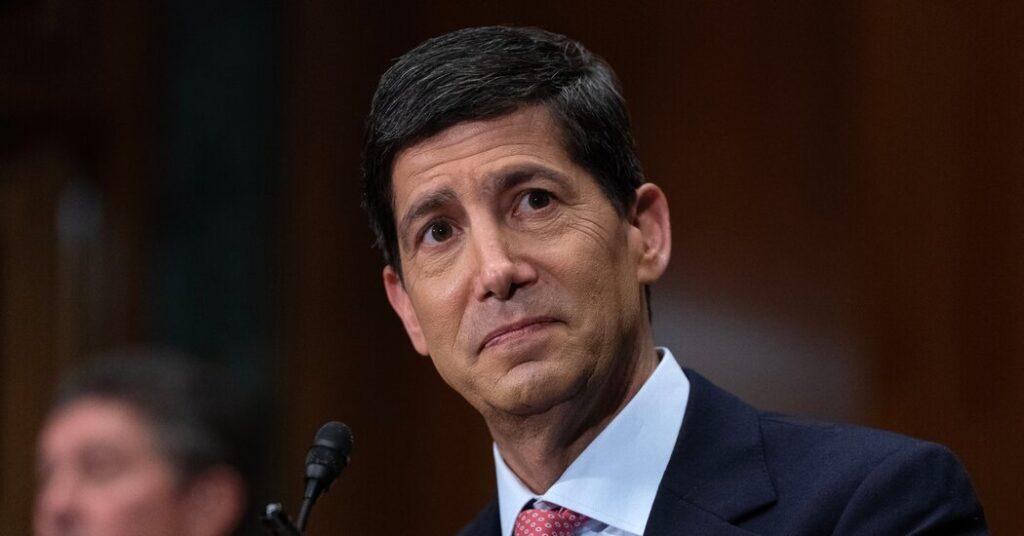
Kevin M. Warsh faces a pivotal choice this week in his second meeting as chairman of the Federal Reserve. He has staked his reputation on reducing inflation after half a decade of it being too high for the central bank’s liking. Now it must decide whether to push for higher borrowing costs to shore up that promise.
Wednesday’s decision offers Warsh his first real chance to assert himself, with risks in both directions.
Cornering his colleagues into raising interest rates would be a sure way to keep public expectations about inflation in check while silencing critics who question Warsh’s desire to go beyond tough words to curb price pressures. However, the obstacles are numerous, depending on how Warsh justifies them.
A rate hike following relatively benign inflation data has the potential to sow confusion over how officials will respond to changes in the economy, testing financial markets already jittery amid volatile energy prices stemming from a new escalation of the war with Iran. After topping $100 a barrel last week, Brent crude, the international oil benchmark, retreated to around $90 after a lull in fighting over the weekend. Warsh would likely also have to deal with criticism from President Trump, who picked him for the job and has made clear his desire for lower rates.
Keeping rates unchanged would leave the Federal Reserve’s policy options open while giving officials more time to see how the economy is developing. Many expect inflation to decline in the second half of the year. By the time the Federal Reserve meets again in September, officials will have two more months of data on their hands. But inaction will put pressure on Warsh to explain how doing nothing is consistent with his recent assertion to lawmakers that the central bank “does not tolerate” high inflation.
The decision before Warsh ultimately depends on the balance he wants to strike between taking an aggressive stance in the early stages of his four-year term as president and maintaining room to maneuver in an environment where most inflation is being driven by supply shocks that the central bank’s tools are not equipped to address. If inflation were caused by an overheated labor market, for example, rather than rising energy prices caused by the war with Iran or Trump’s tariffs, the central bank would feel much more confident about its next steps.
In the run-up to the July meeting, two authorities indicated that raising rates was urgent. Lorie K. Logan, president of the Federal Reserve Bank of Dallas, and Beth M. Hammack of the Cleveland Federal Reserve, emphasized the pressure on consumers and businesses caused by high inflation and the potential for price pressures to widen further. Prices across the service sector, including transportation and shipping costs as well as expenses related to eating out or traveling, have increased compared to the same period last year.
Logan and Hammack argue that higher borrowing costs are necessary to meet the Fed’s 2 percent target. Both are voting members on this year’s policy-setting committee.
But many of their colleagues, including a handful of the Fed’s top decision-makers, signaled that while they were prepared to act if inflation didn’t ease soon, they were comfortable taking a wait-and-see strategy for now. Among them were Philip N. Jefferson, vice president, and John C. Williams, president of the New York Federal Reserve.
Christopher J. Waller, Governor of the Federal Reserve, placed great emphasis on the latest inflation data in determining the Federal Reserve’s next steps. Two reports tracking consumer and wholesale prices in June came in much colder than expected. Still, he made it clear that he would need to see several months of moderate data to feel confident about the outlook.
This internal distribution of opinions will undoubtedly produce the “family strife” that Warsh has long encouraged. But it also suggests that he will be free to push officials in one direction or another if he chooses.
Warsh has chosen to publicly hide his position to avoid boxing at the Federal Reserve. When pressed to be more specific, such as during congressional hearings earlier this month, he was explicit that a month of tepid inflation data did not equate to “mission accomplished.” But in several cases, Warsh’s stance leaned in a moderate direction.
When asked by Sen. John Kennedy, R-Louisiana, what he would do to address inflation, Warsh never mentioned the prospect of raising rates. Instead, he said the Fed’s success would be a function of it affirming the central bank’s commitment to reducing inflation, taking responsibility for any failure to do so and studying its policy tools.
When Kennedy asked how the Fed determines whether inflation is temporary or persistent, Warsh invoked the five working groups he has created, which he said would “get to the big, hard questions instead of trying to cover them up with policies that haven’t proven to be successful.”
Warsh also said he did not consider a one-time change in prices, specifically those caused by the rise of investment in artificial intelligence, inflationary. “Because I think there is a supply response,” he said. At the same time, however, he suggested that the Federal Reserve might view higher prices caused by a war differently, due to the fact that this “tends to reduce the supply side of the economy.”
The Iran war and the rise of AI are the biggest wild cards for the Fed right now. Both have raised prices, but it is unclear whether that will lead to sustainably higher inflation. According to Jan Hatzius, chief economist at Goldman Sachs, temporary factors such as tariffs are the main drivers of recent increases in core inflation and are likely to fade over time.
“Our forecast implies that hawkish talk now ultimately requires no movement, because inflation actually looks somewhat better as time goes on,” Hatzius said.
What has been hard to miss, however, is the fact that the economy has held up relatively well despite the litany of shocks that have occurred in just the last year and a half. To some, that suggests the Federal Reserve will need to raise rates to control inflation.
“It’s hard for me to say that the current policy stance is restrictive given what we’re seeing in the economy,” said Loretta Mester, who led the Federal Reserve Bank of Cleveland for a decade through 2024. Raising rates would help “better align demand with supply,” she said, while also helping to stabilize inflation expectations that appear “more fragile than they have been.”
“The longer this goes on, they will lose credibility if they keep saying we are going to reduce inflation and then don’t take action to reduce it,” Ms Mester added. The most recent set of data gave the Fed some breathing room, but that breathing room will likely be over by the September meeting, he said.
How Warsh talks about Wednesday’s decision is perhaps as important as the move itself. Well before the July meeting, investors had expressed anguish over Warsh’s preference to provide significantly less guidance than his predecessors on the political outlook.
As a result, markets tracking what the Federal Reserve will do have turned upside down. As of Monday, they show just over a 30 percent chance of a quarter-point increase this week. At the September meeting, investors are betting that a rate hike is most likely.
When Warsh takes the podium for a news conference after the rate decision, he will be under more pressure to provide more substance to his views. Both options create their own communication challenges.
Keeping rates stable will keep Warsh on the defensive and he will have to explain why the Fed can still afford to be patient. Raising rates, meanwhile, risks muddying the public’s understanding of how officials will react to incoming data.
“A rise now, when the data appears to be improving, may not build credibility if it confuses people about the reaction function,” said Dean Maki, chief economist at Point72, a hedge fund.
What Warsh will also have to guard against is a rapid readjustment of rate expectations that could prove destabilizing for broader markets. One way around this would be to frame any increase – whether this week or in the future – as a “recalibration” of policy rather than the start of a prolonged and potentially aggressive campaign to raise borrowing costs.
“The market is vulnerable right now,” said Krishna Guha, vice president at Evercore ISI, pointing to the Iran war and concerns that the AI bubble is about to burst. “Do you want to bet on a play that could leave you in chaos in the market just a few weeks into the job?”


