
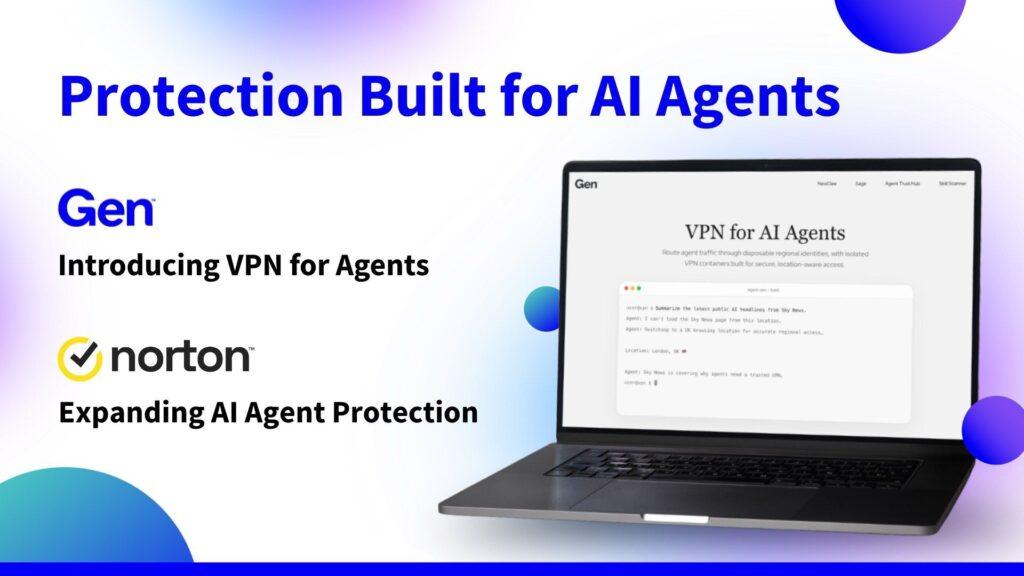
- Norton VPN has launched the “first truly AI-native VPN” for agents
- It is fundamentally integrated with the activities of AI agents.
- Offers multi-tunnel support.
Norton VPN has launched Agent VPN, its native AI VPN built for autonomous AI.
Traditionally, the best VPNs have been designed for users browsing the web, forcing AI agents to share your VPN and internet settings. The setup so far hasn’t been ideal, with AI agents performing tasks on your behalf, either failing to use VPNs when needed or, at best, necessarily dictating all of your host’s VPN settings.
Norton VPN’s new software promises to be “the first truly AI-native agent VPN,” the first to fundamentally integrate with AI agent activities, without requiring client applications or CLI installation, and including innovative features such as built-in support for multiple tunnels and multiple locations.
“With Agent VPN, we have offered two industry firsts: multi-tunnel technology that allows agents to operate independently in different countries simultaneously, and a native AI architecture that requires no installation,” Himmat Bains, product leader at Norton VPN, tells TechRadar.
Developed in collaboration between Gen Threat Labs and Gen AI Foundry (the parent company of Norton, Gen Digital’s fully AI-focused arm), the Agent VPN is currently available through the Gen Agent Trust Hub for a limited number of customers.
How does it work?
As Howie Xu, head of AI and innovation at Gen Digital, noted in a LinkedIn post, “the world has about 8 billion people, but there will soon be many more than 8 billion agents.”
In a VPN-saturated landscape, both human and agent traffic are currently routed through the same VPN routes, making the experience more cumbersome for both.
Agent VPN offers a smart and elegant solution by creating an encrypted channel designed for the fast, cross-platform communication patterns of AI-powered autonomous agents.
Specifically, the software routes agents through region-specific temporary identities using isolated VPN containers powered by Docker, allowing them to establish temporary VPN channels at will from any location they choose.
This way, each agent and each task can have their own independent VPN connection without interfering with yours. This also means that agents can handle many separate VPN connections simultaneously in a variety of different locations at the same time.
For example, they can make simultaneous requests to different websites routed through the US, China, and Iran, each constituting an independently running Docker-based VPN instance.
This approach makes the system more flexible, more powerful and probably more secure than solutions based on a single permanent VPN client.
An open competition
Other providers, including Express VPN and Windscribe, have recently developed solutions to provide VPN services to the agent world, but they have specific use cases.
Windscribe, for example, is designed primarily for OpenClaw systems running independently on a dedicated machine, targeting a specific isolated environment.
ExpressVPN’s solution allows AI agents to change ExpressVPN app settings directly. But, while useful, the solution is arguably less elegant, with the feel of creating a workaround rather than a fundamental solution.
Instead of using a single large VPN for your entire system, Norton Agent VPN creates an instant, entirely new VPN tunnel dedicated exclusively to each individual request. This ‘sandbox’ VPN opens within a temporary mini-environment; tasks are carried out; The container is then permanently deleted and the VPN instance disappears.
Bains, who has already revitalized Norton VPN with a variety of deployments since taking over at the end of 2025, confirms that developing the Agent VPN app required a complete new perspective on VPNs: “These were not incremental improvements, but rather forced us to rethink what a VPN can be.”
“All this while we continue our Norton VPN roadmap with many exciting updates planned for the coming weeks,” he adds.
Whether or not the Norton VPN solution is the best VPN agent for you depends on your own use case. But one thing is for sure: Agents just received a powerful new update for those who need it.
Follow TechRadar on Google News and add us as a preferred source to receive news, reviews and opinions from our experts in your feeds. Be sure to click the Follow button!


