
A Pakistani software engineer in Toronto wants to invest $200 in OGDC. A fund manager in Singapore has been tracking the KSE-100 for two years and is looking for a way to gain exposure. A family office in Dubai, which invests in frontier markets, has Pakistan on its watch list, but has no practical mechanism to act on that conviction.
None of them can invest without navigating a labyrinth of currency accounts, fragmented brokerage processes and settlement systems built for a bygone era. This is not a diaspora problem but a demand problem. The capital is there, the interest is there and the market has earned it. What is missing is a simple way of acting.
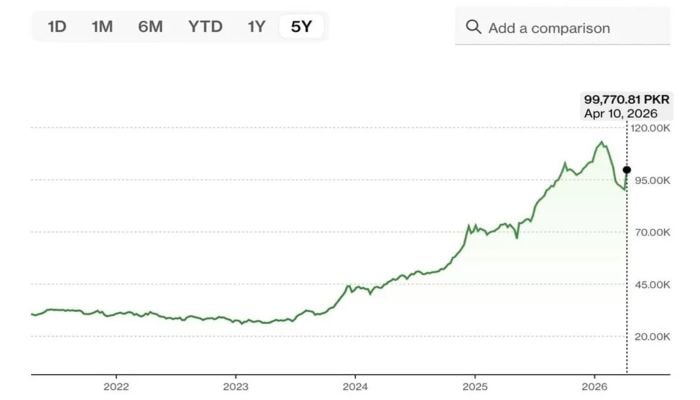
Over the past three years, Pakistan’s stock market has quietly become one of the best performers in the world. The KSE-100 returned over 50% last year and global allocators have started to pay attention. When a market starts to outperform, curiosity arises. And curiosity always leads to the same question: How do I invest in it?
At this point, there is no simple answer. Instead, what investors encounter is friction, layers of operational complexity that turn interest into hesitation and conviction into inaction.
Pakistan’s challenge is often misunderstood. We have 450,000 capital investors in a country of 250 million inhabitants. Domestic participation is limited and the 6.9 million Pakistanis living abroad send more than $38 billion a year but invest almost nothing in the local stock market. And the growing group of international investors paying attention also has no clear entry point. Look closely and you will see that these are not three different problems. They are domestic investors not participating, overseas Pakistanis cannot invest and global capital cannot enter. It is a single problem with three sides. The problem is access.
Pakistan does not have an investment problem. You have an access problem and access determines the rating.
The global context in which this is situated is important. We are experiencing the early stages of the largest restructuring of capital markets since the creation of the stock exchange. Larry Fink, whose firm BlackRock manages nearly $150 billion in assets related to digital products and operates the world’s largest tokenized fund, described it clearly in his 2026 annual letter to shareholders: Tokenization, he wrote, is roughly where the Internet was in 1996, and the plumbing of the global financial system is being rebuilt to allow any asset to be held in any wallet, anywhere.
The figures behind that thesis are substantial. The global bond market alone amounts to $140 trillion. Global equities add another $100 trillion to that figure, and private credit, real estate, commodities and infrastructure further expand the addressable universe. In simple terms, tokenization converts assets such as stocks, fixed income instruments or real estate into digital units that can be accessed from anywhere.
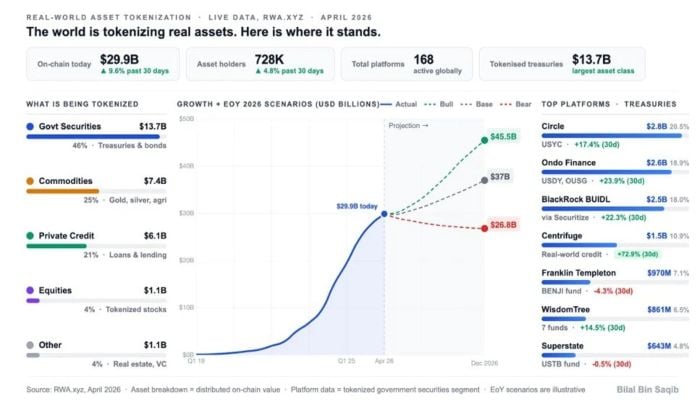
On that scale, the tokenized proportion of real-world assets today stands at $30 billion, an increase of 9.6% in the last 30 days alone. BlackRock, Franklin Templeton, Circle, Ondo, Centrifuge. One hundred and sixty-eight platforms are active worldwide across all major asset classes. This is not a company or a jurisdiction making a speculative bet. These are the early stages of the largest capital migration in history, and its direction is not in doubt.
This is more important for markets like Pakistan. Frontier markets are not trading at a discount simply because of fundamentals; They negotiate at a discount because the pool of potential buyers is limited. Limited access reduces participation, and limited participation suppresses appreciation. Access is not a detail; It is a demand and, unlike many structural challenges, it is one of the most solvable.
When access barriers fall, the dynamic changes. The same investor who can buy Apple or Saudi Aramco from a single interface should be able to buy OGDC or HBL with the same ease. When that becomes possible, Pakistani companies will no longer compete just for domestic capital but for the allocation of a global fund.
The effect is simple: more access leads to more participants, more participants leads to greater demand discovery, stronger demand supports fairer valuations, better valuations reduce the cost of capital – and that’s how access becomes capital formation.
This is where the opportunity becomes tangible. Instead of asking global investors to navigate local complexity, Pakistan can present itself through simple, globally readable products. For example, a selected basket of top Pakistani companies, an index that represents the country’s growth story. Digital wrappers that allow investors anywhere to gain exposure without having to rebuild infrastructure from scratch. It is not about replacing the existing market; it will simply multiply the reach exponentially.
It is also not just about Pakistanis abroad looking inward, but also about the world looking at Pakistan and, for the first time, finding a door opening and the diaspora being the natural starting point. Even if a small percentage of overseas Pakistanis allocated a portion of their capital through accessible instruments, the inflows alone would be significant. But that’s just the ground; The real opportunity begins when Pakistan becomes an investable country for anyone, anywhere, who wants exposure.
When access improves, the effects worsen. A broader investor base deepens liquidity, which then reduces perceived risk, and lower risk attracts more capital. And companies that grow with better-priced capital build the track record that attracts the next wave of attention. Access and valuation reinforce each other and disproportionately reinforce markets that recognize this early benefit.
Other jurisdictions have already moved in this direction. Singapore created a tokenization framework through Project Guardian in less than two years, bringing together major financial institutions to test and implement new market infrastructure. The United Arab Emirates has done the same within the DIFC.
Pakistan is already being watched on all fronts. The performance is real and interest is growing with greater share capture on all fronts. The engineer in Toronto, the fund manager in Singapore, the family office in Dubai, do not expect a narrative; They are waiting for easier access.
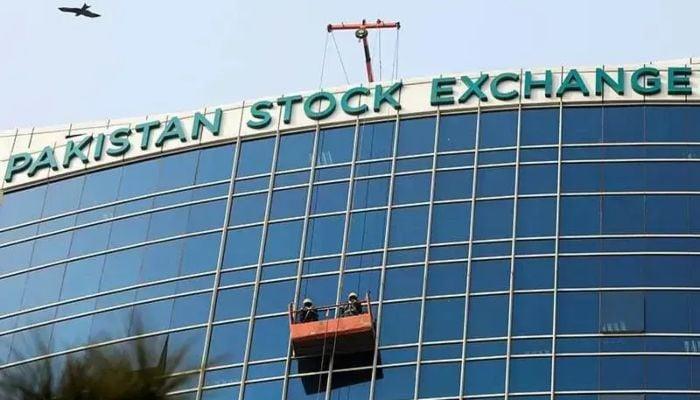
Pakistan Stock Exchange has done its job. Sustained performance has put the market on the global map. The next phase is not about testing the opportunity; it’s simply about making that opportunity accessible. Because in capital markets attention does not automatically translate into investment, access is what turns interest into capital.
And what’s on the other side of that access is bigger than just the diaspora sending money home. It is the integration of Pakistan into the global flow of capital itself.
The author is the Chairman of Pakistan Virtual Assets Regulatory Authority (PVARA).
Disclaimer: The views expressed in this article are those of the writer and do not necessarily reflect the editorial policy of PakGazette.tv.
Originally published in The News


