
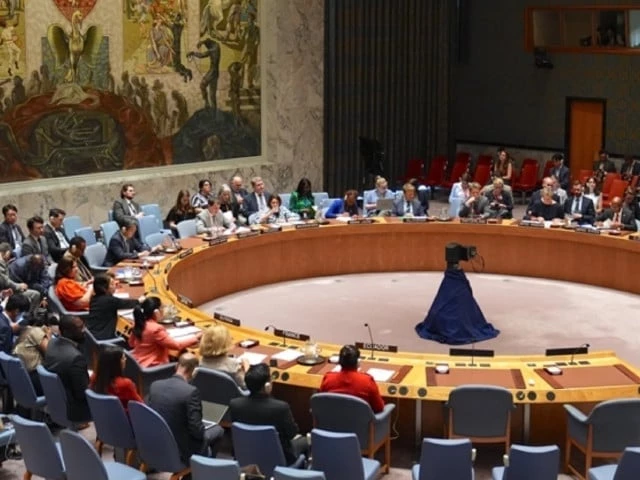
Iftikhar urges UN Security Council to remain vigilant against exploitation or use of natural resources as weapons
Pakistan on Thursday rejected India’s comments at the United Nations Security Council on the Indus Waters Treaty (IWT) and terrorism as a “futile attempt” to distort facts, saying India’s statement was an effort to conceal its alleged sponsorship and financing of terrorism against Pakistan.
The response followed remarks by India’s Permanent Representative to the UN, Ambassador Harish Parvathaneni, who accused Pakistan of “supporting cross-border terrorism” and said that “the issue had affected bilateral cooperation on the IWT.”
In a right of reply to the Indian representative’s remarks in the Security Council debate, First Secretary Ansar Shah rejected India’s claims.
According to a statement published in
“The Treaty does not contain any provision allowing its so-called ‘suspension’. India’s unilateral action is simply illegal. The Arbitration Court, in its August 2025 award, reaffirmed that the Treaty remains valid, binding and fully in force, along with its dispute settlement mechanisms,” Shah said.
He said, “India’s use of a shared natural resource as a weapon for political coercion, with the stated objective of starving the people of Pakistan, is a serious violation of international legal instruments and norms.”
“The situation poses a direct threat to regional and international peace and security and is completely relevant to today’s debate,” Shah said.
Responding to India’s terrorism allegations, he said: “The baseless claim about terrorism is in fact an effort by India to conceal its sponsorship and financing of terrorism against Pakistan. India’s terrorist proxies, the TTP, the BLA and the Majeed Brigade have killed thousands of civilians and law enforcement personnel, including women and children on our soil.”
Read more: Pakistan and China urge greater implementation of UN Security Council resolutions
“India’s involvement in extraterritorial executions, including in North America, is also well known. India is not a victim of terrorism. It is a sponsor of terrorism,” Shah said.
“India also perpetrates state terrorism, including in the illegally occupied Indian territory of Jammu and Kashmir, whose people are denied the right to self-determination, in flagrant violation of numerous Security Council resolutions,” Shah added.
According to the Shah, “India continues to ignore its obligations under the UN Charter, including Article 25, which requires Member States to implement Security Council decisions.”
“Jammu and Kashmir were never and are never an integral part of India. No unilateral or illegal measures of the occupying power can alter the historical, legal and disputed character of the occupied territory of Jammu and Kashmir,” Shah said.
“India must comply with all its legal obligations under international law, the UN Charter and Security Council resolutions, instead of violating them and denying established facts,” he concluded.
First Secretary Ansar Shah’s Right of Reply
In response to the statements of the representative of India
In the open high-level debate of the Security Council
(July 22, 2026)
*******President,
2. Pakistan is forced to take the floor again to respond to India’s misleading statement, which is a… pic.twitter.com/AqbjPsz8qg
– Permanent Mission of Pakistan to the UN (@PakistanUN_NY) July 23, 2026
While speaking at the United Nations Security Council (UNSC) high-level open debate on ‘Natural resource governance: the foundation of peace, security and prosperity’, Pakistan’s Permanent Representative to the United Nations Asim Iftikhar said that the IWT “remains valid, binding and fully in force”, as reaffirmed by the Arbitration Court’s August 2025 award.
He urged the UN Security Council to remain vigilant against the exploitation or weaponization of natural resources and to make full use of preventive diplomacy, peaceful dispute resolution, sanctions regimes and monitoring mechanisms when such actions endanger peace.


