
The Committee sought full details of payments made to provinces over the past 16 years.
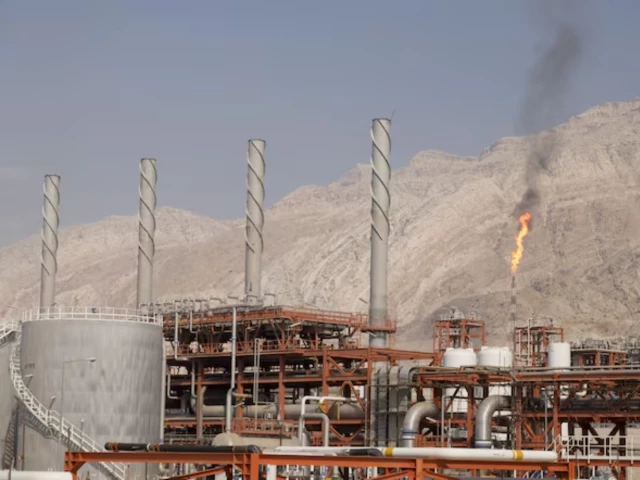
A general view shows a unit of the South Pars Gas field at the seaport of Asalouyeh, northern Persian Gulf, Iran, November 19, 2015. Photo: Reuters/File
ISLAMABAD:
The Senate Functional Committee on Devolution on Friday directed the federal government to ensure that provinces receive a 50% share of revenue generated from oil and gas produced within their territories, in accordance with the 18th Constitutional Amendment.
The committee, chaired by Senator Zamir Hussain Ghumro, was attended by Senators Poonjo Bheel and Jan Muhammad Baloch.
Reviewing the implementation of the 18th Amendment with respect to oil and gas revenue, Senator Ghumro said the federation was receiving its constitutional share while producing provinces were being denied their due rights, creating a sense of deprivation.
The committee sought full details of payments made to provinces over the past 16 years.
Ghumro expressed serious concern over what he called the incomplete implementation of the 18th Amendment and the revival of federal ministries that had earlier been transferred to the provinces.
He recalled that through notifications issued on December 2, 2010, April 15, 2011 and June 29, 2011, a total of 17 ministries dealing with provincial and concurrent issues were transferred to the provinces. “The re-establishment of ministries dealing with provincial affairs after June 30, 2011 was illegal,” he said.
According to him, education, health, national food security, culture and heritage, climate change, social initiatives, housing, EOBI, Evacuee Trust Property Board, Zakat and Ushr and several other institutions were functioning in areas that constitutionally fall under provincial jurisdiction.
Senator Ghumro said that although the federal government maintained that these ministries were only responsible for matters related to the Islamabad Capital Territory (ICT) and federal obligations, the number of federal ministries had increased from the constitutionally provided nine to 31.
“The Constitution provides for federal ministries dealing with defence, foreign affairs, finance, trade, communications, maritime affairs, science and technology, law and justice, and parliamentary affairs.”
The committee chairman said federal spending had risen to around Rp19 trillion, while the country’s combined tax and non-tax revenues amounted to about Rp20 trillion.
He maintained that apart from defense spending, which he described as justified in the prevailing security environment, spending on other federal ministries should not exceed Rs 1 trillion.
According to him, restricting federal spending to Rp 13 trillion could save Rp 5-6 trillion a year, reduce dependence on external borrowing and strengthen the country’s financial sovereignty.
He also expressed concern over the ineffective functioning of the permanent secretariat of the Council of Common Interests (CCI) and called for restructuring of the federal administrative system in accordance with the Constitution.


