
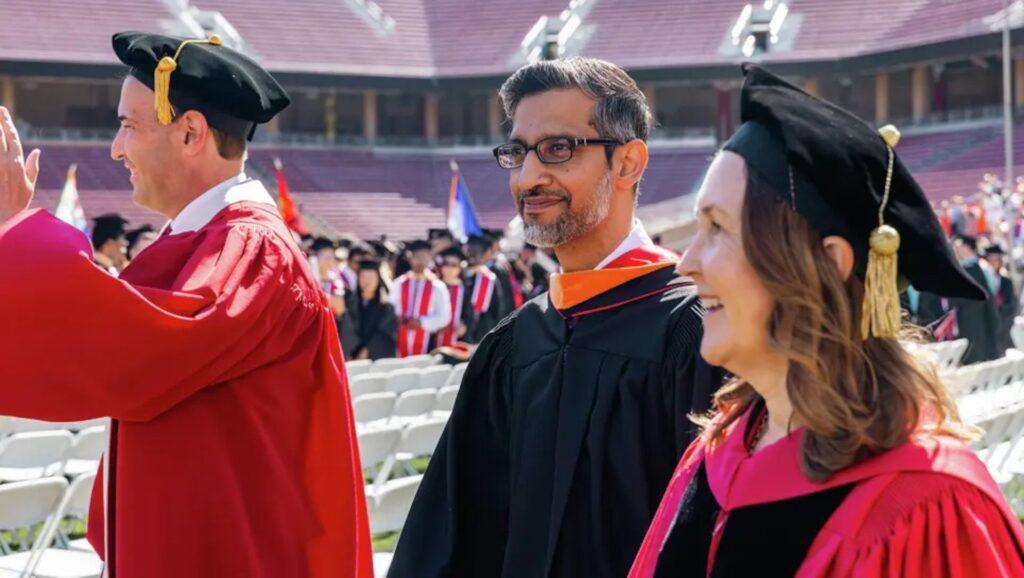
- Alphabet CEO Sundar Pichai delivers commencement speech at Stanford University
- Unlike other speakers, he does not mention AI.
- Pichai offers life guidance and lessons for new graduates
Alphabet CEO Sundar Pichai sidestepped the recent trend of speakers mentioning the benefits of AI in college graduation speeches, but still faced an outcry over Google’s work in the Middle East.
Pichai was giving the commencement speech at Stanford University in California, where he decided not to mention the technological trend of the moment, but rather focus on his own life experience.
However, reports from the ceremony claimed that his speech was interrupted by a walkout by around 200 students protesting Google’s role in the Israel-Palestine conflict.

Life lessons from Sundar Pichai
In fact, Pichai briefly hinted that AI would be mentioned without mentioning it, noting that “people have also been giving me a lot of advice about what to say. It’s actually been the same advice, and it’s about what not to say. People thought it would be very difficult for me; after all, they are the last two letters of my last name.”
“In all honesty, that topic is really irrelevant to what I want to share with you. I’ve learned that the most timeless advice is independent of technology. It’s about you, the life you want to build for yourself, and the choices that will help you pursue that life.”
Local reports claimed that around 200 students walked out when Pichai took the stage, and smaller groups in the audience also caused a disturbance by waving Palestinian banners and flags and blowing whistles before also leaving mid-speech.
Google’s role in the conflict has been a source of controversy for some time, particularly the company’s $1.2 billion cloud computing deal with the Israeli government known as Project Nimbus, which sparked employee protests in 2022.
Pichai’s speech otherwise seemed to be well received, as he recalled stories from his time as a student at the University and described his “three simple filters” that have “helped [him] I got it right more than wrong and took some of the pressure off.”
These were “choose optimism,” “gravitate toward working on hard things” (where he mentioned the “impossible problem” of building the Chrome browser), and “when everything else is equal, do what excites you.”
This was in stark contrast to one of his predecessors at Google, Eric Schmidt, whose recent speech at the University of Arizona’s graduation was roundly criticized and booed by attendees after he declared, “AI will touch everything,” even “if you don’t care about science.”

Follow TechRadar on Google News and add us as a preferred source to receive news, reviews and opinions from our experts in your feeds.


