
The astronauts express their gratitude for the opportunity and term their participation as an honor and a source of pride for Pakistan.
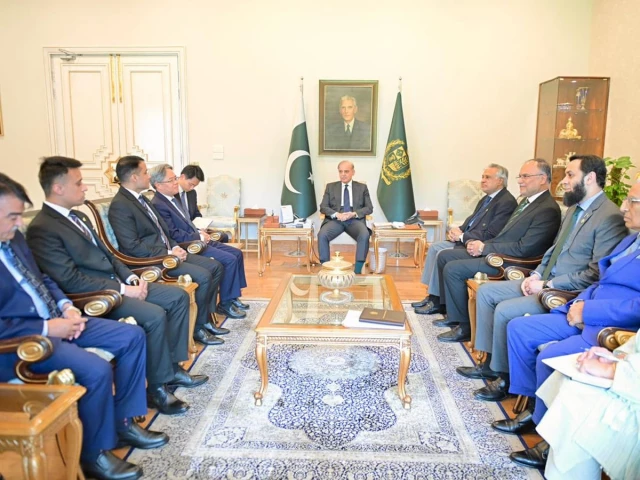
Prime Minister Shehbaz Sharif meets Pakistani astronauts in Islamabad on April 23, 2026. Photo: PMO
Prime Minister Shehbaz Sharif on Thursday met Pakistani astronauts Khurram Daud and Muhammad Zeeshan Ali, selected for a Chinese manned space mission, terming their participation in space research as a historic achievement for the country and a matter of national pride.
China selected the two Pakistani astronauts as candidates for its manned space program. Both will travel to China for training and one will participate in a flight mission as a payload specialist and become the first foreign astronaut on China’s space station.
By completing all training courses and passing relevant assessments, one of them will be selected for a mission crew as a payload specialist to participate in a space flight, becoming the first foreign astronaut to visit the Chinese space station. The Pakistani astronaut will carry out several scientific experiments in microgravity, covering areas including materials science, fluid physics, biological and life sciences, and biotechnology.
The two met the Prime Minister at a meeting at the Prime Minister House today, during which he expressed his “deep pleasure” at meeting the young astronauts and termed their selection for space research as an “important milestone” for Pakistan.
“I am sure that you are going to write a new chapter in the history of Pakistan,” the Prime Minister told the astronauts, appreciating their dedication and hard work that allowed them to reach this important milestone.
Release date: August 23, 2026.
وزenstein پاکستانی خلا باز، خرم داؤد اور محمد ذیشان علی کی ملاقات ہوئی. اس موقع پر سپارکو کے خلاباز اتاشی حسنین افتخار بھی موجود تھے.
ملاقات میں نائب وزیرِ اعظم و وزیرِ خارجہ سینیٹر محمد اسحاق ڈار،… pic.twitter.com/20BVGYUIGH
— Prime Minister’s Office (@PakPMO) April 23, 2026
The prime minister, while highlighting cooperation between Pakistan and China in the space sector, said the astronaut mission through Chinese collaboration would further strengthen the long-standing ties between the two countries, adding that bilateral cooperation in space research reflected a “shared commitment to explore new frontiers and reach greater scientific heights together.”
Chinese Ambassador Jiang Zaidong, present at the meeting, welcomed the Prime Minister’s remarks and described the expanded cooperation between Pakistan and China in space research as encouraging and forward-looking.
The astronauts expressed their gratitude for the opportunity and termed their participation in space research as a “unique honor and a source of pride for Pakistan.” They reaffirmed their determination to meet the nation’s expectations through dedication and hard work.
Read more: Pakistan launches new remote sensing satellite from China
Astronaut Attaché Hasnain Iftikhar of Pakistan Space and Upper Atmosphere Research Commission (SUPARCO) was also present during the meeting.
The meeting was attended by Deputy Prime Minister and Foreign Minister Ishaq Dar, Planning Minister Ahsan Iqbal, Information Minister Attaullah Tarar, Special Assistant to the Prime Minister Tariq Fatemi, Foreign Secretary Amna Baloch and SUPARCO Chairman Muhammad Yousaf Khan.
This is not the first time that Pakistan and China have collaborated on space projects. In October last year, SUPARCO successfully launched the country’s first hyperspectral satellite (HS-1) from China.
The HS-1 satellite was designed to capture ultra-precise hyperspectral images in hundreds of narrow spectral bands, offering unprecedented resolution for the analysis of land, vegetation, water and urban features. Through its advanced imaging capability, HS-1 enabled the nation to accurately map crop vitality, soil moisture, and water quality, while rigorously tracking deforestation, pollution, and melting glaciers.
In July 2025, Pakistan successfully launched its latest remote sensing satellite from China’s Xichang Satellite Launch Center. The launch was carried out by SUPARCO, Pakistan’s national space agency, in collaboration with China Electronics Technology Group Corporation and MICROSAT China.


