
KP advisor says NEC cannot alter provincial revenue share as Center seeks Rs 1.2 trillion for next fiscal year
ISLAMABAD:
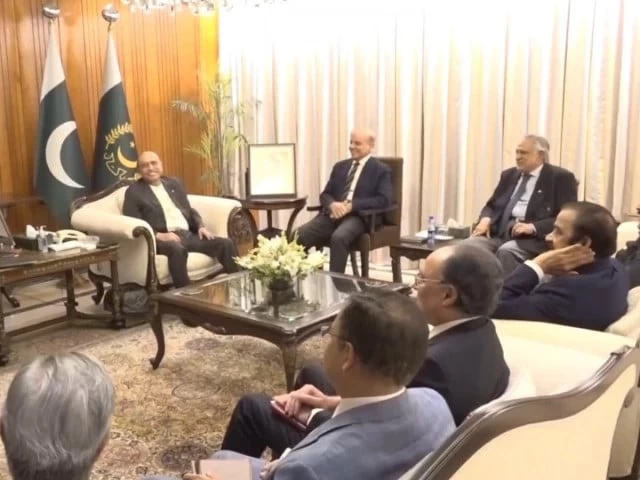
Pakistan’s head of state and head of government met on Monday to resolve differences over the new budget, when Khyber-Pakhtunkhwa’s financial advisor revealed that the Federation wanted to freeze new provincial shares at this year’s level to retain an additional 1.2 trillion rupees.
Muzzammil Aslam, financial advisor to the KP Chief Minister, also said that the National Economic Council (NEC) forum cannot be used to withhold provincial actions and any such move would require legal cover.
The highest-level meeting between President Asif Zardari and Prime Minister Shehbaz Sharif occurred on the day the government postponed the meeting of the NEC, the body tasked with approving development budgets and the national macroeconomic framework, for the third time.
The Ministry of Finance also struggled to get International Monetary Fund (IMF) approval for the new agreement to retain provincial shares under the National Finance Commission (NFC) Award by obtaining the NEC seal. The Finance Ministry on Monday considered several options to convince the IMF, including the possibility of a call to the managing director of the global lender.
Prime Minister Shehbaz met President Zardari, whose party rules two provinces, to seek his support to make the new budget viable. The Center is banking on taking out Rs 1.2 trillion from provinces’ shares under the NFC by fiscal year 2026-27.
This has delayed the announcement of the budget and there was extreme uncertainty in the country due to the lack of clarity in the budget dates.
According to a statement issued by the Presidency, Prime Minister Shehbaz met President Zardari along with his team. “The meeting discussed the economy, budget for the next fiscal year, recent elections in Gilgit-Baltistan, situation in Azad Kashmir, law and order and matters of national importance,” the Presidency said.
He added that while discussing budget proposals and public aid, the president emphasized the priority of public welfare, provincial rights and economic stability in the federal budget. The President directed that all efforts be made to align the growth rate and public welfare plans in the upcoming budget.
Discussions took place around the Federation’s desire to cut a pie of Rs 1.2 trillion from the shares of the four provinces to cover the expenses of initiatives of a strategic nature and provide tax relief that is not possible within the limited federal fiscal space.
In a press conference after meeting the federal government, Muzzammil Aslam, financial advisor to the KP Chief Minister, said there was an extreme level of uncertainty in the government over next year’s budget.
He said there was no consensus between the provinces and the Center on deductions and distribution of Rs 1.2 trillion from the federal development budget, nor between the IMF and the Finance Ministry on the new budget.
The CNE meeting was postponed on Monday without giving any reason and we were not sure if it would happen on Tuesday (today), Aslam said. He added that due to lack of consensus on the Centre’s demand for additional resources, he was not sure if the budget would be announced on June 10.
“Everything is fluid, uncertain and no one is clear,” Aslam said.
He revealed that the federal government has proposed freezing provincial shares in the NFC in this year’s actual transfers. He said the Center is proposed to retain the additional approximately Rs 1.2 trillion that the four provinces will get in the next fiscal year due to the increase in federal tax collection.
For this fiscal year, the government had indicated transfers of Rs 8.2 trillion to the provinces. But due to the extremely poor performance of the FBR, the four provinces can get Rs 7.5 trillion. Aslam said for the next fiscal year, the federal government wanted to freeze provincial shares at this year’s level by getting support from the provinces through the NEC.
To a question, Aslam said that “the NEC is not the forum to deduct provincial shares.” The CNE is a constitutional body chaired by the prime minister and attended by all provincial chief ministers. The KP advisor said it was unclear whether the provincial premier would attend the CNE meeting.
He said the Center has demanded four provinces to contribute according to their shares in the NFC, with KP’s share being around Rs 180 billion. Initially, the federal government had demanded Rp1.7 trillion from the provinces, but later adjusted the demand downwards.
Punjab’s contribution may be around Rs 650 billion, Sindh’s Rs 300 billion, KP’s Rs 180 billion and Balochistan’s Rs 110 billion.
Aslam said the additional money was requested for “some strategic purposes” and former Prime Minister Imran Khan did not even refuse to contribute. But even if all provinces agree to waive their additional shares, technically the money cannot be given based on any CNE decision, Aslam said.
He said Rp1.2 trillion has been demanded in addition to provincial cash surpluses and this would turn their budgets into deficits.
The Rs 1.2 trillion is almost half of the Rs 2.2 trillion revenue shortfall the FBR faced in two fiscal years – the poor performance that has now left the federal government at the mercy of the provinces and also led to raising the petroleum tax to Rs 116 per liter of petrol.
Government sources said the Finance Ministry also addressed the issue of obtaining additional resources from the IMF provinces through the CNE. They said the IMF was reluctant to accept the NEC’s proposed mechanism for deducting provincial shares. They said that IMF support was important before accepting this mechanism.
Government sources said the Rs 1.2 trillion is being demanded for defence, financing strategic water projects, providing tax relief to the corporate sector and reducing withholding tax on real estate transactions. Some of these measures cannot be taken within the federal fiscal space.
The Finance Ministry did not respond to questions on whether it was true that Pakistan had shared its position of requesting Rs 1.2 trillion from the provinces through the NEC mechanism. The ministry also did not comment on whether the IMF agreed to this agreement and whether the money that was demanded from the provinces was only for defense purposes or will also be used to provide fiscal relief.
Aslam again complained that his province is marginalized and only Rs 2.3 billion is being given out of next year’s Rs 1.12 trillion budget. He said the federal allocation under the Accelerated Implementation Program is also reduced by Rs 10 billion to Rs 56 billion.


