
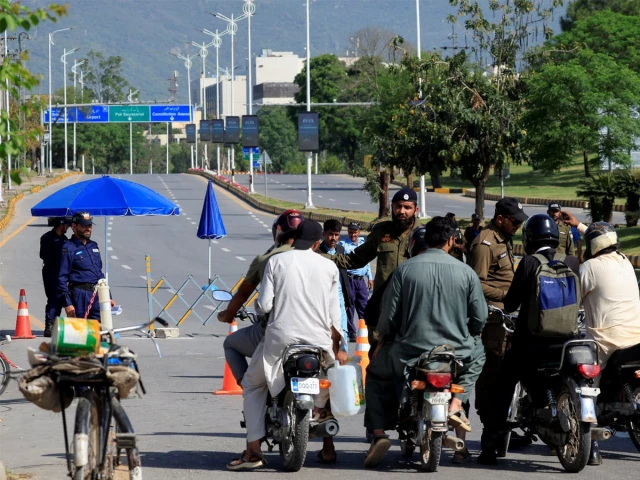
No major roads in Rawalpindi have been completely closed, although police presence remains strong and checks continue.
A Pakistani police officer diverts cyclists from a road leading to the Serena hotel, as Pakistan prepares to host the United States and Iran in the second phase of peace talks in Islamabad on April 22, 2026. Photo: Reuters
ISLAMABAD/RAWALPINDI:
Security eased in parts of the Twin Cities on Wednesday as authorities opened some routes; However, the capital’s Red Zone remained sealed amid the uncertain arrival of American and Iranian delegations.
Earlier in the week, district administrations sealed the entrance to the Red Zone, ordering all public and private offices and schools within the area to shift to online operations, while government work in the capital moved to remote arrangements. Public and heavy transportation was also suspended throughout the capital.
The Red Zone remained closed today for the third consecutive day, with employees in government and private offices instructed to work from home.
According to Islamabad Deputy Commissioner Irfan Nawaz Memon, all entry points to the Red Zone were sealed, and police and other law enforcement agencies maintained strict checkpoints. The Srinagar Expressway towards Serena was closed from Zero Point, while Kashmir Chowk was also closed to general traffic.
Read more: Offices, schools move online as Islamabad Red Zone closes ahead of US-Iran talks
It added that Faizabad and Karachi Company bus terminals remained closed and metropolitan bus service across the city remained suspended. “Bus stops and intercity transport terminals across the city also remain closed; however, Chungi No. 26 Bus Terminal has been reopened to the public.”
In Islamabad’s Blue Zone, the commercial market remained closed. Jinnah Avenue, from Khayaban-e-Suharwardy (Khyber Plaza) to Parliament House, was also closed to traffic, while the metro bus service remained suspended.
However, other markets in the city remained open and operating normally. The capital’s educational institutions also functioned without interruptions.
In Rawalpindi, security remained on high alert, particularly around the old Benazir Bhutto International Airport and along the service roads of the Islamabad Expressway, where shopping malls and wedding halls in the surrounding areas remained closed.
According to the traffic police, markets, hostels and hotels in Faizabad area along Murree Road also remained closed, with heavy police presence continuing. However, other markets in the city and cantonment areas were functioning and routine commercial activity continued.
No major roads in Rawalpindi were completely closed, although the police presence remained strong and checks continued. Traffic, including light transport vehicles and private cars, was moving along Grand Trunk Road and other major routes.
Also read: Trump heeds the truce call of the CDF Munir and the prime minister
Pakistan took center stage as it negotiated a 14-day ceasefire between the United States and Iran, followed by high-stakes talks in Islamabad attended by high-level delegations from the two countries earlier this month. Although the talks did not yield the desired results, the ceasefire remained intact and confidence-building measures were implemented to ensure a permanent truce.
Last night, US President Donald Trump announced an extension of the current ceasefire with Iran at the request of Prime Minister Shehbaz Sharif and Chief of Army Staff and Chief of Defense Forces Field Marshal Asim Munir. In a post on Truth Social, Trump said the truce, which was set to expire within hours, would remain in place until Iran presented a comprehensive plan and negotiations reached a definitive outcome.
The two sides were due to meet in the capital for the second and final round of talks, but no date has been confirmed.


