
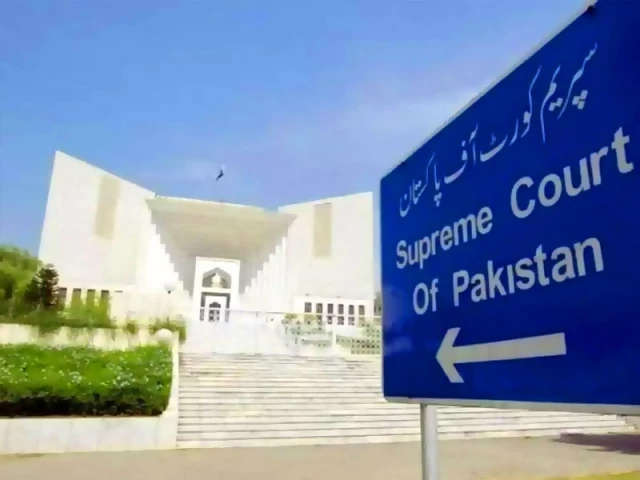
ISLAMABAD:
Supreme Court Justice Malik Shahzad Ahmad Khan has observed that the practice of planting false recoveries of narcotics against innocent people – including politicians belonging to opposition parties as well as individuals who have enmity with police officers or influential people – is common in our society.
“The practice of planting false recoveries of narcotics against innocent persons, including politicians belonging to opposition parties as well as persons having enmity with police officials or influential persons, is common in our society, therefore, to rule out or at least minimize the possibility of false involvement of any innocent person in cases registered under the provisions of the Control of Narcotic Substances Act, 1997 (1997 Act), the provisions of the ibid Act and the rules made thereunder must be strictly construed,” Justice Khan said in his 14-page dissenting opinion to resolve various questions of law relating to the admissibility of reports of forensic experts under Section 36 of the Narcotic Substances Control Act, 1997 and Rule 6 of the Rules of 2001.
The high court constituted a larger bench to resolve the controversy arising from several inconsistent judgments.
In 2015, the court held that mentioning the full protocols in the report was mandatory and that failure to do so would vitiate its probative value. However, in another matter, the Supreme Court took a contrary view.
The majority judgment held that the requirement laid down in the unamended Rule 6 of the 2001 Rules, which required government analysts to submit test results along with full details of the tests applied, was not mandatory but directive.
However, Justice Khan dissented from the majority opinion and held that under Articles 4 and 10-A of the Constitution, every citizen of Pakistan has the constitutional right to be treated in accordance with the law and to receive a fair trial and due process.
“It is, therefore, evident from the articles of the Constitution that no action detrimental to the life, liberty, body, reputation or property of any person shall be taken except in accordance with law. The SC judge observed that the main objective of the Narcotic Substances Control Act is to prevent the use, sale, purchase, transportation etc. of narcotic substances, but if the chemical examiner does not mention the complete protocols in his report, then the same will create doubt in the case of prosecution, which will result in acquittal of the accused on the spot and as such non-compliance with rule 6 of the Rules of 2001 would defeat the purpose of the principal Act i.e. the 1997 Act.
“Likewise, failure to comply with the above rule will also harm the case of an accused, who could have been falsely involved in a narcotics case.
“Likewise, it is also established in the constitutional articles that any criminal accusation against a person will have the right to a fair trial and due process.
“It is clear that under the Constitution, every citizen of Pakistan has the right to be tried in accordance with the law, with a fair trial and with due process,” the high court judge said.
“This Court has time and again held in its various judgments that since very strict punishments are provided for the offenses under the 1997 Act, the provisions of the said Act and the rules made thereunder have to be strictly interpreted. This Court has also repeatedly held that it is in the interest of justice that the relevant statutory provisions dealing with procedure as well as submission of expert reports etc. are followed in letter and spirit,” it added.
According to Justice Khan, it would be very risky to maintain that the failure to mention the full protocols does not, in itself, invalidate the government analyst’s report, and that the mere mention of the names of the internationally recognized tests in the report would amount to “full and sufficient compliance” with the 2001 Standards.
He said the main point to be determined before this larger court is “whether the mention of full protocols (i.e. details of the test)[s] applied, the measures adopted during said tests and their results.[s]) in the government analyst’s report is mandatory or not and if the report does not disclose the complete protocols then as to whether it will vitiate its evidentiary value.”
The Supreme Court judge noted that in different cases, whenever a government analyst is summoned by the court, he tries his best to defend his report by stating that the prescribed protocols were followed and all legal requirements were met during testing of the contraband material.
“Further, the summoning of the Analyst and his registration before the Court and his cross-examination will entail wastage of precious time for the Court and the public at large and will also create additional burden on the Exchequer. Furthermore, it is a common observation that Government Analysts/Experts are generally not summoned by the Courts and once summoned, they vigorously defend their reports because otherwise they may face criminal consequences/departmental proceedings for the issuance of a faulty report.
“I am, therefore, of the opinion that the provisions of Section 510 Cr.PC do not provide sufficient legal safeguards for the protection of the rights and interests of the accused. Even otherwise, Section 510 Cr.PC exempts a government analyst from personally appearing before the court unless summoned by the court; therefore, it is even better for the analyst to mention all the details of his test, analysis and its results in his report to avoid his summons by the court. It will also be better for the safe administration of justice, transparency and fair play,” the judge stated.


